
Technische Daten
| Formel | C25H31N5O4 |
||||||||||
| Molekulargewicht | 465.54 | CAS-Nr. | 938440-64-3 | ||||||||
| Löslichkeit (25°C)* | In vitro | DMSO | 20 mg/mL (42.96 mM) | ||||||||
| Water | Insoluble | ||||||||||
| Ethanol | Insoluble | ||||||||||
| In vivo (Lösungsmittel einzeln und der Reihe nach zum Produkt hinzufügen.) |
|
||||||||||
|
* <1 mg/ml bedeutet schwer löslich oder unlöslich. * Bitte beachten Sie, dass Selleck die Löslichkeit aller Verbindungen intern testet und die tatsächliche Löslichkeit geringfügig von veröffentlichten Werten abweichen kann. Dies ist normal und ist auf geringfügige Batch-zu-Batch-Variationen zurückzuführen. * Versand bei Raumtemperatur (Stabilitätstests zeigen, dass dieses Produkt ohne Kühlmaßnahmen versendet werden kann.) |
|||||||||||
Vorbereitung von Stammlösungen
Biologische Aktivität
| Beschreibung | KU-0063794 ist ein potenter und hochspezifischer dualer mTOR-Inhibitor von mTORC1 und mTORC2 mit einer IC50 von ~10 nM in zellfreien Assays; keine Wirkung auf PI3Ks. | ||||
|---|---|---|---|---|---|
| Ziele |
|
||||
| In vitro | Compared with the mTOR inhibitor PP242, KU-0063794 exhibits higher specificity for mTOR, as being inactive against PI3Ks or 76 other kinases. In HEK-293 cells, this compound at 30 nM is sufficient to rapidly ablate S6K1 activity by blocking the phosphorylation of the hydrophobic motif (Thr389) and subsequently the phosphorylation of the T-loop residue (Thr229). In case of IGF1 stimulation of serum-starved HEK-293 cells, 300 nM of this compound is needed to inhibit the S6K1 activity by ~90%. This chemical at 100-300 nM also completely inhibits the amino-acid-induced phosphorylation of S6K1 and S6 protein. Similar to S6K1, it inhibits the phosphorylation of mTORC1 at Ser2448 and mTORC2 at Ser2481 in a dose-dependent and time-dependent manner. In the presence of serum or following IGF1 stimulation, this compound induces a dose-dependent inhibition of the activity and phosphorylation of Akt at Ser473 and unexpected Thr308 as well as the phosphorylation of the Akt substrates PRAS40 at Thr246, GSK3α/GSK3β at Ser21/Ser9 and Foxo-1/3a at Thr24/Thr32. This compound but not rapamycin inhibits SGK1 activity and Ser422 phosphorylation as well as its physiological substrate NDGR1 in a dose-dependent manner, to the same extent as S6K1 and Akt phosphorylation, whereas it dose not inhibit phorbol ester induced ERK or RSK phosphorylation and RSK activation. Compared with rapamycin, this chemical exhibits more significant potency to induce the complete dephosphorylation of 4E-BP1 at Thr37, Thr46 and Ser65. It inhibits cell growth of both wild-type and mLST8-deficient MEFs and induces a G1 cell cycle arrest, more significantly than rapamycin. |
||||
| In vivo | Ku0063794 inhibits tumor growth and mTOR signaling in a preclinical renal cell carcinoma model. However, this compound was not more effective in the animal study. A possible explanation for lack of greater activity in vivo for this chemical. |
Protokoll (aus Referenz)
| Kinase-Assay: |
|
|---|---|
| Zell-Assay: |
|
| Tierstudie: |
|
Referenzen
|
Kundenproduktvalidierung
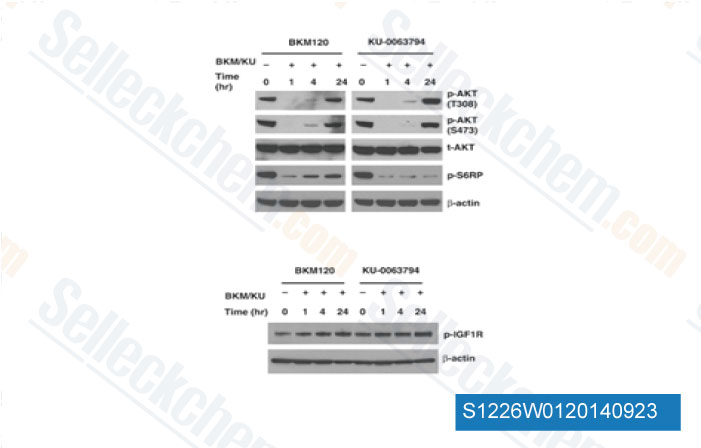
-
Daten von [ Oncogene , 2013 , 10.1038/onc.2013.509 ]

-
Daten von [ J Biol Chem , 2011 , 286, 39450-6 ]
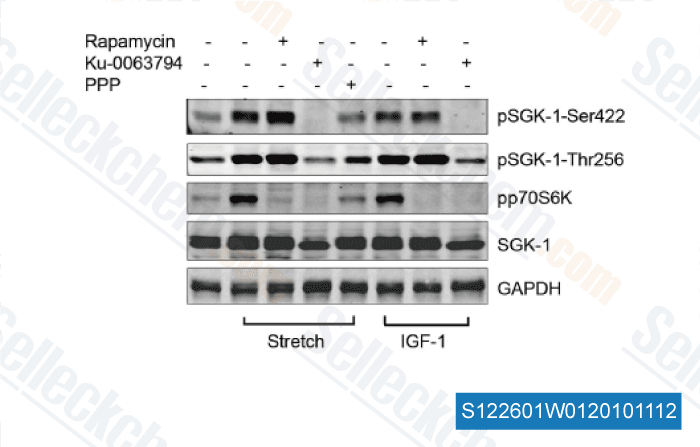
-
Daten von [ Circ Res , 2010 , 107, 1265-1274 ]
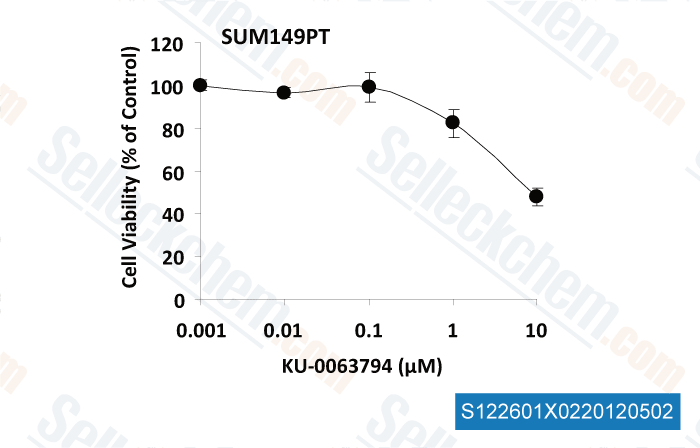
-
, , Dr. Yong-Weon Yi from Georgetown University Medical Center
Selleck's KU-0063794 Wurde zitiert von 84 Publikationen
| SLAP controls mTORC2 integrity via UBE3C-mediated non-degradative mLST8 ubiquitination to suppress colorectal tumorigenesis [ Cell Death Differ, 2026, 33(5):1020-1035] | PubMed: 41398047 |
| Molecular control of PDPNhi macrophage subset induction by ADAP as a host defense in sepsis [ JCI Insight, 2025, e186456] | PubMed: 39903516 |
| mTORC2-driven chromatin cGAS mediates chemoresistance through epigenetic reprogramming in colorectal cancer [ Nat Cell Biol, 2024, 10.1038/s41556-024-01473-0] | PubMed: 39080411 |
| Exploitation of the fibrinolytic system by B-cell acute lymphoblastic leukemia and its therapeutic targeting [ Nat Commun, 2024, 15(1):10059] | PubMed: 39567540 |
| mTORC1 regulates cell survival under glucose starvation through 4EBP1/2-mediated translational reprogramming of fatty acid metabolism [ Nat Commun, 2024, 15(1):4083] | PubMed: 38744825 |
| Resistin secreted by porcine alveolar macrophages leads to endothelial cell dysfunction during Haemophilus parasuis infection [ Virulence, 2023, 14(1):2171636] | PubMed: 36694280 |
| Mechanosensitive mTORC2 independently coordinates leading and trailing edge polarity programs during neutrophil migration [ Mol Biol Cell, 2023, 34(5):ar35] | PubMed: 36857159 |
| Combined Mcl-1 and YAP1/TAZ inhibition for treatment of metastatic uveal melanoma [ Melanoma Res, 2023, 10.1097/CMR.0000000000000911] | PubMed: 37467061 |
| Targeting the REF1/STAT3 axis to treat tuberous sclerosis [ Cardiff University, 2023, ] | PubMed: None |
| Aggresome assembly at the centrosome is driven by CP110-CEP97-CEP290 and centriolar satellites [ Nat Cell Biol, 2022, 24(4):483-496] | PubMed: 35411088 |
RÜCKGABERICHTLINIE
Die bedingungslose Rückgaberichtlinie von Selleck Chemical gewährleistet unseren Kunden ein reibungsloses Online-Einkaufserlebnis. Wenn Sie in irgendeiner Weise mit Ihrem Kauf unzufrieden sind, können Sie jeden Artikel innerhalb von 7 Tagen nach Erhalt zurückgeben. Im Falle von Produktqualitätsproblemen, sei es protokollbezogene oder produktbezogene Probleme, können Sie jeden Artikel innerhalb von 365 Tagen ab dem ursprünglichen Kaufdatum zurückgeben. Bitte befolgen Sie die nachstehenden Anweisungen, wenn Sie Produkte zurücksenden.
VERSAND UND LAGERUNG
Selleck-Produkte werden bei Raumtemperatur transportiert. Wenn Sie das Produkt bei Raumtemperatur erhalten, seien Sie versichert, dass die Qualitätskontrollabteilung von Selleck Experimente durchgeführt hat, um zu überprüfen, dass die normale Temperaturplatzierung von einem Monat die biologische Aktivität von Pulverprodukten nicht beeinträchtigt. Nach dem Sammeln lagern Sie das Produkt bitte gemäß den in der Datenblatt beschriebenen Anforderungen. Die meisten Selleck-Produkte sind unter den empfohlenen Bedingungen stabil.
NICHT FÜR DIE ANWENDUNG AM MENSCHEN, FÜR VETERINÄRMEDIZINISCHE DIAGNOSTIK ODER THERAPEUTISCHE ZWECKE.