
nur für Forschungszwecke
Clopidogrel (SR-25990C) Bisulfate P2 Receptor Modulator
Kat.-Nr.: S1415
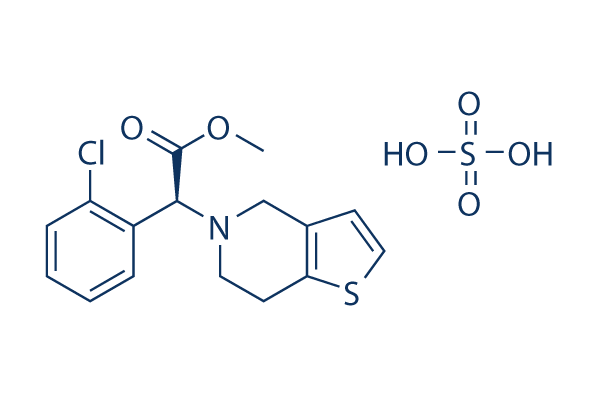
Chemische Struktur
Molekulargewicht: 419.9
Qualitätskontrolle (Quality Control)
| Verwandte Ziele | Adrenergic Receptor AChR 5-HT Receptor COX Calcium Channel Histamine Receptor Dopamine Receptor GABA Receptor TRP Channel Cholinesterase (ChE) |
|---|---|
| Weitere P2 Receptor Inhibitoren | A-438079 Hydrochloride A-804598 MRS 2578 AF-353 A-740003 5-BDBD A-317491 Gefapixant Aurintricarboxylic acid Minodronic acid |
Chemische Informationen, Lagerung & Stabilität (Chemical Information, Storage & Stability)
| Molekulargewicht | 419.9 | Formel | C16H16ClNO2S.H2SO4 |
Lagerung (Ab dem Eingangsdatum) | |
|---|---|---|---|---|---|
| CAS-Nr. | 120202-66-6 | SDF herunterladen | Lagerung von Stammlösungen |
|
|
Löslichkeit (Solubility)
|
In vitro |
DMSO
: 83 mg/mL
(197.66 mM)
Ethanol : 83 mg/mL Water : Insoluble |
Molaritätsrechner
|
In vivo |
|||||
In-vivo-Formulierungsrechner (Klare Lösung)
Schritt 1: Geben Sie die untenstehenden Informationen ein (Empfohlen: Ein zusätzliches Tier zur Berücksichtigung von Verlusten während des Experiments)
Schritt 2: Geben Sie die In-vivo-Formulierung ein (Dies ist nur der Rechner, keine Formulierung. Bitte kontaktieren Sie uns zuerst, wenn es im Abschnitt "Löslichkeit" keine In-vivo-Formulierung gibt.)
Berechnungsergebnisse:
Arbeitskonzentration: mg/ml;
Methode zur Herstellung der DMSO-Stammlösung: mg Wirkstoff vorgelöst in μL DMSO ( Konzentration der Stammlösung mg/mL, Bitte kontaktieren Sie uns zuerst, wenn die Konzentration die DMSO-Löslichkeit der Wirkstoffcharge überschreitet. )
Methode zur Herstellung der In-vivo-Formulierung: Nehmen Sie μL DMSO Stammlösung, dann hinzufügenμL PEG300, mischen und klären, dann hinzufügenμL Tween 80, mischen und klären, dann hinzufügen μL ddH2O, mischen und klären.
Methode zur Herstellung der In-vivo-Formulierung: Nehmen Sie μL DMSO Stammlösung, dann hinzufügen μL Maisöl, mischen und klären.
Hinweis: 1. Bitte stellen Sie sicher, dass die Flüssigkeit klar ist, bevor Sie das nächste Lösungsmittel hinzufügen.
2. Achten Sie darauf, das/die Lösungsmittel der Reihe nach hinzuzufügen. Sie müssen sicherstellen, dass die bei der vorherigen Zugabe erhaltene Lösung eine klare Lösung ist, bevor Sie mit der Zugabe des nächsten Lösungsmittels fortfahren. Physikalische Methoden wie Vortex, Ultraschall oder ein heißes Wasserbad können zur Unterstützung des Lösens verwendet werden.
Wirkmechanismus (Mechanism of Action)
| Targets/IC50/Ki |
P2Y12
|
|---|---|
| In vitro |
Clopidogrel is converted to its active metabolite by cytochrome P450 (CYP) enzymes. Clopidogrel (1 μM) also inhibits EGF-stimulated EGF receptor, PERK expression, and cell proliferation in RGM-1 cells (P<0.05), and causes much less inhibition of EGF-stimulated cell proliferation in EGF receptor over-expressed RGM-1 cells than in RGM-1 cells (22% vs. 32% reduction). Clopidogrel increases blood vessel number, reduces polymorphonuclear count and decreases attachment and bone loss, also decreases osteoclast number in rats submitted or not to periodontal repair. Clopidogrel decreases CXCL4, CXCL12 and PDGF content compared with saline-treated rats, without affecting CXCL5.
|
| In vivo |
Clopidogrel (2mg and 10mg/kg/day) significantly decreases ulcer-induced gastric epithelial cell proliferation and ulcer-stimulated expressions of EGF receptor and phosphorylated extracellular signal-regulated kinase (PERK) at the ulcer margin of rats. Clopidogrel improves endothelial function and NO bioavailability in rats with congestive heart failure. Clopidogrel-treated Congestive heart failure (CHF) rat displays enhances phosphorylation of AKT and eNOS. The clopidogrel/aspirin combination shows only additive-type effects on bleeding time prolongation induced by ear transection in the rabbit, therefore showing that combined inhibition of cyclooxygenase and ADP's effects provide a marked enhanced antithrombotic efficacy.
|
Literatur |
|
Anwendungen (Applications)
| Methoden | Biomarker | Bilder | PMID |
|---|---|---|---|
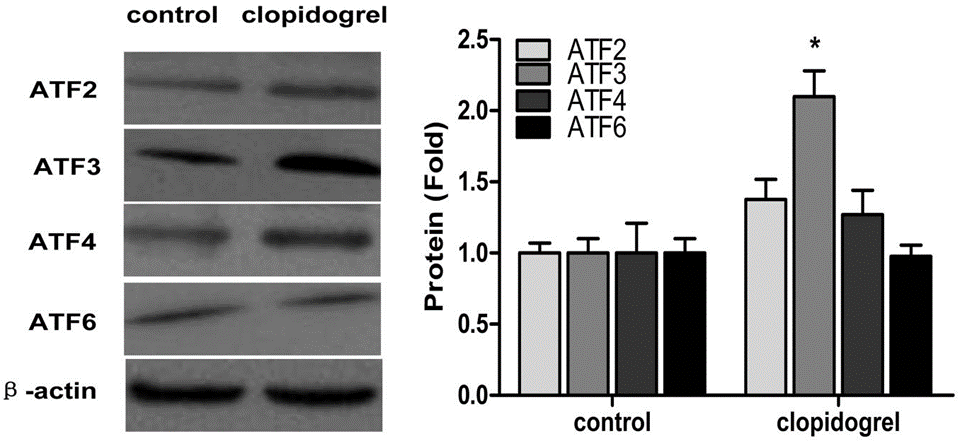
| Western blot | ATF2 / ATF3 / ATF4 / ATF6 TRIB3 / CHOP |
|
24058556 |
Klinische Studieninformationen (Clinical Trial Information)
(Daten von https://clinicaltrials.gov, aktualisiert am 2026-07-06)
| NCT-Nummer | Rekrutierung | Erkrankungen | Sponsor/Kooperationspartner | Startdatum | Phasen |
|---|---|---|---|---|---|
| NCT07683923 | NOT_YET_RECRUITING | SCAD; ACS (Acute Coronary Syndrome) |
Universitätsklinikum Hamburg-Eppendorf |
2027-03-01 | PHASE4 |
| NCT07572747 | NOT_YET_RECRUITING | Chronic Coronary Syndrome |
Khalid F Alhabib |
2027-04-01 | PHASE3 |
| NCT07583784 | RECRUITING | Myocardial Infarction (MI); ST-Segment Elevation Myocardial Infarction(STEMI); NSTEMI - Non-ST-Segment Elevation Myocardial Infarction; AF - Atrial Fibrillation |
Chonnam National University Hospital |
2026-08-26 | |
| NCT07744191 | NOT_YET_RECRUITING | Psoriasis (PsO); Psoriatic Arthritis (PsA) |
NYU Langone Health |
2026-09 | PHASE4 |
| NCT07384702 | NOT_YET_RECRUITING | Bacteremia Due to Staphylococcus Aureus |
Fundación Pública Andaluza para la gestión de la Investigación en Sevilla |
2026-06 | PHASE2 |
| NCT06650488 | RECRUITING | Staphylococcus Aureus Endocarditis; Staphylococcus Aureus Septicemia; Staphylococcus Aureus Bloodstream Infection |
Todd C. Lee MD MPH FIDSA |
2026-01-15 | PHASE4 |

Produkte sind nur für Forschungszwecke bestimmt. Nicht für den menschlichen Gebrauch. Wir verkaufen nicht an Patienten.
©Copyright 2013 Selleck Chemicals. Alle Rechte vorbehalten.