
nur für Forschungszwecke
Thiabendazole P450 (e.g. CYP17) Inhibitor
Kat.-Nr.: S1739
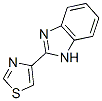
Chemische Struktur
Molekulargewicht: 201.25
Qualitätskontrolle (Quality Control)
- In Nature Medicine für seine erstklassige Qualität zitiert
- COA
- NMR
- HPLC
- SDS
- Datenblatt
| Verwandte Ziele | Dehydrogenase HSP Transferase PDE phosphatase PPAR Vitamin Carbohydrate Metabolism Mitochondrial Metabolism Casein Kinase |
|---|---|
| Weitere P450 (e.g. CYP17) Inhibitoren | Apigenin Baicalein Naringenin Diosmetin Alizarin Orteronel Benzbromarone Sodium Danshensu Naringin Piperine |
Chemische Informationen, Lagerung & Stabilität (Chemical Information, Storage & Stability)
| Molekulargewicht | 201.25 | Formel | C10H7N3S |
Lagerung (Ab dem Eingangsdatum) | |
|---|---|---|---|---|---|
| CAS-Nr. | 148-79-8 | SDF herunterladen | Lagerung von Stammlösungen |
|
|
| Synonyme | N/A | Smiles | C1=CC=C2C(=C1)NC(=N2)C3=CSC=N3 | ||
Löslichkeit (Solubility)
|
In vitro |
DMSO
: 40 mg/mL
(198.75 mM)
Ethanol : 1 mg/mL Water : Insoluble |
Molaritätsrechner
|
In vivo |
|||||
In-vivo-Formulierungsrechner (Klare Lösung)
Schritt 1: Geben Sie die untenstehenden Informationen ein (Empfohlen: Ein zusätzliches Tier zur Berücksichtigung von Verlusten während des Experiments)
Schritt 2: Geben Sie die In-vivo-Formulierung ein (Dies ist nur der Rechner, keine Formulierung. Bitte kontaktieren Sie uns zuerst, wenn es im Abschnitt "Löslichkeit" keine In-vivo-Formulierung gibt.)
Berechnungsergebnisse:
Arbeitskonzentration: mg/ml;
Methode zur Herstellung der DMSO-Stammlösung: mg Wirkstoff vorgelöst in μL DMSO ( Konzentration der Stammlösung mg/mL, Bitte kontaktieren Sie uns zuerst, wenn die Konzentration die DMSO-Löslichkeit der Wirkstoffcharge überschreitet. )
Methode zur Herstellung der In-vivo-Formulierung: Nehmen Sie μL DMSO Stammlösung, dann hinzufügenμL PEG300, mischen und klären, dann hinzufügenμL Tween 80, mischen und klären, dann hinzufügen μL ddH2O, mischen und klären.
Methode zur Herstellung der In-vivo-Formulierung: Nehmen Sie μL DMSO Stammlösung, dann hinzufügen μL Maisöl, mischen und klären.
Hinweis: 1. Bitte stellen Sie sicher, dass die Flüssigkeit klar ist, bevor Sie das nächste Lösungsmittel hinzufügen.
2. Achten Sie darauf, das/die Lösungsmittel der Reihe nach hinzuzufügen. Sie müssen sicherstellen, dass die bei der vorherigen Zugabe erhaltene Lösung eine klare Lösung ist, bevor Sie mit der Zugabe des nächsten Lösungsmittels fortfahren. Physikalische Methoden wie Vortex, Ultraschall oder ein heißes Wasserbad können zur Unterstützung des Lösens verwendet werden.
Wirkmechanismus (Mechanism of Action)
| Targets/IC50/Ki |
CYP1A2
|
|---|---|
| In vitro |
Thiabendazole provokes a strong DNA-damaging activity in the human lymphoblastoid cell line that constitutively expresses human CYP1A1 cDNA, but not in the parental line, indicating that CYP1A1 is chiefly implicated in carbaryl and thiabendazole genotoxicity. This compound provokes a dose- and time-dependent increase in CYP1A1 (EROD activity, protein and mRNA levels) in primary culture of rat hepatocytes. It results in the induction of 7-ethoxyresorufin O-deethylase and 7-pentoxyresorufin O-depentylase activities, CYP1A1, CYP1A2, CYP2B1 and CYP2B1/2 mRNA levels and CYP1A2 and CYP2B1/2 apoprotein levels. This chemical markedly induces GSTP1 mRNA levels, but has only a small effect on GSTT1 mRNA levels. It is rapidly transported by passive diffusion through the human intestinal cells by comparison with the protein-bound residues which are not able to cross the intestinal barrier. It will be firstly metabolized to 5OH-TBZ and subsequently converted to a chemically reactive metabolic intermediate binding to proteins.
|
| In vivo |
Thiabendazole results in nephrosis or hydronephrosis and this organ toxicity may lead to the high dose-dependent mortality in treated mice. This compound results in hormone imbalance and this imbalance may play an important role in the changes of the reproductive or endocrine system in treated mice.
|
Literatur |
|

Produkte sind nur für Forschungszwecke bestimmt. Nicht für den menschlichen Gebrauch. Wir verkaufen nicht an Patienten.
©Copyright 2013 Selleck Chemicals. Alle Rechte vorbehalten.