
nur für Forschungszwecke
Acesulfame Potassium
Kat.-Nr.: S2884
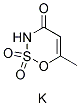
Chemische Struktur
Molekulargewicht: 202.25
Qualitätskontrolle (Quality Control)
- In Nature Medicine für seine erstklassige Qualität zitiert
- COA
- NMR
- HPLC
- SDS
- Datenblatt
Chemische Informationen, Lagerung & Stabilität (Chemical Information, Storage & Stability)
| Molekulargewicht | 202.25 | Formel | C4H5NO4S.K |
Lagerung (Ab dem Eingangsdatum) | |
|---|---|---|---|---|---|
| CAS-Nr. | 55589-62-3 | SDF herunterladen | Lagerung von Stammlösungen |
|
|
| Synonyme | N/A | Smiles | CC1=CC(=O)[N-]S(=O)(=O)O1.[K+] | ||
Löslichkeit (Solubility)
|
In vitro |
DMSO
: 40 mg/mL
(197.77 mM)
Water : 40 mg/mL Ethanol : Insoluble |
Molaritätsrechner
|
In vivo |
|||||
In-vivo-Formulierungsrechner (Klare Lösung)
Schritt 1: Geben Sie die untenstehenden Informationen ein (Empfohlen: Ein zusätzliches Tier zur Berücksichtigung von Verlusten während des Experiments)
Schritt 2: Geben Sie die In-vivo-Formulierung ein (Dies ist nur der Rechner, keine Formulierung. Bitte kontaktieren Sie uns zuerst, wenn es im Abschnitt "Löslichkeit" keine In-vivo-Formulierung gibt.)
Berechnungsergebnisse:
Arbeitskonzentration: mg/ml;
Methode zur Herstellung der DMSO-Stammlösung: mg Wirkstoff vorgelöst in μL DMSO ( Konzentration der Stammlösung mg/mL, Bitte kontaktieren Sie uns zuerst, wenn die Konzentration die DMSO-Löslichkeit der Wirkstoffcharge überschreitet. )
Methode zur Herstellung der In-vivo-Formulierung: Nehmen Sie μL DMSO Stammlösung, dann hinzufügenμL PEG300, mischen und klären, dann hinzufügenμL Tween 80, mischen und klären, dann hinzufügen μL ddH2O, mischen und klären.
Methode zur Herstellung der In-vivo-Formulierung: Nehmen Sie μL DMSO Stammlösung, dann hinzufügen μL Maisöl, mischen und klären.
Hinweis: 1. Bitte stellen Sie sicher, dass die Flüssigkeit klar ist, bevor Sie das nächste Lösungsmittel hinzufügen.
2. Achten Sie darauf, das/die Lösungsmittel der Reihe nach hinzuzufügen. Sie müssen sicherstellen, dass die bei der vorherigen Zugabe erhaltene Lösung eine klare Lösung ist, bevor Sie mit der Zugabe des nächsten Lösungsmittels fortfahren. Physikalische Methoden wie Vortex, Ultraschall oder ein heißes Wasserbad können zur Unterstützung des Lösens verwendet werden.
Wirkmechanismus (Mechanism of Action)
| In vitro |
Acesulfame potassium activates two members of the human TAS2R family (hTAS2R43 and hTAS2R44) to stimulate bitter taste. Acesulfame potassium elicited robust elevation of cytosolic Ca2+ in hTAS2R44-expressing cells, with a threshold value of activation of 0.25 mM and an EC50 value of 2.5 mM. Acesulfame potassium elicited response of hTAS2R43-expressing cells with a threshold value of 3.1 mM and an estimated EC50 value ﹥10 mM
Acesulfame potassium acts directly on the pancreatic islets and potentiates glucose-induced insulin release. Acesulfame potassium (1.0-15.0 mM) augmented insulin release from islets incubated in the presence of 7.0 mM d-glucose.
Acesulfame Potassium enhanced glucose absorption via activating sweet taste receptors in the enterocyte to translocate GLUT2 to the apical membrane through the PLC βII. In Caco-2 and RIE-1 cells, Acesulfame potassium (10 mM) increased glucose uptake by 20-30 % when incubated for 10 min with glucose >25 mM.
Acesulfame potassium increased the contractile response of isolated rat detrusor muscle strips via increased extracellular Ca2+ influx. Acesulfame potassium (10-7 M to 10-2 M) enhanced the contractile response to 10 Hz EFS compared to control. The atropine-resistant response to EFS is marginally increased by Acesulfame potassium (10-6 M). Acesulfame potassium (10-6 M) increased the maximum contractile response to α, β methylene ATP by 35% and to KCl by 12%. Acesulfame potassium (10-6 M) increased the log EC50 from -2.7 to -3.03.
|
|---|---|
| In vivo |
Acesulfame potassium acts on two members of the TAS1R family of G-protein-coupled receptors (TAS1R2 and TAS1R3) to stimulate sweet taste. Selective elimination of T1R-subunits differentially abolishes de tection and perception of these two taste modalities.
Acesulfame potassium can also induce insulin secretion in rats. Injection of Acesulfame potassium (150 mg/kg body weight) increased the plasma insulin concentration at 5 min from 27.3 mU/mL to 58.6 mU/mL. Infusion of Acesulfame potassium (20 mg/kg body weight/min) for one hour maintained the insulin concentration at a high level (about 85-100 mU/mL). When using different amounts of Acesulfame potassium, the insulin secretion is stimulated in a dose-dependent fashion.
Oral administration of Acesulfame potassium (60, 450, 1500 and 2250 mg/kg body weight) induced a significant increase in the frequency of cellular damage and chromosome aberrations in the Bone marrow cells isolated from mice femora. Oral administration of Acesulfame potassium at the concentration of 150, 300, and 600 mg/kg body weight is found to induce DNA damage in bone marrow cells of mice with a minimum effective concentration (MEC) value of 150 mg/kg in the comet assay.
|
Literatur |
|
Klinische Studieninformationen (Clinical Trial Information)
(Daten von https://clinicaltrials.gov, aktualisiert am 2024-05-22)
| NCT-Nummer | Rekrutierung | Erkrankungen | Sponsor/Kooperationspartner | Startdatum | Phasen |
|---|---|---|---|---|---|
| NCT05379270 | Active not recruiting | Breastfeeding |
George Washington University |
2022-02-28 | Not Applicable |

Produkte sind nur für Forschungszwecke bestimmt. Nicht für den menschlichen Gebrauch. Wir verkaufen nicht an Patienten.
©Copyright 2013 Selleck Chemicals. Alle Rechte vorbehalten.