
nur für Forschungszwecke
Camostat Mesilate Sodium Channel Inhibitor
Kat.-Nr.: S2874
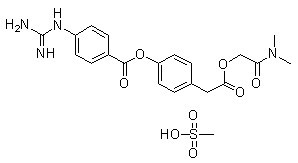
Chemische Struktur
Molekulargewicht: 494.52
Qualitätskontrolle (Quality Control)
| Verwandte Ziele | CFTR CRM1 CD markers AChR Calcium Channel Potassium Channel GABA Receptor TRP Channel ATPase GluR |
|---|---|
| Weitere Sodium Channel Inhibitoren | A-803467 cariporide Tolperisone HCl Vinpocetine Veratramine Bulleyaconi cine A GS967 Ambroxol HCl Benzocaine Nefopam HCl |
Zellkultur, Behandlung & Arbeitskonzentration
(Cell Culture, Treatment & Working Concentration)
| Zelllinien | Assay-Typ | Konzentration | Inkubationszeit | Formulierung | Aktivitätsbeschreibung | PMID |
|---|---|---|---|---|---|---|
| Caco-2 | Function assay | 48 hours | Determination of IC50 values for inhibition of SARS-CoV-2 induced cytotoxicity of Caco-2 cells after 48 hours by high content imaging, IC50 = 0.64 μM. | ChEMBL | ||
| Klicken Sie hier, um weitere experimentelle Daten zu Zelllinien anzuzeigen | ||||||
Chemische Informationen, Lagerung & Stabilität (Chemical Information, Storage & Stability)
| Molekulargewicht | 494.52 | Formel | C20H22N4O5.CH4O3S |
Lagerung (Ab dem Eingangsdatum) | |
|---|---|---|---|---|---|
| CAS-Nr. | 59721-29-8 | SDF herunterladen | Lagerung von Stammlösungen |
|
|
| Synonyme | FOY-305, FOY-S980 | Smiles | CN(C)C(=O)COC(=O)CC1=CC=C(C=C1)OC(=O)C2=CC=C(C=C2)N=C(N)N.CS(=O)(=O)O | ||
Löslichkeit (Solubility)
|
In vitro |
DMSO
: 100 mg/mL
(202.21 mM)
Water : 20 mg/mL Ethanol : Insoluble |
Molaritätsrechner
|
In vivo |
|||||
In-vivo-Formulierungsrechner (Klare Lösung)
Schritt 1: Geben Sie die untenstehenden Informationen ein (Empfohlen: Ein zusätzliches Tier zur Berücksichtigung von Verlusten während des Experiments)
Schritt 2: Geben Sie die In-vivo-Formulierung ein (Dies ist nur der Rechner, keine Formulierung. Bitte kontaktieren Sie uns zuerst, wenn es im Abschnitt "Löslichkeit" keine In-vivo-Formulierung gibt.)
Berechnungsergebnisse:
Arbeitskonzentration: mg/ml;
Methode zur Herstellung der DMSO-Stammlösung: mg Wirkstoff vorgelöst in μL DMSO ( Konzentration der Stammlösung mg/mL, Bitte kontaktieren Sie uns zuerst, wenn die Konzentration die DMSO-Löslichkeit der Wirkstoffcharge überschreitet. )
Methode zur Herstellung der In-vivo-Formulierung: Nehmen Sie μL DMSO Stammlösung, dann hinzufügenμL PEG300, mischen und klären, dann hinzufügenμL Tween 80, mischen und klären, dann hinzufügen μL ddH2O, mischen und klären.
Methode zur Herstellung der In-vivo-Formulierung: Nehmen Sie μL DMSO Stammlösung, dann hinzufügen μL Maisöl, mischen und klären.
Hinweis: 1. Bitte stellen Sie sicher, dass die Flüssigkeit klar ist, bevor Sie das nächste Lösungsmittel hinzufügen.
2. Achten Sie darauf, das/die Lösungsmittel der Reihe nach hinzuzufügen. Sie müssen sicherstellen, dass die bei der vorherigen Zugabe erhaltene Lösung eine klare Lösung ist, bevor Sie mit der Zugabe des nächsten Lösungsmittels fortfahren. Physikalische Methoden wie Vortex, Ultraschall oder ein heißes Wasserbad können zur Unterstützung des Lösens verwendet werden.
Wirkmechanismus (Mechanism of Action)
| Targets/IC50/Ki |
epithelial sodium channel (ENaC)
50 nM
|
|---|---|
| In vitro |
Camostat (30 μM) prolongs attenuation of ENaC function in human airway epithelial cell models that is reversible upon the addition of excess trypsin. Camostat mesilate (500 mM) inhibits generation of TGF-beta by suppressing plasmin activity and reduces the activity of TGF-beta, which blocks in vitro activation of HSCs. Camostat mesilate (20 mM) combined with insulin results a significant hypoglycemic effect following large intestinal administration. Camostat mesilate (20 mM) is effective in reducing insulin degradation in both small and large intestinal homogenates of rats. Camostat mesilate (2 mM) inhibits MCP-1 and TNF- production in activated rat monocytes. Camostat mesilate (2 mM) inhibits proliferation and MCP-1 production of cultured rat PSCs.
|
| In vivo |
Camostat (100 μg/kg i.t.) induces a potent and prolonged attenuation of ENaC activity in the guinea pig trachea. Camostat mesilate (1-2 mg/g of diet) markedly attenuats an increase in hepatic plasmin and TGF-beta levels, HSC activation, and hepatic fibrosis without apparent systemic or local side effects in porcine serum–treated rats. Camostat mesilate (1 mg/g) prevents pancreatic atrophy and improves pancreatic exocrine function of rat chronic pancreatitis induced by DBTC. Camostat mesilate (1 mg/g) inhibits chronic inflammation and pancreatic fibrosis induced by DBTC. Camostat mesilate (1 mg/g) inhibits the development of pancreatic fibrosis and PSCs activation in the pancreas induced by DBTC. Camostat mesilate (1 mg/g) suppresses monocytes infiltration and inhibits MCP-1 expression both in serum and in pancreatic tissue. Camostat mesilate (100 mg/kg) significantly increases the body weight and pancreatic wet weight, and it significantly inhibits inflammatory changes and fibrosis of the pancreas through the suppression of gene expressions of PAP, p8, and cytokines in rat chronic pancreatitis.
|
Literatur |
|
Klinische Studieninformationen (Clinical Trial Information)
(Daten von https://clinicaltrials.gov, aktualisiert am 2025-04-18)
| NCT-Nummer | Rekrutierung | Erkrankungen | Sponsor/Kooperationspartner | Startdatum | Phasen |
|---|---|---|---|---|---|
| NCT04321096 | COMPLETED | Corona Virus Infection |
University of Aarhus |
2020-04-04 | PHASE1; PHASE2 |
| NCT04470544 | COMPLETED | Severe Acute Respiratory Syndrome |
Alan Bryce |
2020-07-28 | PHASE2 |
| NCT04338906 | WITHDRAWN | COVID |
Heinrich-Heine University, Duesseldorf |
2020-05 | PHASE4 |
| NCT04681430 | COMPLETED | Corona Virus Infection; SARS-CoV-2 Infection; SARS-CoV-2 PCR Test Positive; SARS-CoV-2 Acute Respiratory Disease |
Heinrich-Heine University, Duesseldorf |
2021-01-08 | PHASE2 |
| NCT04652765 | TERMINATED | Covid19; SARS-CoV Infection; Coronavirus Infection |
Sidney Kimmel Comprehensive Cancer Center at Johns Hopkins |
2021-02-03 | PHASE1 |
| NCT04530617 | TERMINATED | Covid19; Diabetes; Hypertension; Obesity |
Instituto Nacional de Ciencias Medicas y Nutricion Salvador Zubiran |
2020-10-05 | PHASE2 |

Produkte sind nur für Forschungszwecke bestimmt. Nicht für den menschlichen Gebrauch. Wir verkaufen nicht an Patienten.
©Copyright 2013 Selleck Chemicals. Alle Rechte vorbehalten.