
nur für Forschungszwecke
Deferiprone Eisen-Chelatbildner
Kat.-Nr.: S4067
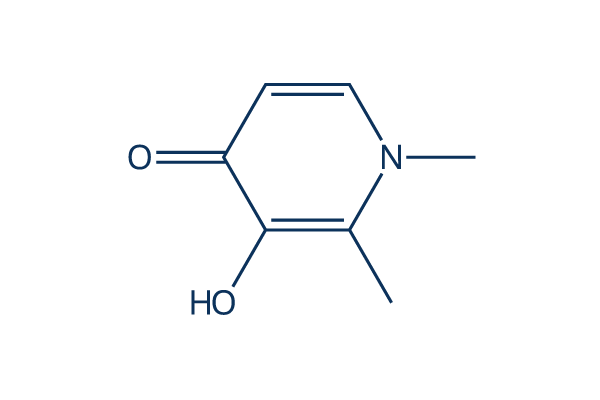
Chemische Struktur
Molekulargewicht: 139.15
Qualitätskontrolle (Quality Control)
| Verwandte Ziele | Dehydrogenase HSP Transferase P450 (e.g. CYP17) PDE phosphatase PPAR Vitamin Carbohydrate Metabolism Mitochondrial Metabolism |
|---|---|
| Weitere UGT Inhibitoren | Cremophor EL |
Chemische Informationen, Lagerung & Stabilität (Chemical Information, Storage & Stability)
| Molekulargewicht | 139.15 | Formel | C7H9NO2 |
Lagerung (Ab dem Eingangsdatum) | |
|---|---|---|---|---|---|
| CAS-Nr. | 30652-11-0 | SDF herunterladen | Lagerung von Stammlösungen |
|
|
| Synonyme | CP20 | Smiles | CC1=C(C(=O)C=CN1C)O | ||
Löslichkeit (Solubility)
|
In vitro |
Water : 27 mg/mL
DMSO
: Insoluble
Ethanol : Insoluble |
Molaritätsrechner
|
In vivo |
|||||
In-vivo-Formulierungsrechner (Klare Lösung)
Schritt 1: Geben Sie die untenstehenden Informationen ein (Empfohlen: Ein zusätzliches Tier zur Berücksichtigung von Verlusten während des Experiments)
Schritt 2: Geben Sie die In-vivo-Formulierung ein (Dies ist nur der Rechner, keine Formulierung. Bitte kontaktieren Sie uns zuerst, wenn es im Abschnitt "Löslichkeit" keine In-vivo-Formulierung gibt.)
Berechnungsergebnisse:
Arbeitskonzentration: mg/ml;
Methode zur Herstellung der DMSO-Stammlösung: mg Wirkstoff vorgelöst in μL DMSO ( Konzentration der Stammlösung mg/mL, Bitte kontaktieren Sie uns zuerst, wenn die Konzentration die DMSO-Löslichkeit der Wirkstoffcharge überschreitet. )
Methode zur Herstellung der In-vivo-Formulierung: Nehmen Sie μL DMSO Stammlösung, dann hinzufügenμL PEG300, mischen und klären, dann hinzufügenμL Tween 80, mischen und klären, dann hinzufügen μL ddH2O, mischen und klären.
Methode zur Herstellung der In-vivo-Formulierung: Nehmen Sie μL DMSO Stammlösung, dann hinzufügen μL Maisöl, mischen und klären.
Hinweis: 1. Bitte stellen Sie sicher, dass die Flüssigkeit klar ist, bevor Sie das nächste Lösungsmittel hinzufügen.
2. Achten Sie darauf, das/die Lösungsmittel der Reihe nach hinzuzufügen. Sie müssen sicherstellen, dass die bei der vorherigen Zugabe erhaltene Lösung eine klare Lösung ist, bevor Sie mit der Zugabe des nächsten Lösungsmittels fortfahren. Physikalische Methoden wie Vortex, Ultraschall oder ein heißes Wasserbad können zur Unterstützung des Lösens verwendet werden.
Wirkmechanismus (Mechanism of Action)
| Merkmale |
Possesses 10-fold higher cytotoxicity than maltol in both HL-60 and HSC-2 cell lines.
|
|---|---|
| In vitro |
Deferiprone (100 μM) is able to protect myocytes from doxorubicin-induced lactate dehydrogenase release. This compound (300 μM) quickly and efficiently removes iron(III) from its complex with doxorubicin. It (300 μM) rapidly enters myocytes and displaces iron from a fluorescence-quenched trapped intracellular iron-calcein complex, suggesting that in the myocyte, this compound should also be able to displace iron from its complex with doxorubicin. This chemical (3 mM) also greatly reduces hydroxyl radical production by the iron(III)-doxorubicin complex in the xanthine oxidase/xanthine superoxide generating system. It (0.5 mM) increases removal of RBC membrane free iron in a time and dose dependent manner. This compound (0.3 mM) is effective in inhibiting radioactive iron mobilization from iron-loaded heart cells and protecting or restoring mitochondrial respiratory enzyme activity. It (1 mM) results in a sharp decrease in complex I-III activity in iron-loaded heart cells. This chemical shows cytotoxic effect of human tumor cell lines HSC-2, HSC-3 and HL-60 with IC50 of 13.5 μg/mL, 9.9 μg/mL and 10.6 μg/mL, the cytotoxic activity of HK1 against HL-60 and HSC-2 cells is reduced in the presence of FeCl3. It (100 μg/mL) induces internucleosomal DNA fragmentation in HL-60 cells, but the addition of FeCl3 inhibits the DNA fragmentation. This compound (100 μg/mL) activates the caspase 3, 8 and 9 in HSC-2 cells.
|
| In vivo |
Deferiprone (100 mg/kg) reduces the mean basilar artery cross-sectional areas by 24% in rabbits. This compound combined with subarachnoid hemorrhage(SAH) shows a variable amount of corrugation of the internal elastic lamina in rabbits.
|
Literatur |
|
Klinische Studieninformationen (Clinical Trial Information)
(Daten von https://clinicaltrials.gov, aktualisiert am 2026-04-08)
| NCT-Nummer | Rekrutierung | Erkrankungen | Sponsor/Kooperationspartner | Startdatum | Phasen |
|---|---|---|---|---|---|
| NCT05604131 | RECRUITING | Acute Myocardial Infarction Type 1 |
Rohan Dharmakumar |
2022-11-08 | PHASE2 |
| NCT07759895 | NOT_YET_RECRUITING | Schizoaffecitve Disorder; Schizophrenia and Schizoaffective Disorder; Schizophrenia and Predominant Negative Symptoms |
Amit Lotan |
2026-09-01 | PHASE2 |
| NCT03754725 | ACTIVE_NOT_RECRUITING | SAH; Dementia |
Duke University |
2020-10-01 | PHASE1; PHASE2 |
| NCT07023666 | RECRUITING | Sickle Cell Disease |
Inova Health Care Services |
2025-10-07 | PHASE2 |
| NCT05111821 | TERMINATED | Stroke |
University Hospital, Bordeaux |
2022-06-08 | PHASE2 |
| NCT00907283 | UNKNOWN | Neurodegenerative Disease; Iron Overload |
Ente Ospedaliero Ospedali Galliera |
2008-11 | PHASE2 |

Produkte sind nur für Forschungszwecke bestimmt. Nicht für den menschlichen Gebrauch. Wir verkaufen nicht an Patienten.
©Copyright 2013 Selleck Chemicals. Alle Rechte vorbehalten.