
nur für Forschungszwecke
Omipalisib (GSK2126458) PI3K Inhibitor
Kat.-Nr.: S2658
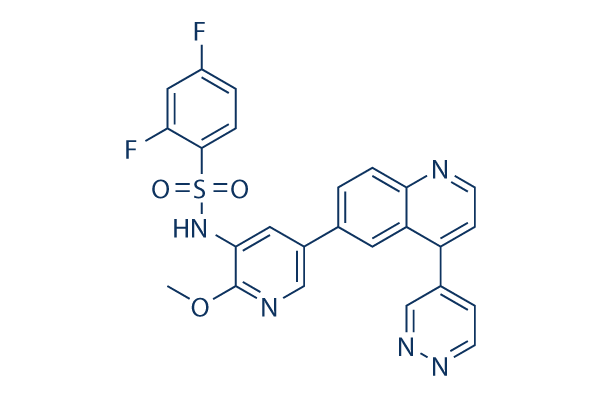
Chemische Struktur
Molekulargewicht: 505.5
Qualitätskontrolle (Quality Control)
| Verwandte Ziele | Akt mTOR GSK-3 ATM/ATR DNA-PK AMPK PDPK1 PTEN PI4K PP2A |
|---|---|
| Weitere PI3K Inhibitoren | GDC-0077 (Inavolisib) SAR405 Quercetin (Sophoretin) LY294002 XL147 analogue Tersolisib (STX-478) Buparlisib (BKM120) 740 Y-P (PDGFR 740Y-P) GO-203 TFA Eganelisib (IPI-549) |
Zellkultur, Behandlung & Arbeitskonzentration
(Cell Culture, Treatment & Working Concentration)
| Zelllinien | Assay-Typ | Konzentration | Inkubationszeit | Formulierung | Aktivitätsbeschreibung | PMID |
|---|---|---|---|---|---|---|
| HCT116 | Cytotoxicity assay | 72 hrs | Cytotoxicity against human HCT116 cells after 72 hrs by MTT assay, IC50 = 0.01 μM. | 26819001 | ||
| Bel7404 | Cytotoxicity assay | 72 hrs | Cytotoxicity against human Bel7404 cells after 72 hrs by MTT assay, IC50 = 0.01 μM. | 26819001 | ||
| MDA-MB-231 | Cytotoxicity assay | 72 hrs | Cytotoxicity against human MDA-MB-231 cells after 72 hrs by MTT assay, IC50 = 0.13 μM. | 26819001 | ||
| A549 | Cytotoxicity assay | 72 hrs | Cytotoxicity against human A549 cells after 72 hrs by MTT assay, IC50 = 0.14 μM. | 27448924 | ||
| HCT116 | Cytotoxicity assay | 72 hrs | Cytotoxicity against human HCT116 cells after 72 hrs by MTT assay, IC50 = 0.154 μM. | 27448924 | ||
| U87MG | Cytotoxicity assay | 72 hrs | Cytotoxicity against human U87MG cells after 72 hrs by MTT assay, IC50 = 0.537 μM. | 27448924 | ||
| A549 | Cytotoxicity assay | 72 hrs | Cytotoxicity against human A549 cells after 72 hrs by MTT assay, IC50 = 0.6 μM. | 26819001 | ||
| TC32 | qHTS assay | qHTS of pediatric cancer cell lines to identify multiple opportunities for drug repurposing: Primary screen for TC32 cells | 29435139 | |||
| U-2 OS | qHTS assay | qHTS of pediatric cancer cell lines to identify multiple opportunities for drug repurposing: Primary screen for U-2 OS cells | 29435139 | |||
| A673 | qHTS assay | qHTS of pediatric cancer cell lines to identify multiple opportunities for drug repurposing: Primary screen for A673 cells | 29435139 | |||
| DAOY | qHTS assay | qHTS of pediatric cancer cell lines to identify multiple opportunities for drug repurposing: Primary screen for DAOY cells | 29435139 | |||
| BT-37 | qHTS assay | qHTS of pediatric cancer cell lines to identify multiple opportunities for drug repurposing: Primary screen for BT-37 cells | 29435139 | |||
| RD | qHTS assay | qHTS of pediatric cancer cell lines to identify multiple opportunities for drug repurposing: Primary screen for RD cells | 29435139 | |||
| SK-N-SH | qHTS assay | qHTS of pediatric cancer cell lines to identify multiple opportunities for drug repurposing: Primary screen for SK-N-SH cells | 29435139 | |||
| NB1643 | qHTS assay | qHTS of pediatric cancer cell lines to identify multiple opportunities for drug repurposing: Primary screen for NB1643 cells | 29435139 | |||
| OHS-50 | qHTS assay | qHTS of pediatric cancer cell lines to identify multiple opportunities for drug repurposing: Primary screen for OHS-50 cells | 29435139 | |||
| LAN-5 | qHTS assay | qHTS of pediatric cancer cell lines to identify multiple opportunities for drug repurposing: Confirmatory screen for LAN-5 cells | 29435139 | |||
| NB-EBc1 | qHTS assay | qHTS of pediatric cancer cell lines to identify multiple opportunities for drug repurposing: Confirmatory screen for NB-EBc1 cells | 29435139 | |||
| SK-N-SH | qHTS assay | qHTS of pediatric cancer cell lines to identify multiple opportunities for drug repurposing: Confirmatory screen for SK-N-SH cells | 29435139 | |||
| Rh41 | qHTS assay | qHTS of pediatric cancer cell lines to identify multiple opportunities for drug repurposing: Primary screen for Rh41 cells | 29435139 | |||
| A673 | qHTS assay | qHTS of pediatric cancer cell lines to identify multiple opportunities for drug repurposing: Confirmatory screen for A673 cells) | 29435139 | |||
| BT-37 | qHTS assay | qHTS of pediatric cancer cell lines to identify multiple opportunities for drug repurposing: Confirmatory screen for BT-37 cells | 29435139 | |||
| MG 63 (6-TG R) | qHTS assay | qHTS of pediatric cancer cell lines to identify multiple opportunities for drug repurposing: Confirmatory screen for MG 63 (6-TG R) cells | 29435139 | |||
| Rh30 | qHTS assay | qHTS of pediatric cancer cell lines to identify multiple opportunities for drug repurposing: Primary screen for Rh30 cells | 29435139 | |||
| Rh30 | qHTS assay | qHTS of pediatric cancer cell lines to identify multiple opportunities for drug repurposing: Confirmatory screen for Rh30 cells | 29435139 | |||
| OHS-50 | qHTS assay | qHTS of pediatric cancer cell lines to identify multiple opportunities for drug repurposing: Confirmatory screen for OHS-50 cells | 29435139 | |||
| Rh41 | qHTS assay | qHTS of pediatric cancer cell lines to identify multiple opportunities for drug repurposing: Confirmatory screen for Rh41 cells | 29435139 | |||
| SJ-GBM2 | qHTS assay | qHTS of pediatric cancer cell lines to identify multiple opportunities for drug repurposing: Primary screen for SJ-GBM2 cells | 29435139 | |||
| SK-N-MC | qHTS assay | qHTS of pediatric cancer cell lines to identify multiple opportunities for drug repurposing: Primary screen for SK-N-MC cells | 29435139 | |||
| NB-EBc1 | qHTS assay | qHTS of pediatric cancer cell lines to identify multiple opportunities for drug repurposing: Primary screen for NB-EBc1 cells | 29435139 | |||
| LAN-5 | qHTS assay | qHTS of pediatric cancer cell lines to identify multiple opportunities for drug repurposing: Primary screen for LAN-5 cells | 29435139 | |||
| Rh18 | qHTS assay | qHTS of pediatric cancer cell lines to identify multiple opportunities for drug repurposing: Primary screen for Rh18 cells | 29435139 | |||
| NB1643 | qHTS assay | qHTS of pediatric cancer cell lines to identify multiple opportunities for drug repurposing: Confirmatory screen for NB1643 cells | 29435139 | |||
| SK-N-MC | qHTS assay | qHTS of pediatric cancer cell lines to identify multiple opportunities for drug repurposing: Confirmatory screen for SK-N-MC cells | 29435139 | |||
| TC32 | qHTS assay | qHTS of pediatric cancer cell lines to identify multiple opportunities for drug repurposing: Confirmatory screen for TC32 cells | 29435139 | |||
| Rh18 | qHTS assay | qHTS of pediatric cancer cell lines to identify multiple opportunities for drug repurposing: Confirmatory screen for Rh18 cells | 29435139 | |||
| Saos-2 | qHTS assay | qHTS of pediatric cancer cell lines to identify multiple opportunities for drug repurposing: Confirmatory screen for Saos-2 cells | 29435139 | |||
| Klicken Sie hier, um weitere experimentelle Daten zu Zelllinien anzuzeigen | ||||||
Chemische Informationen, Lagerung & Stabilität (Chemical Information, Storage & Stability)
| Molekulargewicht | 505.5 | Formel | C25H17F2N5O3S |
Lagerung (Ab dem Eingangsdatum) | |
|---|---|---|---|---|---|
| CAS-Nr. | 1086062-66-9 | SDF herunterladen | Lagerung von Stammlösungen |
|
|
| Synonyme | GSK458 | Smiles | COC1=C(C=C(C=N1)C2=CC3=C(C=CN=C3C=C2)C4=CN=NC=C4)NS(=O)(=O)C5=C(C=C(C=C5)F)F | ||
Löslichkeit (Solubility)
|
In vitro |
DMSO
: 101 mg/mL
(199.8 mM)
Water : Insoluble Ethanol : Insoluble |
Molaritätsrechner
|
In vivo |
|||||
In-vivo-Formulierungsrechner (Klare Lösung)
Schritt 1: Geben Sie die untenstehenden Informationen ein (Empfohlen: Ein zusätzliches Tier zur Berücksichtigung von Verlusten während des Experiments)
Schritt 2: Geben Sie die In-vivo-Formulierung ein (Dies ist nur der Rechner, keine Formulierung. Bitte kontaktieren Sie uns zuerst, wenn es im Abschnitt "Löslichkeit" keine In-vivo-Formulierung gibt.)
Berechnungsergebnisse:
Arbeitskonzentration: mg/ml;
Methode zur Herstellung der DMSO-Stammlösung: mg Wirkstoff vorgelöst in μL DMSO ( Konzentration der Stammlösung mg/mL, Bitte kontaktieren Sie uns zuerst, wenn die Konzentration die DMSO-Löslichkeit der Wirkstoffcharge überschreitet. )
Methode zur Herstellung der In-vivo-Formulierung: Nehmen Sie μL DMSO Stammlösung, dann hinzufügenμL PEG300, mischen und klären, dann hinzufügenμL Tween 80, mischen und klären, dann hinzufügen μL ddH2O, mischen und klären.
Methode zur Herstellung der In-vivo-Formulierung: Nehmen Sie μL DMSO Stammlösung, dann hinzufügen μL Maisöl, mischen und klären.
Hinweis: 1. Bitte stellen Sie sicher, dass die Flüssigkeit klar ist, bevor Sie das nächste Lösungsmittel hinzufügen.
2. Achten Sie darauf, das/die Lösungsmittel der Reihe nach hinzuzufügen. Sie müssen sicherstellen, dass die bei der vorherigen Zugabe erhaltene Lösung eine klare Lösung ist, bevor Sie mit der Zugabe des nächsten Lösungsmittels fortfahren. Physikalische Methoden wie Vortex, Ultraschall oder ein heißes Wasserbad können zur Unterstützung des Lösens verwendet werden.
Wirkmechanismus (Mechanism of Action)
| Targets/IC50/Ki |
p110α
(Cell-free assay) 0.019 nM(Ki)
p110δ
(Cell-free assay) 0.024 nM(Ki)
p110γ
(Cell-free assay) 0.06 nM(Ki)
p110β
(Cell-free assay) 0.13 nM(Ki)
mTORC1
(Cell-free assay) 0.18 nM(Ki)
mTORC2
(Cell-free assay) 0.3 nM(Ki)
|
|---|---|
| In vitro |
Omipalisib (GSK2126458) potently inhibits the activity of common activating mutants of p110α (E542K, E545K, and H1047R) found in human cancer with Ki of 8 pM, 8 pM and 9 pM, respectively. This compound causes a significant reduction in the levels of pAkt-S473 with remarkable potency in T47D and BT474 cells with IC50 of 0.41 nM and 0.18 nM, respectively. Furthermore, it leads to a G1 cell cycle arrest and produces the inhibitory effect on cell proliferation in a large panel of cell lines, including T47D and BT474 breast cancer lines with IC50 of 3 nM and 2.4 nM, respectively.
|
| Kinase-Assay |
HTRF In-vitro-Profilierungsassays zur PI3K-Hemmung
|
|
Verbindungen werden seriell (3-fach in 100 % DMSO) über eine 384-Well-Polypropylen-Mutterplatte von Spalte 1 bis Spalte 12 und Spalte 13 bis Spalte 24 verdünnt, um 11 Konzentrationen für Omipalisib (GSK2126458) zu erhalten. Die Spalten 6 und 18 enthalten nur DMSO. Sobald die Titrationen vorgenommen wurden, werden 0,05 μL auf eine 384-Well-Assay-Platte mit geringem Volumen übertragen. Diese Assay-Platte enthält drei pharmakologische Kontrollen (bekannte PI3K-Inhibitoren) und 3 Assay-Kontrollen: (1) Enzym ohne Inhibitor; (2) Puffer ohne Enzym und (3) Puffer ohne Enzym plus natives PIP3. DMSO wird in alle Vertiefungen der Spalten 6 und 18 gestempelt. PIP3 wird mit 40 μM in 1X Reaktionspuffer (1 μL 200 μM PIP3) zu alternierenden Reihen der Spalte 18 (Vertiefungen 18 B, D, F, H, J, L, N, P) gegeben. Die Kontrollreaktionen ohne Enzym werden in den Vertiefungen 18 A, C, E, G, I, K, M, O (0,1 μL 100 % DMSO) durchgeführt. Der PI3-Kinase-Profilierungsassay wird mit dem HTRF-Kit optimiert. Das Assay-Kit enthält sieben Reagenzien: 1) 4X Reaktionspuffer; 2) natives PIP2 (Substrat); 3) Stop A (EDTA); 4) Stop B (Biotin-PIP3); 5) Detektionsmix A (Streptavidin-APC); 6) Detektionsmix B (Eu-markiertes Anti-GST plus GST-markierte PH-Domäne); 7) Detektionsmix C (KF). Der PI3Kinase-Reaktionspuffer wird durch 1:4-Verdünnung des Stamms mit deionisiertem Wasser hergestellt. Frisch zubereitetes DTT wird am Verwendungstag in einer Endkonzentration von 5 mM hinzugefügt. Die Enzymzugabe und die Vorinkubation der Verbindung werden durch Zugabe von 2,5 μL PI3K (in doppelter Endkonzentration) in 1X Reaktionspuffer zu allen Vertiefungen mit einem Multidrop Combi initiiert. Die Platten werden 15 Minuten lang bei Raumtemperatur inkubiert. Die Reaktionen werden durch Zugabe von 2,5 μL 2X Substratlösung (PIP2 und ATP in 1X Reaktionspuffer) mit einem Multidrop Combi initiiert. Die Platten werden eine Stunde lang bei Raumtemperatur inkubiert. Die Reaktionen werden durch Zugabe von 2,5 μL Stopplösung (Stop A und Stop B im Verhältnis 5:1 vorgemischt) zu allen Vertiefungen mit dem Multidrop Combi gequencht. Die gequenchten Reaktionen werden dann verarbeitet, um die Produktbildung nachzuweisen, indem 2,5 μL Detektionslösung zu allen Vertiefungen mit dem Multidrop Combi gegeben werden (Detektionsmix C, Detektionsmix A und Detektionsmix B im Verhältnis 18:1:1 kombiniert, d. h.: für ein Gesamtvolumen von 6000 μL mischen Sie 5400 μL Detektionsmix C, 300 μL Detektionsmix A und 300 μL Detektionsmix B. Hinweis: Diese Lösung sollte 2 Stunden vor Gebrauch hergestellt werden). Nach einer einstündigen Inkubation im Dunkeln wird das HTRF-Signal auf dem Envision-Plattenleser bei 330 nm Anregung und dualer Emissionsdetektion bei 620 nm (Eu) und 665 nm (APC) gemessen.
|
|
| In vivo |
In a BT474 human tumor xenograft model, Omipalisib (GSK2126458) treatment results in a dose-dependent reduction in pAkt-S473 levels, and exhibited dose-dependent tumor growth inhibition at a low dose of 300 μg/kg. Besides, it shows low blood clearance and good oral bioavailability in four preclinical species (mouse, rat, dog, and monkey).
|
Literatur |
|
Anwendungen (Applications)
| Methoden | Biomarker | Bilder | PMID |
|---|---|---|---|
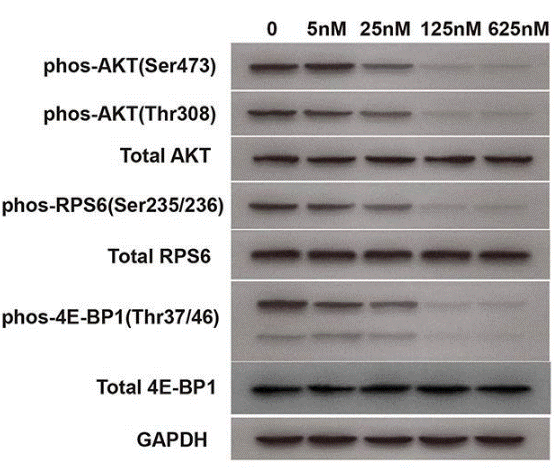
| Western blot | p-AKT / AKT / p-RPS6 / RPS6 / p-4E-BP1 / 4E-BP1 |
|
31069214 |
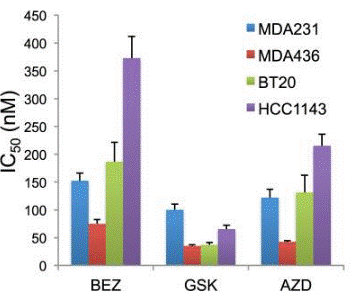
| Growth inhibition assay | IC50 |
|
26148118 |
Klinische Studieninformationen (Clinical Trial Information)
(Daten von https://clinicaltrials.gov, aktualisiert am 2019-11-21)
| NCT-Nummer | Rekrutierung | Erkrankungen | Sponsor/Kooperationspartner | Startdatum | Phasen |
|---|---|---|---|---|---|
| NCT01725139 | COMPLETED | Idiopathic Pulmonary Fibrosis |
GlaxoSmithKline |
2013-03-08 | PHASE1 |
| NCT01248858 | TERMINATED | Cancer |
GlaxoSmithKline |
2010-12-03 | PHASE1 |
| NCT01725139 | Completed | Idiopathic Pulmonary Fibrosis |
GlaxoSmithKline |
2013-03-08 | Phase 1 |
| NCT00972686 | COMPLETED | Solid Tumours |
GlaxoSmithKline |
2009-08-31 | PHASE1 |
| NCT01248858 | Terminated | Cancer |
GlaxoSmithKline |
2010-12-03 | Phase 1 |
| NCT00972686 | Completed | Solid Tumours |
GlaxoSmithKline |
2009-08-31 | Phase 1 |

Produkte sind nur für Forschungszwecke bestimmt. Nicht für den menschlichen Gebrauch. Wir verkaufen nicht an Patienten.
©Copyright 2013 Selleck Chemicals. Alle Rechte vorbehalten.