
nur für Forschungszwecke
Guadecitabine sodium DNMT-Inhibitor
Kat.-Nr.: S7013
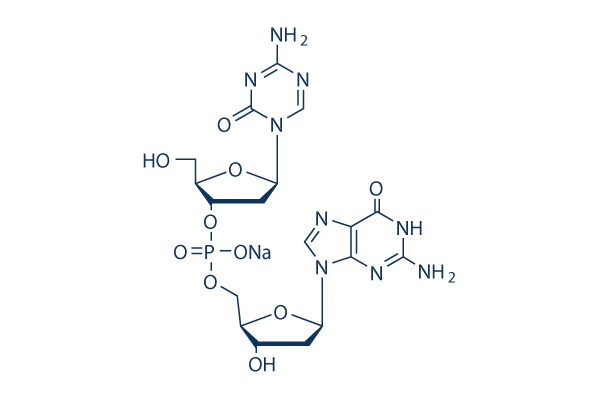
Chemische Struktur
Molekulargewicht: 579.39
Qualitätskontrolle (Quality Control)
- In Nature Medicine für seine erstklassige Qualität zitiert
- COA
- NMR
- HPLC
- SDS
- Datenblatt
| Verwandte Ziele | PRMT EZH2 MAT2A DNA Methyltransferase LSD1 JMJD G9a/GLP MLL NSD FTO |
|---|---|
| Ausgewählte Produkte | Y-27632 Dihydrochloride SB431542 CHIR-99021 (Laduviglusib) RMC-7977 RMC-6236 (Daraxonrasib) MRTX1133 MG132 Z-VAD-FMK VT3989 IAG933 |
Chemische Informationen, Lagerung & Stabilität (Chemical Information, Storage & Stability)
| Molekulargewicht | 579.39 | Formel | C18 H23 N9 O10 P . Na |
Lagerung (Ab dem Eingangsdatum) | |
|---|---|---|---|---|---|
| CAS-Nr. | 929904-85-8 | -- | Lagerung von Stammlösungen |
|
|
| Synonyme | SGI-110 sodium; S-110 sodium | Smiles | C1C(C(OC1N2C=NC3=C2N=C(NC3=O)N)COP(=O)([O-])OC4CC(OC4CO)N5C=NC(=NC5=O)N)O.[Na+] | ||
Löslichkeit (Solubility)
|
In vitro |
DMSO
: 100 mg/mL
(172.59 mM)
Water : 50 mg/mL Ethanol : Insoluble |
Molaritätsrechner
|
In vivo |
|||||
In-vivo-Formulierungsrechner (Klare Lösung)
Schritt 1: Geben Sie die untenstehenden Informationen ein (Empfohlen: Ein zusätzliches Tier zur Berücksichtigung von Verlusten während des Experiments)
Schritt 2: Geben Sie die In-vivo-Formulierung ein (Dies ist nur der Rechner, keine Formulierung. Bitte kontaktieren Sie uns zuerst, wenn es im Abschnitt "Löslichkeit" keine In-vivo-Formulierung gibt.)
Berechnungsergebnisse:
Arbeitskonzentration: mg/ml;
Methode zur Herstellung der DMSO-Stammlösung: mg Wirkstoff vorgelöst in μL DMSO ( Konzentration der Stammlösung mg/mL, Bitte kontaktieren Sie uns zuerst, wenn die Konzentration die DMSO-Löslichkeit der Wirkstoffcharge überschreitet. )
Methode zur Herstellung der In-vivo-Formulierung: Nehmen Sie μL DMSO Stammlösung, dann hinzufügenμL PEG300, mischen und klären, dann hinzufügenμL Tween 80, mischen und klären, dann hinzufügen μL ddH2O, mischen und klären.
Methode zur Herstellung der In-vivo-Formulierung: Nehmen Sie μL DMSO Stammlösung, dann hinzufügen μL Maisöl, mischen und klären.
Hinweis: 1. Bitte stellen Sie sicher, dass die Flüssigkeit klar ist, bevor Sie das nächste Lösungsmittel hinzufügen.
2. Achten Sie darauf, das/die Lösungsmittel der Reihe nach hinzuzufügen. Sie müssen sicherstellen, dass die bei der vorherigen Zugabe erhaltene Lösung eine klare Lösung ist, bevor Sie mit der Zugabe des nächsten Lösungsmittels fortfahren. Physikalische Methoden wie Vortex, Ultraschall oder ein heißes Wasserbad können zur Unterstützung des Lösens verwendet werden.
Wirkmechanismus (Mechanism of Action)
| Targets/IC50/Ki |
DNA methyltransferase
|
|---|---|
| In vitro |
Guadecitabine (SGI-110) is a 5-aza-2′-deoxycytidine-containing demethylating dinucleotide that works via a mechanism similar to that of 5-aza-CdR after incorporation of its aza-moiety into DNA. However, it is well protected from deamination by cytidine deaminase. This compound (1 μM) induces a significant decrease in the level of methylation in both T24 and HCT116 cells and is able to induce robust p16 expression. It also causes depletion of extractable DNMT1 in cells at 1 μM concentration. Furthermore, it decreases the plating efficiency of T24 bladder carcinoma cells in a dose-dependent manner, with no colonies forming at 10 μM concentration, which is quite similar to 5-aza-CdR in T24 cells. It shows immunomodulatory activity in vitro. At 1 μM, it induces/up-regulates the expression of several cancer/testis antigens (CTA) (i.e., MAGE-A1, MAGE-A2, MAGE-A3, MAGE-A4, MAGE-A10, GAGE1-2, GAGE 1-6, NY-ESO-1, and SSX 1-5) in cancer cell lines (cutaneous melanoma, mesothelioma, renal cell carcinoma, and sarcoma cells), both at mRNA and at protein levels. This compound also up-regulates the expression of HLA class I antigens and of ICAM-1, resulting in improved recognition of cancer cells by gp100-specific CTL. |
| In vivo |
Guadecitabine (SGI-110) is as effective as 5-Aza-CdR, but is better tolerated in mice. This compound (10 mg/kg) displays potent activity on inducing p16 expression, reducing DNA methylation at the p16 promoter region, and retarding tumor growth in human xenograft. It is effective by both i.p. and s.c. deliveries. |
Literatur |
|
Klinische Studieninformationen (Clinical Trial Information)
(Daten von https://clinicaltrials.gov, aktualisiert am 2026-08-05)
| NCT-Nummer | Rekrutierung | Erkrankungen | Sponsor/Kooperationspartner | Startdatum | Phasen |
|---|---|---|---|---|---|
| NCT03220477 | ACTIVE_NOT_RECRUITING | Lung Cancer |
Memorial Sloan Kettering Cancer Center |
2017-08-04 | PHASE1 |
| NCT02935361 | ACTIVE_NOT_RECRUITING | Chronic Myelomonocytic Leukemia; Myelodysplastic Syndrome; Recurrent Acute Myeloid Leukemia With Myelodysplasia-Related Changes |
University of Southern California |
2016-11-02 | PHASE1; PHASE2 |
| NCT02998567 | ACTIVE_NOT_RECRUITING | Non Small Cell Lung Cancer |
Royal Marsden NHS Foundation Trust |
2017-01-26 | PHASE1 |
| NCT02684162 | COMPLETED | Acute Myeloid Leukemia; Chronic Myelomonocytic Leukemia; Myelodysplastic Syndrome; Recurrent Acute Myeloid Leukemia; Recurrent Myelodysplastic Syndrome |
M.D. Anderson Cancer Center |
2016-06-22 | PHASE2 |
| NCT02131597 | COMPLETED | High Risk Myelodysplastic Syndrome |
M.D. Anderson Cancer Center |
2014-11-10 | PHASE2 |
| NCT04340843 | ACTIVE_NOT_RECRUITING | Locally Advanced Unresectable Primary Central Chondrosarcoma; Metastatic Primary Central Chondrosarcoma; Unresectable Primary Central Chondrosarcoma |
National Cancer Institute (NCI) |
2020-09-08 | PHASE2 |

Produkte sind nur für Forschungszwecke bestimmt. Nicht für den menschlichen Gebrauch. Wir verkaufen nicht an Patienten.
©Copyright 2013 Selleck Chemicals. Alle Rechte vorbehalten.