
Technische Daten
| Formel | C15 H10 Br N3 O |
||||||||||
| Molekulargewicht | 328.16 | CAS-Nr. | 676596-65-9 | ||||||||
| Löslichkeit (25°C)* | In vitro | DMSO | 66 mg/mL (201.12 mM) | ||||||||
| Water | Insoluble | ||||||||||
| Ethanol | Insoluble | ||||||||||
| In vivo (Lösungsmittel einzeln und der Reihe nach zum Produkt hinzufügen.) |
|
||||||||||
|
* <1 mg/ml bedeutet schwer löslich oder unlöslich. * Bitte beachten Sie, dass Selleck die Löslichkeit aller Verbindungen intern testet und die tatsächliche Löslichkeit geringfügig von veröffentlichten Werten abweichen kann. Dies ist normal und ist auf geringfügige Batch-zu-Batch-Variationen zurückzuführen. * Versand bei Raumtemperatur (Stabilitätstests zeigen, dass dieses Produkt ohne Kühlmaßnahmen versendet werden kann.) |
|||||||||||
Vorbereitung von Stammlösungen
Biologische Aktivität
| Beschreibung | 1-Azakenpaullone (1-Akp) ist ein potenter und selektiver GSK-3β-Inhibitor mit einer IC50 von 18 nM und einer >100-fachen Selektivität gegenüber CDK1/Cyclin B und CDK5/p25. | ||||
|---|---|---|---|---|---|
| Ziele |
|
||||
| In vitro | 1-Azakenpaullone hemmt CDK1/Cyclin B, CDK5/p25 und GSK-3β wirksam mit IC50-Werten von 0,018 μM, 4,2 μM bzw. 2,0 μM. In menschlichen Inseln stimuliert diese Verbindung (5 mM) in Kombination mit Glucose (8 mM) die β-Zellproliferation. Sie stimuliert effektiv die Replikation von INS-1E-Zellen und schützt INS-1E-Zellen vor Glucolipotoxizität-induziertem Zelltod. |
||||
| In vivo | Die Vorbehandlung mit 1-Azakenpaullone (10 oder 100 pmol, i.c.v.) schwächt die induzierte lokomotorische Hyperaktivität, die Störung der PPI und kognitive Defizite ab und verbessert die induzierte motorische Inkordination im Rotarod-Test. |
Protokoll (aus Referenz)
| Kinase-Assay: |
|
|---|---|
| Zell-Assay: |
|
| Tierstudie: |
|
Referenzen
|
Kundenproduktvalidierung
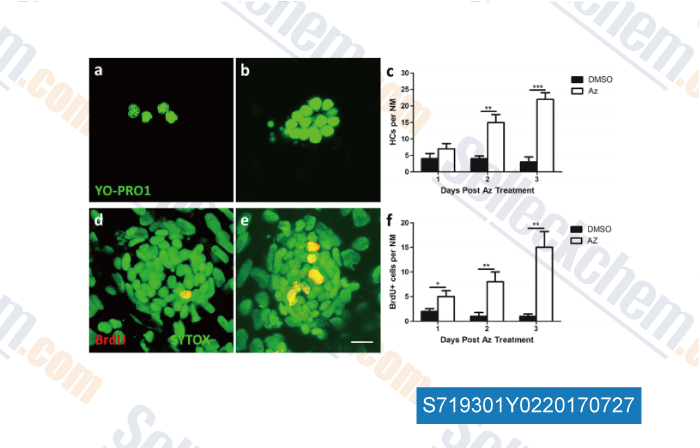
-
, , Mol Neurobiol, 2018, 55(2):1639-1651

-
, , Dev Genes Evol, 2015, 225(1):47-53.

-
Daten von [ , , Mol Cancer Ther, 2018, 17(1):232-242 ]
Sellecks 1-Azakenpaullone Wurde zitiert von 18 Publikationen
| Bisphenol A impairs developmental potential of mouse blastoids through oxidative stress [ Environ Int, 2025, 204:109820] | PubMed: 41033068 |
| Cellular remodeling and JAK inhibition promote zygotic gene expression in the Ciona germline [ EMBO Rep, 2024, 25(5):2188-2201] | PubMed: 38649664 |
| Patterns of NFkB activation resulting from damage, reactive microglia, cytokines, and growth factors in the mouse retina [ Exp Neurol, 2023, 359:114233] | PubMed: 36174748 |
| Induction of mouse totipotent stem cells by a defined chemical cocktail [ Nature, 2022, 10.1038/s41586-022-04967-9] | PubMed: 35728625 |
| Filamin C regulates skeletal muscle atrophy by stabilizing dishevelled-2 to inhibit autophagy and mitophagy [ Mol Ther Nucleic Acids, 2022, 27:147-164] | PubMed: 34976434 |
| Establishment and characterization of immortalized sweat gland myoepithelial cells [ Sci Rep, 2022, 12(1):7] | PubMed: 34997030 |
| Modulation of Neuroinflammatory Signaling Enhances the Neurogenic Reprogramming Capacity of Müller Glia Across Species [ The Ohio State University, 2021, ] | PubMed: None |
| Overexpression of ubiquitin-conjugating enzyme E2 L3 in hepatocellular carcinoma potentiates apoptosis evasion by inhibiting the GSK3β/p65 pathway. [ Cancer Lett, 2020, 1;481:1-14] | PubMed: 32268166 |
| A novel human colon signet-ring cell carcinoma organoid line: establishment, characterization and application [ Carcinogenesis, 2020, 41(7):993-1004] | PubMed: 31740922 |
| BYSL Promotes Glioblastoma Cell Migration, Invasion, and Mesenchymal Transition Through the GSK-3β/β-Catenin Signaling Pathway [ Front Oncol, 2020, 10:565225] | PubMed: 33178594 |
RÜCKGABERICHTLINIE
Die bedingungslose Rückgaberichtlinie von Selleck Chemical gewährleistet unseren Kunden ein reibungsloses Online-Einkaufserlebnis. Wenn Sie in irgendeiner Weise mit Ihrem Kauf unzufrieden sind, können Sie jeden Artikel innerhalb von 7 Tagen nach Erhalt zurückgeben. Im Falle von Produktqualitätsproblemen, sei es protokollbezogene oder produktbezogene Probleme, können Sie jeden Artikel innerhalb von 365 Tagen ab dem ursprünglichen Kaufdatum zurückgeben. Bitte befolgen Sie die nachstehenden Anweisungen, wenn Sie Produkte zurücksenden.
VERSAND UND LAGERUNG
Selleck-Produkte werden bei Raumtemperatur transportiert. Wenn Sie das Produkt bei Raumtemperatur erhalten, seien Sie versichert, dass die Qualitätskontrollabteilung von Selleck Experimente durchgeführt hat, um zu überprüfen, dass die normale Temperaturplatzierung von einem Monat die biologische Aktivität von Pulverprodukten nicht beeinträchtigt. Nach dem Sammeln lagern Sie das Produkt bitte gemäß den in der Datenblatt beschriebenen Anforderungen. Die meisten Selleck-Produkte sind unter den empfohlenen Bedingungen stabil.
NICHT FÜR DIE ANWENDUNG AM MENSCHEN, FÜR VETERINÄRMEDIZINISCHE DIAGNOSTIK ODER THERAPEUTISCHE ZWECKE.