
Technische Daten
| Formel | C11H8O4 |
||||||
| Molekulargewicht | 204.18 | CAS-Nr. | 14003-96-4 | ||||
| Löslichkeit (25°C)* | In vitro | DMSO | 41 mg/mL (200.8 mM) | ||||
| Water | Insoluble | ||||||
| Ethanol | Insoluble | ||||||
| In vivo (Lösungsmittel einzeln und der Reihe nach zum Produkt hinzufügen.) |
|
||||||
|
* <1 mg/ml bedeutet schwer löslich oder unlöslich. * Bitte beachten Sie, dass Selleck die Löslichkeit aller Verbindungen intern testet und die tatsächliche Löslichkeit geringfügig von veröffentlichten Werten abweichen kann. Dies ist normal und ist auf geringfügige Batch-zu-Batch-Variationen zurückzuführen. * Versand bei Raumtemperatur (Stabilitätstests zeigen, dass dieses Produkt ohne Kühlmaßnahmen versendet werden kann.) |
|||||||
Vorbereitung von Stammlösungen
Biologische Aktivität
| Beschreibung | 4μ8C (IRE1 Inhibitor III) ist ein potenter und selektiver IRE1 RNase-Inhibitor mit einer IC50 von 76 nM. | ||
|---|---|---|---|
| Ziele |
|
||
| In vitro | 4μ8C blockiert den Zugang des Substrats (RIDD) zum aktiven Zentrum von IRE1 und inaktiviert selektiv sowohl das Spleißen von Xbp1 als auch den IRE1-vermittelten mRNA-Abbau. Die IRE1-Inhibition induziert anschließend ER stress ohne messbare akute Toxizität. 4μ8C blockiert als IRE1-Inhibitor die Produktion von IL-4, IL-5 und IL-13 aus CD4+ T-Zellen. |
||
| In vivo | 4μ8c ist ein IRE1 Inhibitor III, der atherosklerotische Läsionen reduziert und die Plaqueentwicklung bei Mäusen wirksam mildert. |
||
| Merkmale | IRE1-RNase-selektiver Inhibitor, der als Plattform für die Entwicklung neuer lokal wirksamer Medikamente verwendet wird. |
Protokoll (aus Referenz)
| Kinase-Assay: |
|
|---|---|
| Zell-Assay: |
|
| Tierstudie: |
|
Referenzen
|
Kundenproduktvalidierung

-
Daten von [ , , Free Radic Biol Med, 2018, 124:395-407 ]
-
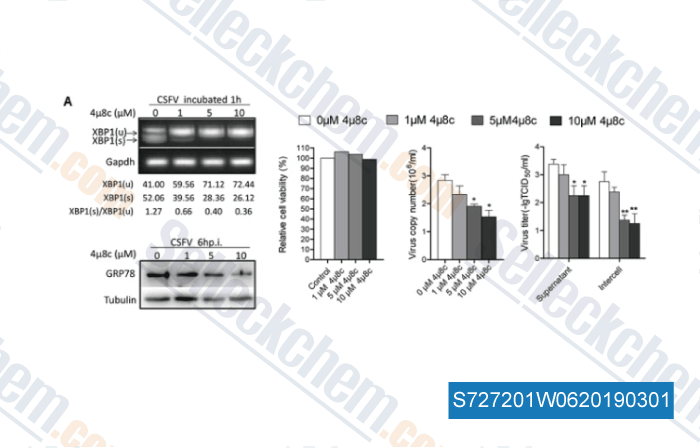
Daten von [ , , Front Microbiol, 2017, 8:2129 ]
-
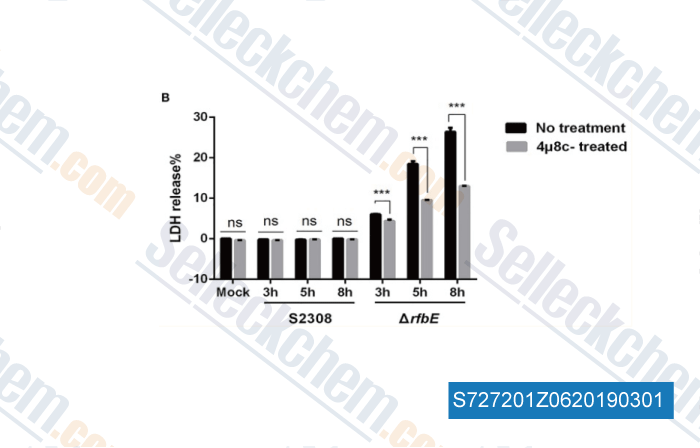
Daten von [ , , Front Cell Infect Microbiol, 2017, 7:422 ]
-
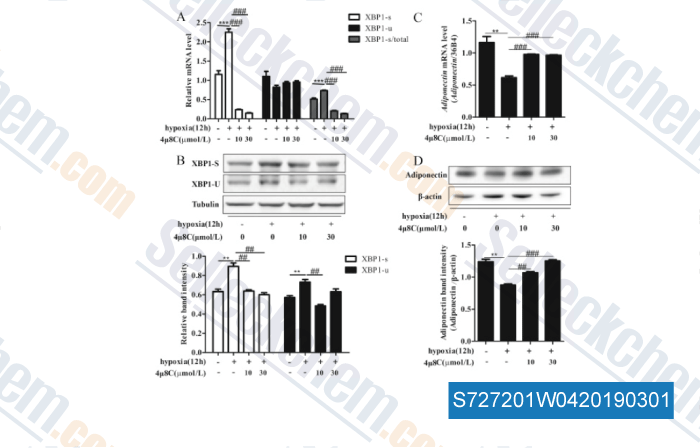
Daten von [ , , Biochem Biophys Res Commun, 2017, 493(1):346-351 ]
Sellecks 4μ8C Wurde zitiert von 57 Publikationen
| TaIRE1-mediated unconventional splicing of the TabZIP60 mRNA and the miR172 precursor regulates heat stress tolerance in wheat [ J Integr Plant Biol, 2025, 67(9):2388-2400.] | PubMed: 40607649 |
| TaIRE1-mediated unconventional splicing of the TabZIP60 mRNA and the miR172 precursor regulates heat stress tolerance in wheat [ J Integr Plant Biol, 2025, 10.1111/jipb.13963] | PubMed: 40607649 |
| The IRE1α/XBP1-mediated upregulation of LMTK2 attenuates endoplasmic reticulum stress by enhancing autophagic activity [ Cancer Lett, 2025, 633:217993] | PubMed: 40834986 |
| Curcumin Attenuates Fumonisin B1-Induced PK-15 Cell Apoptosis by Upregulating miR-1249 Expression to Inhibit the IRE1/MKK7/JNK/CASPASE3 Signaling Pathway [ Antioxidants (Basel), 2025, 14(2)168] | PubMed: 40002355 |
| Mitochondrial ROS-ER Stress Axis Governs IL-10 Production in Neutrophils and Regulates Inflammation in Murine Chlamydia pneumoniae Lung Infection [ Cells, 2025, 14(19)1523] | PubMed: 41090752 |
| Oridonin alleviates SiNPs-induced pulmonary fibrosis by inhibiting pyroptosis via IRE1α-XBP1s-NLRP3 pathway [ Int Immunopharmacol, 2025, 164:115388] | PubMed: 40845545 |
| PERK Regulates Epithelial-Mesenchymal Transition Through Autophagy and Lipid Metabolism in Lens Epithelial Cells [ Invest Ophthalmol Vis Sci, 2025, 66(5):35] | PubMed: 40408092 |
| MAM-Mediated Mitochondrial Ca2+ Overload and Endoplasmic Reticulum Stress Aggravates Synaptic Plasticity Impairment in Diabetic Mice [ Brain Sci, 2025, 15(11)1157] | PubMed: 41300164 |
| TMED4 facilitates regulatory T cell suppressive function via ROS homeostasis in tumor and autoimmune mouse models [ J Clin Invest, 2024, 135(1)e179874] | PubMed: 39480507 |
| MANF facilitates breast cancer cell survival under glucose-starvation conditions via PRKN-mediated mitophagy regulation [ Autophagy, 2024, 1-22.] | PubMed: 39147386 |
RÜCKGABERICHTLINIE
Die bedingungslose Rückgaberichtlinie von Selleck Chemical gewährleistet unseren Kunden ein reibungsloses Online-Einkaufserlebnis. Wenn Sie in irgendeiner Weise mit Ihrem Kauf unzufrieden sind, können Sie jeden Artikel innerhalb von 7 Tagen nach Erhalt zurückgeben. Im Falle von Produktqualitätsproblemen, sei es protokollbezogene oder produktbezogene Probleme, können Sie jeden Artikel innerhalb von 365 Tagen ab dem ursprünglichen Kaufdatum zurückgeben. Bitte befolgen Sie die nachstehenden Anweisungen, wenn Sie Produkte zurücksenden.
VERSAND UND LAGERUNG
Selleck-Produkte werden bei Raumtemperatur transportiert. Wenn Sie das Produkt bei Raumtemperatur erhalten, seien Sie versichert, dass die Qualitätskontrollabteilung von Selleck Experimente durchgeführt hat, um zu überprüfen, dass die normale Temperaturplatzierung von einem Monat die biologische Aktivität von Pulverprodukten nicht beeinträchtigt. Nach dem Sammeln lagern Sie das Produkt bitte gemäß den in der Datenblatt beschriebenen Anforderungen. Die meisten Selleck-Produkte sind unter den empfohlenen Bedingungen stabil.
NICHT FÜR DIE ANWENDUNG AM MENSCHEN, FÜR VETERINÄRMEDIZINISCHE DIAGNOSTIK ODER THERAPEUTISCHE ZWECKE.