
Technische Daten
| Formel | C18H17FN4O |
||||||
| Molekulargewicht | 324.35 | CAS-Nr. | 934162-61-5 | ||||
| Löslichkeit (25°C)* | In vitro | DMSO | 33 mg/mL (101.74 mM) | ||||
| Water | Insoluble | ||||||
| Ethanol | Insoluble | ||||||
| In vivo (Lösungsmittel einzeln und der Reihe nach zum Produkt hinzufügen.) |
|
||||||
|
* <1 mg/ml bedeutet schwer löslich oder unlöslich. * Bitte beachten Sie, dass Selleck die Löslichkeit aller Verbindungen intern testet und die tatsächliche Löslichkeit geringfügig von veröffentlichten Werten abweichen kann. Dies ist normal und ist auf geringfügige Batch-zu-Batch-Variationen zurückzuführen. * Versand bei Raumtemperatur (Stabilitätstests zeigen, dass dieses Produkt ohne Kühlmaßnahmen versendet werden kann.) |
|||||||
Vorbereitung von Stammlösungen
Biologische Aktivität
| Beschreibung | A-966492 ist ein neuartiger und potenter Inhibitor von PARP1 und PARP2 mit einem Ki von 1 nM bzw. 1,5 nM. | ||||||
|---|---|---|---|---|---|---|---|
| Ziele |
|
||||||
| In vitro | A-966492 is one of the most potent PARP inhibitors. This compound displays excellent potency against the PARP-1 enzyme with a Kiof 1 nM and an EC50 of 1 nM in a whole cell assay. It significantly enhances the efficacy of TMZ in a dose-dependent manner. In addition, this chemical is orally bioavailable across multiple species, crosses the blood−brain barrier, and appears to distribute into tumor tissue. It represents a promising, structurally diverse benzimidazole analogue and is being further characterized preclinically. |
||||||
| In vivo | A-966492 also demonstrates good in vivo efficacy in a B16F10 subcutaneous murine melanoma model in combination and in an MX-1 breast cancer xenograft model both as a single agent and in combination. In addition, this compound has excellent pharmaceutical properties and has demonstrated in vivo efficacy in preclinical mouse tumor models in combination with TMZ, as well as single agent activity in a BRCA1-deficient MX-1 tumor model. It is further characterized in Sprague−Dawley rats, beagle dogs, and cynomolgus monkeys, with this chemical demonstrating oral bioavailabilities of 34−72% and half-lives of 1.7−1.9 hours. In vivo, it demonstrates significant enhancement of the efficacy of TMZ in a murine B16F10 syngeneic melanoma model, with the combination groups showing superior efficacy. |
||||||
| Merkmale | Ein vielversprechendes, strukturell vielfältiges Benzimidazol-Analogon, das präklinisch weiter charakterisiert wird. |
Protokoll (aus Referenz)
| Kinase-Assay: |
|
|---|---|
| Zell-Assay: |
|
| Tierstudie: |
|
Referenzen
|
Kundenproduktvalidierung
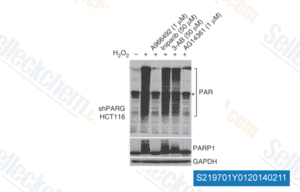
-
Daten von [ Nat Methods , 2013 , 10(10), 981-4 ]
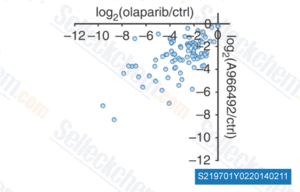
-
Daten von [ Nat Methods , 2013 , 10(10), 981-4 ]
Selleck's A-966492 Wurde zitiert von 15 Publikationen
| Response of Breast Cancer Cells to PARP Inhibitors Is Independent of BRCA Status [ Journal of Clinical Medicine, March 30, 2020, 940] | PubMed: 32235451 |
| Selectivity profile of the poly(ADP-ribose) polymerase (PARP) inhibitor, A-966492 [ bioRxiv, March 23, 2017, nan] | |
| PARP1 Suppresses the Transcription of PD-L1 by Poly(ADP-Ribosyl)ating STAT3 [ Cancer Immunology Research, January 2019, 136-149] | PubMed: 30401677 |
| Histone Parylation factor 1 contributes to the inhibition of PARP1 by cancer drugs [ Nat Commun, 2021, 12(1):736] | PubMed: 33531508 |
| Pharmacological Poly (ADP-Ribose) Polymerase Inhibitors Decrease Mycobacterium tuberculosis Survival in Human Macrophages [ Front Immunol, 2021, 12:712021] | PubMed: 34899683 |
| CRISPR screening identifies novel PARP inhibitor classification based on distinct base excision repair pathway dependencies [ bioRxiv, 2021, 10.1101/2020.10.18.333070] | PubMed: None |
| Response of Breast Cancer Cells to PARP Inhibitors Is Independent of BRCA Status [ Journal of Clinical Medicine, 2020, 940] | PubMed: 32235451 |
| Response of Breast Cancer Cells to PARP Inhibitors Is Independent of BRCA Status. [ J Clin Med, 2020, 30;9(4)] | PubMed: 32235451 |
| [ Cancer Immunol Res, 2019, ] | PubMed: 30401677 |
| PARP1 Suppresses the Transcription of PD-L1 by Poly(ADP-Ribosyl)ating STAT3 [ Cancer Immunology Research, 2019, 136-149] | PubMed: 30401677 |
RÜCKGABERICHTLINIE
Die bedingungslose Rückgaberichtlinie von Selleck Chemical gewährleistet unseren Kunden ein reibungsloses Online-Einkaufserlebnis. Wenn Sie in irgendeiner Weise mit Ihrem Kauf unzufrieden sind, können Sie jeden Artikel innerhalb von 7 Tagen nach Erhalt zurückgeben. Im Falle von Produktqualitätsproblemen, sei es protokollbezogene oder produktbezogene Probleme, können Sie jeden Artikel innerhalb von 365 Tagen ab dem ursprünglichen Kaufdatum zurückgeben. Bitte befolgen Sie die nachstehenden Anweisungen, wenn Sie Produkte zurücksenden.
VERSAND UND LAGERUNG
Selleck-Produkte werden bei Raumtemperatur transportiert. Wenn Sie das Produkt bei Raumtemperatur erhalten, seien Sie versichert, dass die Qualitätskontrollabteilung von Selleck Experimente durchgeführt hat, um zu überprüfen, dass die normale Temperaturplatzierung von einem Monat die biologische Aktivität von Pulverprodukten nicht beeinträchtigt. Nach dem Sammeln lagern Sie das Produkt bitte gemäß den in der Datenblatt beschriebenen Anforderungen. Die meisten Selleck-Produkte sind unter den empfohlenen Bedingungen stabil.
NICHT FÜR DIE ANWENDUNG AM MENSCHEN, FÜR VETERINÄRMEDIZINISCHE DIAGNOSTIK ODER THERAPEUTISCHE ZWECKE.