
Technische Daten
| Formel | C20H20ClN3 |
||||||
| Molekulargewicht | 337.85 | CAS-Nr. | 857531-00-1 | ||||
| Löslichkeit (25°C)* | In vitro | DMSO | 68 mg/mL (201.27 mM) | ||||
| Ethanol | 5 mg/mL (14.79 mM) | ||||||
| Water | Insoluble | ||||||
| In vivo (Lösungsmittel einzeln und der Reihe nach zum Produkt hinzufügen.) |
|
||||||
|
* <1 mg/ml bedeutet schwer löslich oder unlöslich. * Bitte beachten Sie, dass Selleck die Löslichkeit aller Verbindungen intern testet und die tatsächliche Löslichkeit geringfügig von veröffentlichten Werten abweichen kann. Dies ist normal und ist auf geringfügige Batch-zu-Batch-Variationen zurückzuführen. * Versand bei Raumtemperatur (Stabilitätstests zeigen, dass dieses Produkt ohne Kühlmaßnahmen versendet werden kann.) |
|||||||
Vorbereitung von Stammlösungen
Biologische Aktivität
| Beschreibung | AT7867 ist ein potenter ATP-kompetitiver Inhibitor von Akt1/2/3 und p70S6K/PKA mit IC50 von 32 nM/17 nM/47 nM bzw. 85 nM/20 nM in zellfreien Assays; diese Verbindung zeigt geringe Aktivität außerhalb der AGC-Kinase-Familie. | |||||||||||
|---|---|---|---|---|---|---|---|---|---|---|---|---|
| Ziele |
|
|||||||||||
| In vitro | AT7867 hemmt auch die strukturell verwandten AGC-Kinasen p70S6K und PKA mit IC50 von 20 nM bzw. 85 nM. Diese Verbindung zeigt ATP-kompetitive Aktivität gegenüber Akt2 mit einem Ki von 18 nM. Sie zeigt eine Antiproliferation in Zelllinien mit PTEN- oder PIK3CA-Mutationen und ist sehr potent gegenüber MES-SA, MDA-MB-468, MCF-7, HCT116 und HT29 mit IC50 von 0,94 μM, 2,26 μM, 1,86 μM, 1,76 μM bzw. 3,04 μM. Diese Chemikalie unterdrückt auch das Zellwachstum von U87MG-, PC-3- und DU145-Zellen mit IC50 von 8,22 μM, 10,37 μM bzw. 11,86 μM. Sie unterdrückt die Akt-Aktivität durch Hemmung der Phosphorylierung von GSK-3β in menschlichen Tumorzellen mit IC50 von 2-4 μM. Diese Verbindung induziert auch die Phosphorylierung der folgenden direkten Akt-Substrate, einschließlich der proapoptotischen Transkriptionsfaktoren FKHR (FoxO1a), FKHRL1 (FoxO3a) und des nachgeschalteten Ziels S6RP in U87MG-Zellen. | |||||||||||
| In vivo | AT7867 zeigt eine Bioverfügbarkeit von 44% bei Mäusen über den p.o.-Weg. Diese Verbindung konnte das gespaltene PARP in MES-SA-Xenotransplantaten bei 20 mg/kg i.p. oder 90 mg/kg p.o. erhöhen. Sie hemmt signifikant das Tumorwachstum in MES-SA-Xenotransplantaten oder U87MG-Xenotransplantaten mit T/C von 0,37 bzw. 0,51. | |||||||||||
| Dichte | 1.214 g/mL | |||||||||||
Protokoll (aus Referenz)
| Kinase-Assay:[1] |
|
|---|---|
| Zell-Assay:[1] |
|
| Tierstudie:[1] |
|
Referenzen
|
Kundenproduktvalidierung
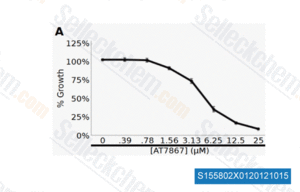
-
, , Mark Axelrod of University Of Virginia
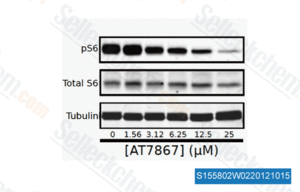
-
, , Mark Axelrod of University Of Virginia
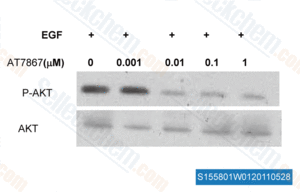
-
, , Dr. Zhang of Tianjin Medical University
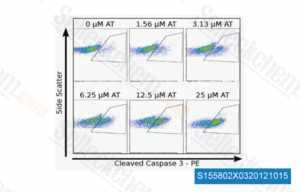
-
, , Mark Axelrod of University Of Virginia
Sellecks AT7867 Wurde zitiert von 27 Publikationen
| Functional restoration of lysosomes and mitochondria through modulation of AKT activity ameliorates senescence [ Exp Gerontol, 2023, 173:112091] | PubMed: 36657533 |
| Inhibition of IκB Kinase Is a Potential Therapeutic Strategy to Circumvent Resistance to Epidermal Growth Factor Receptor Inhibition in Triple-Negative Breast Cancer Cells [ Cancers (Basel), 2022, 14(21)5215] | PubMed: 36358633 |
| The PKN1- TRAF1 signaling axis as a potential new target for chronic lymphocytic leukemia [ Oncoimmunology, 2021, 10(1):1943234] | PubMed: 34589290 |
| Dual Inhibition of AKT and MEK Pathways Potentiates the Anti-Cancer Effect of Gefitinib in Triple-Negative Breast Cancer Cells [ Cancers (Basel), 2021, 13(6)1205] | PubMed: 33801977 |
| Combined Omics Approaches Reveal the Roles of Non-canonical WNT7B Signaling and YY1 in the Proliferation of Human Pancreatic Progenitor Cells [ Cell Chem Biol, 2020, S2451-9456(20)30340-8] | PubMed: 33125912 |
| A positive feedback loop formed by NGFR and FOXP3 contributes to the resistance of non-small cell lung cancer to icotinib [ Transl Cancer Res, 2020, 9(2):1044-1052] | PubMed: 35117449 |
| Genipin, a natural AKT inhibitor, targets the PH domain to affect downstream signaling and alleviates inflammation [ Biochem Pharmacol, 2019, 170:113660] | PubMed: 31605673 |
| A natural AKT inhibitor swertiamarin targets AKT-PH domain, inhibits downstream signaling, and alleviates inflammation. [ FEBS J, 2019, 10.1111/febs.15112] | PubMed: 31665825 |
| Inhibitors of AKT kinase increase LDL receptor mRNA expression by two different mechanisms [ PLoS One, 2019, 14(6):e0218537] | PubMed: 31216345 |
| The flavonoid baicalin improves glucose metabolism by targeting the PH domain of AKT and activating AKT/GSK3β phosphorylation. [ FEBS Lett, 2019, 593(2):175-186] | PubMed: 30489635 |
RÜCKGABERICHTLINIE
Die bedingungslose Rückgaberichtlinie von Selleck Chemical gewährleistet unseren Kunden ein reibungsloses Online-Einkaufserlebnis. Wenn Sie in irgendeiner Weise mit Ihrem Kauf unzufrieden sind, können Sie jeden Artikel innerhalb von 7 Tagen nach Erhalt zurückgeben. Im Falle von Produktqualitätsproblemen, sei es protokollbezogene oder produktbezogene Probleme, können Sie jeden Artikel innerhalb von 365 Tagen ab dem ursprünglichen Kaufdatum zurückgeben. Bitte befolgen Sie die nachstehenden Anweisungen, wenn Sie Produkte zurücksenden.
VERSAND UND LAGERUNG
Selleck-Produkte werden bei Raumtemperatur transportiert. Wenn Sie das Produkt bei Raumtemperatur erhalten, seien Sie versichert, dass die Qualitätskontrollabteilung von Selleck Experimente durchgeführt hat, um zu überprüfen, dass die normale Temperaturplatzierung von einem Monat die biologische Aktivität von Pulverprodukten nicht beeinträchtigt. Nach dem Sammeln lagern Sie das Produkt bitte gemäß den in der Datenblatt beschriebenen Anforderungen. Die meisten Selleck-Produkte sind unter den empfohlenen Bedingungen stabil.
NICHT FÜR DIE ANWENDUNG AM MENSCHEN, FÜR VETERINÄRMEDIZINISCHE DIAGNOSTIK ODER THERAPEUTISCHE ZWECKE.