
Technische Daten
| Formel | C19H23N7O2 |
||||||
| Molekulargewicht | 381.43 | CAS-Nr. | 896466-04-9 | ||||
| Löslichkeit (25°C)* | In vitro | DMSO | 76 mg/mL (199.25 mM) | ||||
| Ethanol | 76 mg/mL (199.25 mM) | ||||||
| Water | Insoluble | ||||||
| In vivo (Lösungsmittel einzeln und der Reihe nach zum Produkt hinzufügen.) |
|
||||||
|
* <1 mg/ml bedeutet schwer löslich oder unlöslich. * Bitte beachten Sie, dass Selleck die Löslichkeit aller Verbindungen intern testet und die tatsächliche Löslichkeit geringfügig von veröffentlichten Werten abweichen kann. Dies ist normal und ist auf geringfügige Batch-zu-Batch-Variationen zurückzuführen. * Versand bei Raumtemperatur (Stabilitätstests zeigen, dass dieses Produkt ohne Kühlmaßnahmen versendet werden kann.) |
|||||||
Vorbereitung von Stammlösungen
Biologische Aktivität
| Beschreibung | AT9283 ist ein potenter JAK2/3-Inhibitor mit einer IC50 von 1,2 nM/1,1 nM in zellfreien Assays; auch potent gegen Aurora A/B, Abl1(T315I). | |||||||||||
|---|---|---|---|---|---|---|---|---|---|---|---|---|
| Ziele |
|
|||||||||||
| In vitro | AT9283 führt zu einem klaren polyploiden Phänotyp, indem es die Aktivität der Aurora B Kinase in HCT116-Zellen mit einer IC50 von 30 nM hemmt. Darüber hinaus hemmt diese Verbindung auch die Koloniebildung von HCT116. |
|||||||||||
| In vivo | Bei HCT116-Mäusen mit menschlichem Kolonkarzinom-Xenotransplantat führt die AT9283-Behandlung (15 mg/kg und 20 mg/kg) über 16 Tage zu einer signifikanten Hemmung des Tumorwachstums von 67 % bzw. 76 %. Darüber hinaus weist diese Verbindung auch eine signifikant längere Halbwertszeit in Tumoren (2,5 Stunden) im Vergleich zum Plasma (0,5 Stunden) und eine moderate orale Bioverfügbarkeit bei Mäusen (Fp.o. = 24 %) auf. |
Protokoll (aus Referenz)
| Kinase-Assay: |
|
|---|---|
| Zell-Assay: |
|
| Tierstudie: |
|
Referenzen
|
Kundenproduktvalidierung
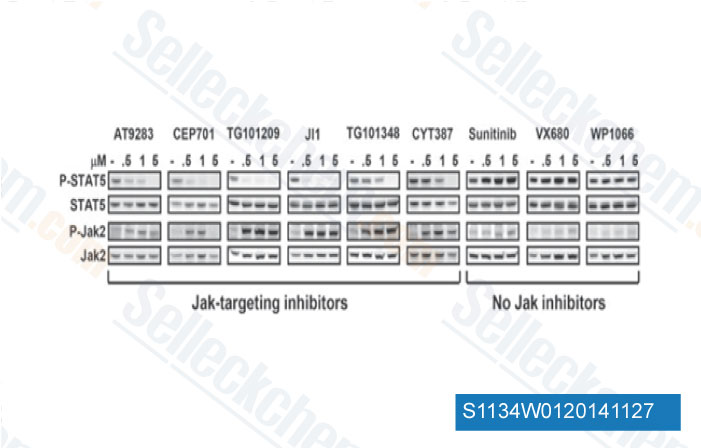
-
Daten von [ J Cell Mol Med , 2013 , 17(2), 265-76 ]
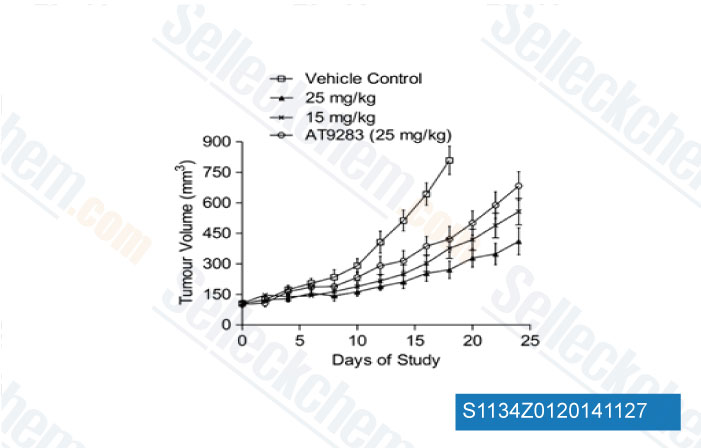
-
Daten von [ Drug Development Reseach , 2013 , 272-281 ]
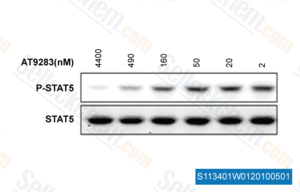
-
, , Dr. Claude Haan and Catherine Rolvering of Universite du Luxembourg
Sellecks AT9283 Wurde zitiert von 37 Publikationen
| Overcoming MET-targeted drug resistance in MET-amplified lung cancer by aurora kinase B inhibition [ Biochim Biophys Acta Mol Cell Res, 2025, 1872(7):120001] | PubMed: 40499687 |
| FAM207A acts as a novel and potential biomarker in lung adenocarcinoma and shapes the immunesuppressive tumor microenvironment [ Clin Exp Med, 2025, 25(1):125] | PubMed: 40259152 |
| Molecular basis of JAK kinase regulation guiding therapeutic approaches: Evaluating the JAK3 pseudokinase domain as a drug target [ Adv Biol Regul, 2025, 95:101072] | PubMed: 39755448 |
| DLGAP5 promotes lung adenocarcinoma growth via upregulating PLK1 and serves as a therapeutic target [ J Transl Med, 2024, 22(1):209] | PubMed: 38414025 |
| Regulation of Cell Cycle Progression through RB Phosphorylation by Nilotinib and AT-9283 in Human Melanoma A375P Cells [ Int J Mol Sci, 2024, 25(5)2956] | PubMed: 38474202 |
| Selective impact of ALK and MELK inhibition on ERα stability and cell proliferation in cell lines representing distinct molecular phenotypes of breast cancer [ Sci Rep, 2024, 14(1):8200] | PubMed: 38589728 |
| The Aurora kinase inhibitor AT9283 inhibits Burkitt lymphoma growth by regulating Warburg effect [ PeerJ, 2023, 11:e16581] | PubMed: 38099309 |
| Selective Impact of ALK and MELK Inhibition on ERα Stability and Cell Proliferation in Cell Lines Representing Distinct Molecular Phenotypes of Breast Cancer [ bioRxiv, 2023, 10.1101/2023.12.19.572304] | PubMed: none |
| Inhibition of IκB Kinase Is a Potential Therapeutic Strategy to Circumvent Resistance to Epidermal Growth Factor Receptor Inhibition in Triple-Negative Breast Cancer Cells [ Cancers (Basel), 2022, 14(21)5215] | PubMed: 36358633 |
| PERV induces CXCL10 in human monocytes and monocyte-derived primary cells [ Intervirology, 2022, 10.1159/000527074] | PubMed: 36382641 |
RÜCKGABERICHTLINIE
Die bedingungslose Rückgaberichtlinie von Selleck Chemical gewährleistet unseren Kunden ein reibungsloses Online-Einkaufserlebnis. Wenn Sie in irgendeiner Weise mit Ihrem Kauf unzufrieden sind, können Sie jeden Artikel innerhalb von 7 Tagen nach Erhalt zurückgeben. Im Falle von Produktqualitätsproblemen, sei es protokollbezogene oder produktbezogene Probleme, können Sie jeden Artikel innerhalb von 365 Tagen ab dem ursprünglichen Kaufdatum zurückgeben. Bitte befolgen Sie die nachstehenden Anweisungen, wenn Sie Produkte zurücksenden.
VERSAND UND LAGERUNG
Selleck-Produkte werden bei Raumtemperatur transportiert. Wenn Sie das Produkt bei Raumtemperatur erhalten, seien Sie versichert, dass die Qualitätskontrollabteilung von Selleck Experimente durchgeführt hat, um zu überprüfen, dass die normale Temperaturplatzierung von einem Monat die biologische Aktivität von Pulverprodukten nicht beeinträchtigt. Nach dem Sammeln lagern Sie das Produkt bitte gemäß den in der Datenblatt beschriebenen Anforderungen. Die meisten Selleck-Produkte sind unter den empfohlenen Bedingungen stabil.
NICHT FÜR DIE ANWENDUNG AM MENSCHEN, FÜR VETERINÄRMEDIZINISCHE DIAGNOSTIK ODER THERAPEUTISCHE ZWECKE.