
Technische Daten
| Formel | C22H19ClN4O5 |
||||||
| Molekulargewicht | 454.86 | CAS-Nr. | 475108-18-0 | ||||
| Löslichkeit (25°C)* | In vitro | DMSO | 56 mg/mL (123.11 mM) | ||||
| Water | Insoluble | ||||||
| Ethanol | Insoluble | ||||||
| In vivo (Lösungsmittel einzeln und der Reihe nach zum Produkt hinzufügen.) |
|
||||||
|
* <1 mg/ml bedeutet schwer löslich oder unlöslich. * Bitte beachten Sie, dass Selleck die Löslichkeit aller Verbindungen intern testet und die tatsächliche Löslichkeit geringfügig von veröffentlichten Werten abweichen kann. Dies ist normal und ist auf geringfügige Batch-zu-Batch-Variationen zurückzuführen. * Versand bei Raumtemperatur (Stabilitätstests zeigen, dass dieses Produkt ohne Kühlmaßnahmen versendet werden kann.) |
|||||||
Vorbereitung von Stammlösungen
Biologische Aktivität
| Beschreibung | Tivozanib ist ein potenter und selektiver VEGFR-Inhibitor f r VEGFR1/2/3 mit IC50 von 30 nM/6,5 nM/15 nM und hemmt auch PDGFR und c-Kit, wobei eine geringe Aktivit t gegen FGFR-1, Flt3, c-Met, EGFR und IGF-1R beobachtet wurde. Phase 3. | |||||||||||
|---|---|---|---|---|---|---|---|---|---|---|---|---|
| Ziele |
|
|||||||||||
| In vitro | AV-951 ist ein neues Chinolin-Harnstoff-Derivat. AV-951 blockiert die VEGF-abh gige Aktivierung von Mitogen-aktivierten Proteinkinasen und die Proliferation von Endothelzellen. | |||||||||||
| In vivo | In-vivo-Studien zeigen, dass AV-951 auch die Mikrogendichte verringert und die VEGFR2-Phosphorylierungsniveaus in Tumor-Xenografts unterdr ckt, insbesondere bei einer Konzentration von 1 mg/kg (p.o. Verabreichung). AV-951 zeigt eine fast vollst ndige Hemmung des Wachstums von Tumor-Xenografts (TGI>85%) bei athymischen Ratten. Eine weitere Studie an einem Rattenmodell f r peritoneale disseminierte Tumore zeigt, dass AV-951 das berleben der tumorragenden Ratten mit einer MST von 53,5 Tagen verl ngern konnte. AV-951 zeigt Antitumoraktivit t gegen viele menschliche Tumor-Xenografts, einschlie lich Lungen-, Brust-, Darm-, Eierstock-, Bauchspeicheldr sen- und Prostatakrebs. |
Protokoll (aus Referenz)
| Kinase-Assay:[1] |
|
|---|---|
| Zell-Assay:[1] |
|
| Tierstudie:[1] |
|
Referenzen
|
Kundenproduktvalidierung
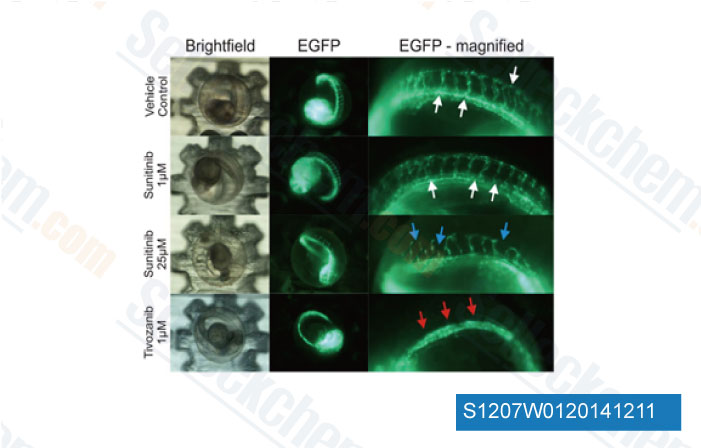
-
Daten von [ Cytometry A , 2014 , 85(6), 537-47 ]
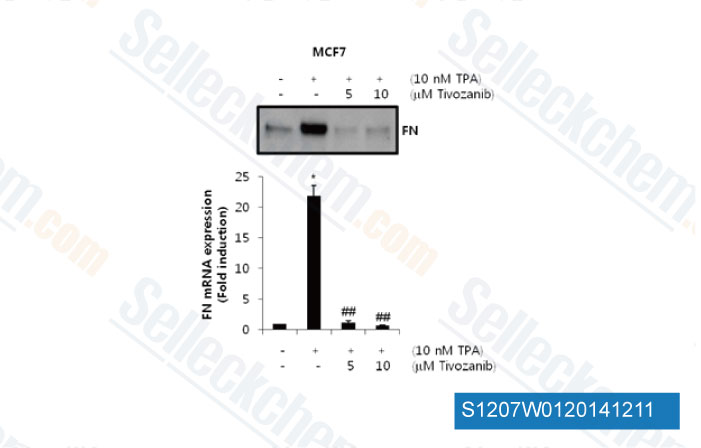
-
Daten von [ Cell Physiol Biochem , 2013 , 32(5), 1541-50 ]
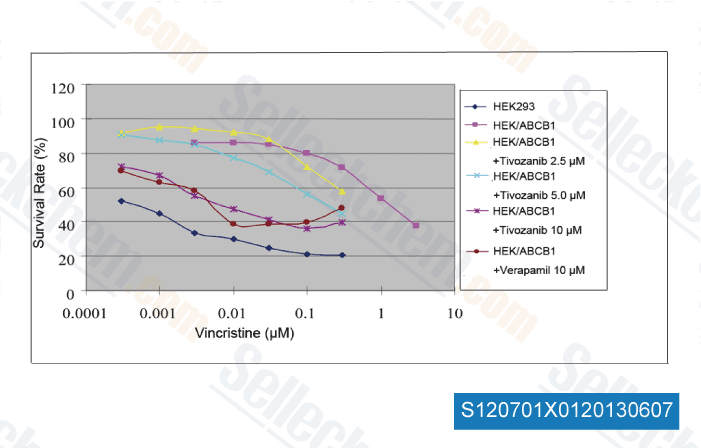
-
,
![<p> </p><p>Figure 7 shows the effect of Tivozanib on the accumulation of [<sup>3</sup>H]-mitoxantrone. The accumulation of [<sup>3</sup>H]-mitoxantrone in empty vector transfected HEK293/pcDNA3.1, ABCG2 vector transfected wild-type ABCG2-482-R2, mutant ABCG2-482-G2 and mutant ABCG2-482-T7 cells was measured by the Accumulation Assays. Columns are the mean of triplicate determinations; bars, SD. *P<0.05, **P<0.01 versus the control group. Fumitremorgin C (FTC) was used as a positive control of ABCG2 inhibitor.</p>](https://file.selleckchem.com/downloads/review/700px/Tivozanib-S120701Z0120130607.gif)
-
,
Sellecks Tivozanib Wurde zitiert von 42 Publikationen
| APOE- ε4-induced Fibronectin at the blood-brain barrier is a conserved pathological mediator of disrupted astrocyte-endothelia interaction in Alzheimer's disease [ bioRxiv, 2025, 2025.01.24.634732] | PubMed: 39975303 |
| Gliovascular transcriptional perturbations in Alzheimer's disease reveal molecular mechanisms of blood brain barrier dysfunction [ Nat Commun, 2024, 15(1):4758] | PubMed: 38902234 |
| Targeting PDGF signaling of cancer-associated fibroblasts blocks feedback activation of HIF-1α and tumor progression of clear cell ovarian cancer [ Cell Rep Med, 2024, S2666-3791(24)00201-5] | PubMed: 38670097 |
| Sensitizing cholangiocarcinoma to chemotherapy by inhibition of the drug-export pump MRP3 [ Biomed Pharmacother, 2024, 180:117533] | PubMed: 39405909 |
| Patient-derived rhabdomyosarcoma cells recapitulate the genetic and transcriptomic landscapes of primary tumors [ iScience, 2024, 27(10):110862] | PubMed: 39319271 |
| VEGF-A165a and angiopoietin-2 differently affect the barrier formed by retinal endothelial cells [ Exp Eye Res, 2024, 247:110062] | PubMed: 39187056 |
| ZDHHC2-Mediated AGK Palmitoylation Activates AKT-mTOR Signaling to Reduce Sunitinib Sensitivity in Renal Cell Carcinoma [ Cancer Res, 2023, 83(12):2034-2051] | PubMed: 37078777 |
| Relevance of the organic anion transporting polypeptide 1B3 (OATP1B3) in the personalized pharmacological treatment of hepatocellular carcinoma [ Biochem Pharmacol, 2023, 214:115681] | PubMed: 37429423 |
| Systematic identification of biomarker-driven drug combinations to overcome resistance [ Nat Chem Biol, 2022, 10.1038/s41589-022-00996-7] | PubMed: 35332332 |
| Impairment of the Retinal Endothelial Cell Barrier Induced by Long-Term Treatment with VEGF-A165 No Longer Depends on the Growth Factor's Presence [ Biomolecules, 2022, 12(5)734] | PubMed: 35625661 |
RÜCKGABERICHTLINIE
Die bedingungslose Rückgaberichtlinie von Selleck Chemical gewährleistet unseren Kunden ein reibungsloses Online-Einkaufserlebnis. Wenn Sie in irgendeiner Weise mit Ihrem Kauf unzufrieden sind, können Sie jeden Artikel innerhalb von 7 Tagen nach Erhalt zurückgeben. Im Falle von Produktqualitätsproblemen, sei es protokollbezogene oder produktbezogene Probleme, können Sie jeden Artikel innerhalb von 365 Tagen ab dem ursprünglichen Kaufdatum zurückgeben. Bitte befolgen Sie die nachstehenden Anweisungen, wenn Sie Produkte zurücksenden.
VERSAND UND LAGERUNG
Selleck-Produkte werden bei Raumtemperatur transportiert. Wenn Sie das Produkt bei Raumtemperatur erhalten, seien Sie versichert, dass die Qualitätskontrollabteilung von Selleck Experimente durchgeführt hat, um zu überprüfen, dass die normale Temperaturplatzierung von einem Monat die biologische Aktivität von Pulverprodukten nicht beeinträchtigt. Nach dem Sammeln lagern Sie das Produkt bitte gemäß den in der Datenblatt beschriebenen Anforderungen. Die meisten Selleck-Produkte sind unter den empfohlenen Bedingungen stabil.
NICHT FÜR DIE ANWENDUNG AM MENSCHEN, FÜR VETERINÄRMEDIZINISCHE DIAGNOSTIK ODER THERAPEUTISCHE ZWECKE.