
Technische Daten
| Formel | C26H30FN7O3 |
||||||||||
| Molekulargewicht | 507.56 | CAS-Nr. | 722544-51-6 | ||||||||
| Löslichkeit (25°C)* | In vitro | DMSO | 100 mg/mL (197.02 mM) | ||||||||
| Water | Insoluble | ||||||||||
| Ethanol | Insoluble | ||||||||||
| In vivo (Lösungsmittel einzeln und der Reihe nach zum Produkt hinzufügen.) |
|
||||||||||
|
* <1 mg/ml bedeutet schwer löslich oder unlöslich. * Bitte beachten Sie, dass Selleck die Löslichkeit aller Verbindungen intern testet und die tatsächliche Löslichkeit geringfügig von veröffentlichten Werten abweichen kann. Dies ist normal und ist auf geringfügige Batch-zu-Batch-Variationen zurückzuführen. * Versand bei Raumtemperatur (Stabilitätstests zeigen, dass dieses Produkt ohne Kühlmaßnahmen versendet werden kann.) |
|||||||||||
Vorbereitung von Stammlösungen
Biologische Aktivität
| Beschreibung | Defosbarasertib (AZD1152-HQPA, AZD2811, INH-34, Barasertib-HQPA) ist ein hochselektiver Aurora B Inhibitor mit einem IC50-Wert von 0,37 nM in einem zellfreien Assay, ~3700-fach selektiver für Aurora B als für Aurora A. Phase 1. | ||
|---|---|---|---|
| Ziele |
|
||
| In vitro | Barasertib (AZD1152-HQPA), ein hochselektiver Aurora B Inhibitor, verursacht Polyploidie und Apoptose in vielen Krebszelllinien. |
||
| In vivo | Barasertib (AZD1152-HQPA) ist ein Aurora B Kinase-Inhibitor und hat Wirksamkeit gegen RB1 / SCLC-Zelllinien-Xenografts, RB1 / SCLC PDXs und autochthone Rb1 / neuroendokrine Tumoren. |
Protokoll (aus Referenz)
| Zell-Assay: |
|
|---|
Referenzen
|
Kundenproduktvalidierung
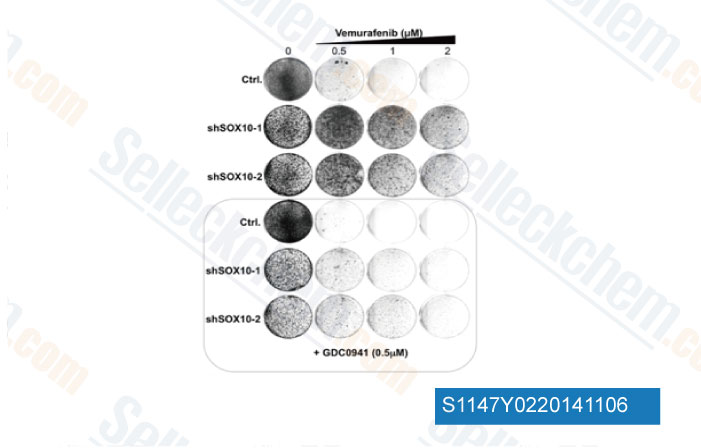
-
Daten von [ Nature , 2014 , 508(7494), 118-22 ]
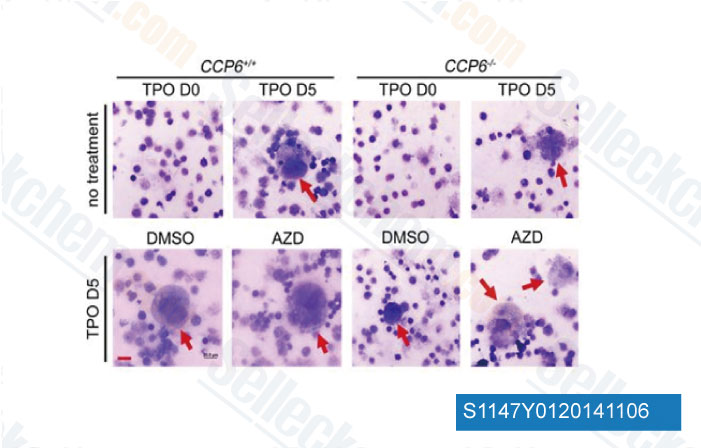
-
Daten von [ J Exp Med , 2014 , 10.1084/jem.20141123 ]
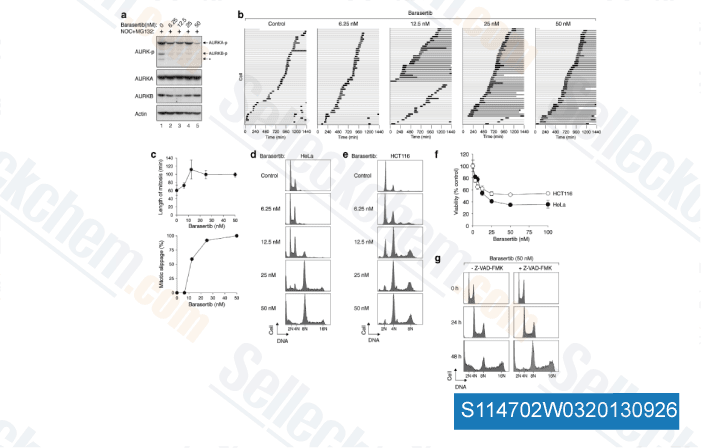
-
Daten von [ Oncogene , 2014 , 33, 3550-60 ]
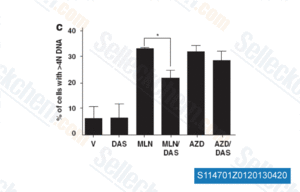
-
Daten von [ Oncogene , 2012 , 31, 1217–1227 ]
Sellecks Barasertib-HQPA (AZD2811) Wurde zitiert von 171 Publikationen
| High-throughput screening identifies Aurora kinase B as a critical therapeutic target for Merkel cell carcinoma [ Nat Commun, 2025, 16(1):1583] | PubMed: 39939315 |
| Unraveling AURKB as a potential therapeutic target in pulmonary hypertension using integrated transcriptomic analysis and pre-clinical studies [ Cell Rep Med, 2025, 6(2):101964] | PubMed: 39933527 |
| Aurora B controls microtubule stability to regulate abscission dynamics in stem cells [ Cell Rep, 2025, 44(2):115238] | PubMed: 39854207 |
| Identification of chemical inhibitors targeting long noncoding RNA through gene signature-based high throughput screening [ Int J Biol Macromol, 2025, 292:139119] | PubMed: 39722392 |
| Oversized cells activate global proteasome-mediated protein degradation to maintain cell size homeostasis [ Elife, 2025, 14e75393] | PubMed: 39791360 |
| The mechanoresponsive chromosomal passenger complex sustains furrow ingression under confinement [ J Mol Cell Biol, 2025, mjaf019] | PubMed: 40693957 |
| Overcoming MET-targeted drug resistance in MET-amplified lung cancer by aurora kinase B inhibition [ Biochim Biophys Acta Mol Cell Res, 2025, 1872(7):120001] | PubMed: 40499687 |
| Proteomic profiling identifies upregulation of aurora kinases causing resistance to taxane-type chemotherapy in triple negative breast cancer [ Sci Rep, 2025, 15(1):3211] | PubMed: 39863788 |
| Nucleosome stability safeguards cell identity, stress resilience and healthy aging [ bioRxiv, 2025, 2025.09.17.676776] | PubMed: 41000743 |
| Proteogenomic characterization of small cell lung cancer identifies biological insights and subtype-specific therapeutic strategies [ Cell, 2024, 187(1):184-203.e28] | PubMed: 38181741 |
RÜCKGABERICHTLINIE
Die bedingungslose Rückgaberichtlinie von Selleck Chemical gewährleistet unseren Kunden ein reibungsloses Online-Einkaufserlebnis. Wenn Sie in irgendeiner Weise mit Ihrem Kauf unzufrieden sind, können Sie jeden Artikel innerhalb von 7 Tagen nach Erhalt zurückgeben. Im Falle von Produktqualitätsproblemen, sei es protokollbezogene oder produktbezogene Probleme, können Sie jeden Artikel innerhalb von 365 Tagen ab dem ursprünglichen Kaufdatum zurückgeben. Bitte befolgen Sie die nachstehenden Anweisungen, wenn Sie Produkte zurücksenden.
VERSAND UND LAGERUNG
Selleck-Produkte werden bei Raumtemperatur transportiert. Wenn Sie das Produkt bei Raumtemperatur erhalten, seien Sie versichert, dass die Qualitätskontrollabteilung von Selleck Experimente durchgeführt hat, um zu überprüfen, dass die normale Temperaturplatzierung von einem Monat die biologische Aktivität von Pulverprodukten nicht beeinträchtigt. Nach dem Sammeln lagern Sie das Produkt bitte gemäß den in der Datenblatt beschriebenen Anforderungen. Die meisten Selleck-Produkte sind unter den empfohlenen Bedingungen stabil.
NICHT FÜR DIE ANWENDUNG AM MENSCHEN, FÜR VETERINÄRMEDIZINISCHE DIAGNOSTIK ODER THERAPEUTISCHE ZWECKE.