
Technische Daten
| Formel | C31H31ClFN7O2 |
||||||||||
| Molekulargewicht | 588.07 | CAS-Nr. | 1158838-45-9 | ||||||||
| Löslichkeit (25°C)* | In vitro | DMSO | 100 mg/mL (170.04 mM) | ||||||||
| Water | Insoluble | ||||||||||
| Ethanol | Insoluble | ||||||||||
| In vivo (Lösungsmittel einzeln und der Reihe nach zum Produkt hinzufügen.) |
|
||||||||||
|
* <1 mg/ml bedeutet schwer löslich oder unlöslich. * Bitte beachten Sie, dass Selleck die Löslichkeit aller Verbindungen intern testet und die tatsächliche Löslichkeit geringfügig von veröffentlichten Werten abweichen kann. Dies ist normal und ist auf geringfügige Batch-zu-Batch-Variationen zurückzuführen. * Versand bei Raumtemperatur (Stabilitätstests zeigen, dass dieses Produkt ohne Kühlmaßnahmen versendet werden kann.) |
|||||||||||
Vorbereitung von Stammlösungen
Biologische Aktivität
| Beschreibung | TCS7010 (Aurora A Inhibitor I) ist ein neuartiger, potenter und selektiver Inhibitor von Aurora A mit einem IC50 von 3,4 nM in einem zellfreien Assay. Er ist 1000-fach selektiver für Aurora A als für Aurora B und löst apoptosis über den ROS-vermittelten UPR-Signalweg aus. | ||
|---|---|---|---|
| Ziele |
|
||
| In vitro | TCS7010 (Aurora A Inhibitor I) ist ein 2,4-Dianilinopyrimidin, das Aurora A selektiv und potent hemmt. Es hemmt effektiv die Proliferation von HCT116- und HT29-Zellen mit einem IC50 von 190 nM bzw. 2,9 μM. Die Aurora A-Selektivität dieser Verbindung gegenüber Aurora B hängt von einer einzelnen Aminosäure (Thr217) von Aurora A ab. In KCL-22-Zellen erhöht es (1-5 μM) den G2/M-Zellanteil, induziert die Histon-H3-Serin-10-Phosphorylierung und unterdrückt die mitotische Aurora A-Autophosphorylierung an Thr288. Es (0,5-5 μM) unterdrückt auch die Zellproliferation in KCL-22-Zellen sowie in BCR-ABL-negativen Leukämiezelllinien KG-1 und HL-60. Diese Verbindung induziert effektiv Apoptose in KCL-22-Zellen bei 5 μM. In einer neueren Studie wurde auch festgestellt, dass es das Zellwachstum von HCT116-, HT29- und HeLa-Zellen hemmt, mit einem IC50 von 377,6 nM, 5,6 μM und 416 nM. |
||
| Merkmale | Aurora A Inhibitor I ist ein neuartiger, potenter und selektiver Inhibitor von Aurora A. |
Protokoll (aus Referenz)
| Kinase-Assay: |
|
|---|---|
| Zell-Assay: |
|
| Tierstudie: |
|
Referenzen
|
Kundenproduktvalidierung
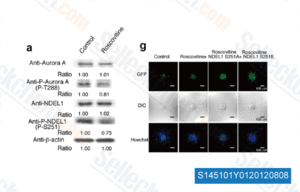
-
Daten von [ J Neurosci , 2012 , 32, 11050-11066 ]
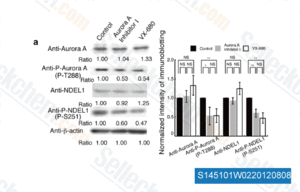
-
Daten von [ J Neurosci , 2012 , 32, 11050-11066 ]
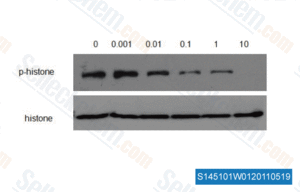
-
, , Dr. Zhang of Tianjin Medical University
Sellecks TCS7010 (Aurora A Inhibitor I) Wurde zitiert von 37 Publikationen
| ERK1-mediated GLYCTK2 phosphorylation promotes fructolysis to sustain glioblastoma survival under glucose deprivation [ Cell Death Discov, 2025, 11(1):266] | PubMed: 40467571 |
| ZO-2 is a scaffold at the centriole and mitotic spindle poles that enhances microtubule stability and supports the proper development of mitotic spindles and cilia [ Cell Tissue Res, 2025, 10.1007/s00441-025-03992-0] | PubMed: 40728639 |
| Primary Cilia Restrain PI3K-AKT Signaling to Orchestrate Human Decidualization [ Int J Mol Sci, 2022, 23(24)15573] | PubMed: 36555215 |
| Phospholipase D1 promotes astrocytic differentiation through the FAK/AURKA/STAT3 signaling pathway in hippocampal neural stem/progenitor cells [ Biochim Biophys Acta Mol Cell Res, 2022, 1869(12):119361] | PubMed: 36162649 |
| In vitro human cell-based aneugen molecular mechanism assay [ Environ Mol Mutagen, 2022, 63(3):151-161] | PubMed: 35426156 |
| Repression of the AURKA-CXCL5 axis induces autophagic cell death and promotes radiosensitivity in non-small-cell lung cancer [ Cancer Lett, 2021, 509:89-104] | PubMed: 33848520 |
| Aurora B-dependent polarization of the cortical actomyosin network during mitotic exit [ EMBO Rep, 2021, e52387] | PubMed: 34431205 |
| Exploiting loss of heterozygosity for allele-selective colorectal cancer chemotherapy. [ Nat Commun, 2020, 11(1):1308] | PubMed: 32161261 |
| MECP2 Mutations Affect Ciliogenesis: A Novel Perspective for Rett Syndrome and Related Disorders [ EMBO Mol Med, 2020, 8;e10270] | PubMed: 32383329 |
| ULK1-ATG13 and Their Mitotic Phospho-Regulation by CDK1 Connect Autophagy to Cell Cycle [ PLoS Biol, 2020, 9;18(6):e3000288] | PubMed: 32516310 |
RÜCKGABERICHTLINIE
Die bedingungslose Rückgaberichtlinie von Selleck Chemical gewährleistet unseren Kunden ein reibungsloses Online-Einkaufserlebnis. Wenn Sie in irgendeiner Weise mit Ihrem Kauf unzufrieden sind, können Sie jeden Artikel innerhalb von 7 Tagen nach Erhalt zurückgeben. Im Falle von Produktqualitätsproblemen, sei es protokollbezogene oder produktbezogene Probleme, können Sie jeden Artikel innerhalb von 365 Tagen ab dem ursprünglichen Kaufdatum zurückgeben. Bitte befolgen Sie die nachstehenden Anweisungen, wenn Sie Produkte zurücksenden.
VERSAND UND LAGERUNG
Selleck-Produkte werden bei Raumtemperatur transportiert. Wenn Sie das Produkt bei Raumtemperatur erhalten, seien Sie versichert, dass die Qualitätskontrollabteilung von Selleck Experimente durchgeführt hat, um zu überprüfen, dass die normale Temperaturplatzierung von einem Monat die biologische Aktivität von Pulverprodukten nicht beeinträchtigt. Nach dem Sammeln lagern Sie das Produkt bitte gemäß den in der Datenblatt beschriebenen Anforderungen. Die meisten Selleck-Produkte sind unter den empfohlenen Bedingungen stabil.
NICHT FÜR DIE ANWENDUNG AM MENSCHEN, FÜR VETERINÄRMEDIZINISCHE DIAGNOSTIK ODER THERAPEUTISCHE ZWECKE.