
Technische Daten
| Formel | C40H50N8O6 |
||||||
| Molekulargewicht | 738.88 | CAS-Nr. | 1009119-64-5 | ||||
| Löslichkeit (25°C)* | In vitro | DMSO | 148 mg/mL (200.3 mM) | ||||
| Ethanol | 148 mg/mL (200.3 mM) | ||||||
| Water | Insoluble | ||||||
| In vivo (Lösungsmittel einzeln und der Reihe nach zum Produkt hinzufügen.) |
|
||||||
|
* <1 mg/ml bedeutet schwer löslich oder unlöslich. * Bitte beachten Sie, dass Selleck die Löslichkeit aller Verbindungen intern testet und die tatsächliche Löslichkeit geringfügig von veröffentlichten Werten abweichen kann. Dies ist normal und ist auf geringfügige Batch-zu-Batch-Variationen zurückzuführen. * Versand bei Raumtemperatur (Stabilitätstests zeigen, dass dieses Produkt ohne Kühlmaßnahmen versendet werden kann.) |
|||||||
Vorbereitung von Stammlösungen
Biologische Aktivität
| Beschreibung | Daclatasvir (BMS-790052, EBP883) ist ein hochselektiver Inhibitor von HCV NS5A mit einer EC50 von 9-50 pM für eine breite Palette von HCV-Replikongenotypen und dem infektiösen JFH-1 Genotyp 2a Virus in Zellkultur. Phase 3. | ||
|---|---|---|---|
| Ziele |
|
||
| In vitro | Daclatasvir (BMS-790052) ist einer der bisher potentesten Inhibitoren der HCV-Replikation. Die mittleren EC50-Werte dieser Verbindung betragen 50 und 9 pM für HCV-Genotyp 1a bzw. 1b Replikone. Es zeigt einen therapeutischen Index (CC50/EC50) von mindestens 105 und ist inaktiv gegenüber einer Reihe von 10 RNA- und DNA-Viren, mit EC50 höher als 10 μM. Dies bestätigt seine Spezifität für HCV. In Huh7-Zellen, die die HCV-Genotyp-1b-Replikone beherbergen, blockiert es sowohl die transiente als auch die stabile HCV-Genomreplikation mit EC50-Werten im Bereich von 1-15 pM. Bei Konzentrationen von 100 pM oder 1 nM wurde gezeigt, dass es die subzelluläre Lokalisation und biochemische Fraktionierung von NS5A verändert. Diese Verbindung hemmt Hybridreplikone, die HCV-Genotyp-4 NS5A-Gene enthalten, mit einer EC50 von 7-13 pM. Residue 30 von NS5A ist eine wichtige Stelle für die BMS-790052-vermittelte Resistenz in den Hybridreplikonen. | ||
| Merkmale | Erstklassiger, hochselektiver Inhibitor des Hepatitis-C-Virus (HCV) NS5A mit picomolaren EC50-Werten. |
Protokoll (aus Referenz)
| Kinase-Assay:[4] |
|
|---|---|
| Zell-Assay:[1] |
|
Referenzen
|
Kundenproduktvalidierung
![<p>The toxicity of BMS-790052 (BMS) and Telaprevir (TPV) was measured by seeding 96-well plates to 70% confluence and exposing the cells to up to 50 μM of compound for 72 hours. MTT [3-(4,5-dimethylthiazol-2-yl)-2,5-diphenyltetrazolium bromide] was added to each well at a final concentration of 500 μg/ml 4 h before dissolving crystals in 100 μl of DMSO and measuring at 550 nm UV wavelengths. The 50% cytotoxic concentration (CC50) was then calculation using the OD550 value and the following formula: log CC50=log concentration of HPP-[(HPP-50)/(HPP-LPP)×log d HPP: highest protective percentage closest to 50% LPP: Lowest protective percentage closest to 50% d: dilution factor</p>](https://file.selleckchem.com/downloads/review/700px/Telaprevir-VX950+BMS-790052-S153801B0120110611.gif)
-
, 2011 , Dr. Julie Sheldon,Dr Esteban Domingo and Dr Celia Perales
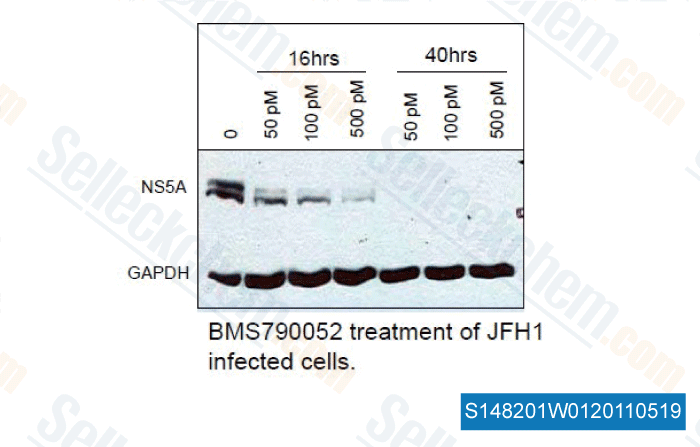
-
, 2011 , Dr. Anita Nag of Florida State University
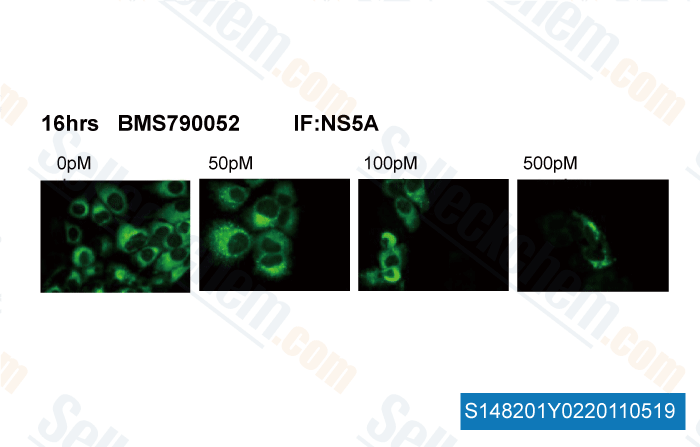
-
, 2011 , Dr. Anita Nag of Florida State University
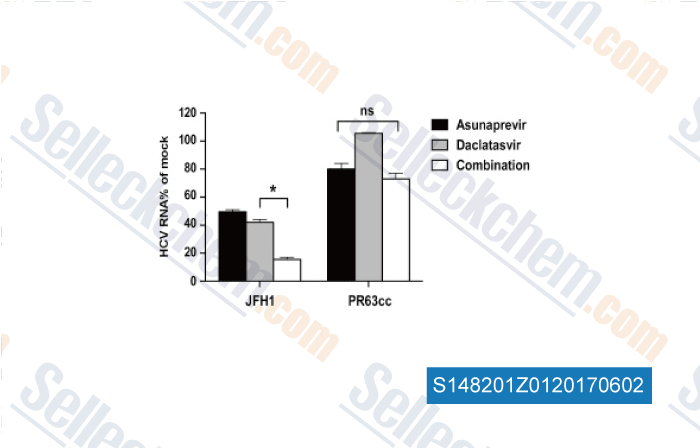
-
Daten von [ , , Antiviral Res, 2017, 139:18-24 ]
Sellecks Daclatasvir (BMS-790052) Wurde zitiert von 58 Publikationen
| Rapid hepatitis C virus replication machinery removal after antiviral treatment with DAA monitored by multimodal imaging [ Structure, 2025, S0969-2126(25)00193-5] | PubMed: 40553718 |
| Hepatitis C virus-induced differential transcriptional traits in host cells after persistent infection elimination by direct-acting antivirals in cell culture [ J Med Virol, 2024, 96(7):e29787] | PubMed: 38988177 |
| Antiviral drugs prolong survival in murine recessive dystrophic epidermolysis bullosa [ EMBO Mol Med, 2024, 16(4):870-884] | PubMed: 38462666 |
| Patient-derived rhabdomyosarcoma cells recapitulate the genetic and transcriptomic landscapes of primary tumors [ iScience, 2024, 27(10):110862] | PubMed: 39319271 |
| Unraveling the dynamics of hepatitis C virus adaptive mutations and their impact on antiviral responses in primary human hepatocytes [ J Virol, 2024, e0192123.] | PubMed: 38319104 |
| Mechanisms of Action of the Host-Targeting Agent Cyclosporin A and Direct-Acting Antiviral Agents against Hepatitis C Virus [ Viruses, 2023, 15(4)981] | PubMed: 37112961 |
| Hepatitis C virus cell culture adaptive mutations enhance cell culture propagation by multiple mechanisms but boost antiviral responses in primary human hepatocytes [ bioRxiv, 2023, 2023.11.22.568224] | PubMed: 38045248 |
| Combination of antiviral drugs inhibits SARS-CoV-2 polymerase and exonuclease and demonstrates COVID-19 therapeutic potential in viral cell culture [ Commun Biol, 2022, 5(1):154] | PubMed: 35194144 |
| Going Viral: An Investigation into the Chameleonic Behaviour of Antiviral Compounds [ Chemistry, 2022, e202202798.] | PubMed: 36286339 |
| Correlation of hepatitis C virus-mediated endoplasmic reticulum stress with autophagic flux impairment and hepatocarcinogenesis [ Med Mol Morphol, 2021, 10.1007/s00795-020-00271-5] | PubMed: 33386512 |
RÜCKGABERICHTLINIE
Die bedingungslose Rückgaberichtlinie von Selleck Chemical gewährleistet unseren Kunden ein reibungsloses Online-Einkaufserlebnis. Wenn Sie in irgendeiner Weise mit Ihrem Kauf unzufrieden sind, können Sie jeden Artikel innerhalb von 7 Tagen nach Erhalt zurückgeben. Im Falle von Produktqualitätsproblemen, sei es protokollbezogene oder produktbezogene Probleme, können Sie jeden Artikel innerhalb von 365 Tagen ab dem ursprünglichen Kaufdatum zurückgeben. Bitte befolgen Sie die nachstehenden Anweisungen, wenn Sie Produkte zurücksenden.
VERSAND UND LAGERUNG
Selleck-Produkte werden bei Raumtemperatur transportiert. Wenn Sie das Produkt bei Raumtemperatur erhalten, seien Sie versichert, dass die Qualitätskontrollabteilung von Selleck Experimente durchgeführt hat, um zu überprüfen, dass die normale Temperaturplatzierung von einem Monat die biologische Aktivität von Pulverprodukten nicht beeinträchtigt. Nach dem Sammeln lagern Sie das Produkt bitte gemäß den in der Datenblatt beschriebenen Anforderungen. Die meisten Selleck-Produkte sind unter den empfohlenen Bedingungen stabil.
NICHT FÜR DIE ANWENDUNG AM MENSCHEN, FÜR VETERINÄRMEDIZINISCHE DIAGNOSTIK ODER THERAPEUTISCHE ZWECKE.