Daclatasvir (BMS-790052)

Katalog-Nr.S1482 Charge:S148203

Drucken

Technische Daten

Formel

C40H50N8O6

Molekulargewicht 738.88 CAS-Nr. 1009119-64-5
Löslichkeit (25°C)* In vitro DMSO 148 mg/mL (200.3 mM)
Ethanol 148 mg/mL (200.3 mM)
Water Insoluble
In vivo (Lösungsmittel einzeln und der Reihe nach zum Produkt hinzufügen.)
Homogeneous suspension
CMC-NA
≥5mg/ml Taking the 1 mL working solution as an example, add 5 mg of this product to 1 ml of CMC-Na solution, mix evenly to obtain a homogeneous suspension with a final concentration of 5 mg/ml.
Clear solution
5%DMSO 40%PEG300 5%Tween80 50%ddH2O

Validiert von Selleck Labs. Sollten Sie Anpassungen an dieser Formulierung benötigen, wenden Sie sich an unser Vertriebsteam für kundenspezifische Tests.

7.4mg/ml (10.02mM) Taking the 1 mL working solution as an example, add 50 μL of 148 mg/ml clarified DMSO stock solution to 400 μL of PEG300, mix evenly to clarify it; add 50 μL of Tween80 to the above system, mix evenly to clarify; then continue to add 500 μL of ddH2O to adjust the volume to 1 mL. The mixed solution should be used immediately for optimal results. 
Clear solution
5% DMSO 95% Corn oil

Validiert von Selleck Labs. Sollten Sie Anpassungen an dieser Formulierung benötigen, wenden Sie sich an unser Vertriebsteam für kundenspezifische Tests.

1.06mg/ml (1.43mM) Taking the 1 mL working solution as an example, add 50 μL of 21.2 mg/ml clear DMSO stock solution to 950 μL of corn oil and mix evenly. The mixed solution should be used immediately for optimal results. 
* <1 mg/ml bedeutet schwer löslich oder unlöslich.
* Bitte beachten Sie, dass Selleck die Löslichkeit aller Verbindungen intern testet und die tatsächliche Löslichkeit geringfügig von veröffentlichten Werten abweichen kann. Dies ist normal und ist auf geringfügige Batch-zu-Batch-Variationen zurückzuführen.
* Versand bei Raumtemperatur (Stabilitätstests zeigen, dass dieses Produkt ohne Kühlmaßnahmen versendet werden kann.)

Vorbereitung von Stammlösungen

Biologische Aktivität

Beschreibung Daclatasvir (BMS-790052, EBP883) ist ein hochselektiver Inhibitor von HCV NS5A mit einer EC50 von 9-50 pM für eine breite Palette von HCV-Replikongenotypen und dem infektiösen JFH-1 Genotyp 2a Virus in Zellkultur. Phase 3.
Ziele
HCV NS5A
9 pM-50 pM(EC50)
In vitro Daclatasvir (BMS-790052) is one of the most potent inhibitors of HCV replication reported so far. The mean EC50 values of this compound are 50 and 9 pM for HCV genotype 1a and 1b replicons, respectively. It displays a therapeutic index (CC50/EC50) of at least 105 and is inactive towards a panel of 10 RNA and DNA viruses, with EC50 higher than 10 μM. This confirms its specificity for HCV. In Huh7 cells harboring the HCV genotype 1b replicons, it blocks both transient and stable HCV genome replication, with EC50 values ranging from 1-15 pM. At concentrations of 100 pM or 1 nM, it has been shown to alter the subcellular localization and biochemical fractionation of NS5A. This compound inhibits hybrid replicons containing HCV genotype-4 NS5A genes with EC50 of 7-13 pM. Residue 30 of NS5A is an important site for BMS-790052-mediated resistance in the hybrid replicons.
Merkmale Erstklassiger, hochselektiver Inhibitor des Hepatitis-C-Virus (HCV) NS5A mit pikomolaren EC50-Werten.

Protokoll (aus Referenz)

Kinase-Assay:[4]
  • FRET-Assay für HCV NS5A-Inhibitoren

    Dieses Peptid (Ac-Asp-Glu-Asp [EDANS]-Glu-Glu-Abu-[COO] Ala-Ser-Lys [DABCYL]-NH2) enthält einen Fluoreszenz-Donor {EDANS, 5-[(2-Aminoethyl)amino]naphthalin-1-sulfonsäure} in der Nähe eines Endes und einen Akzeptor {DABCYL, 4-[(4-Dimethylamino)phenyl]azo}benzoesäure} in der Nähe des anderen Endes. Der intermolekulare Resonanzenergietransfer zwischen Donor und Akzeptor löscht die Fluoreszenz des Peptids, aber während das NS3 Proteases das Peptid spaltet, werden die Produkte von der Resonanzenergietransfer-Löschung befreit. Da mehr Substrat durch die NS3 Proteases gespalten wird, nimmt die Fluoreszenz des Donors mit der Zeit zu. Die Nachweisreagenzien sind: 5x Luciferase-Zellkulturallysereagenz, verdünnt mit dH2O auf 1x, unter Zugabe von NaCl (150 mM) und FRET-Peptid (20 μM). HCV-Huh-7-Zellen wurden in 96-Well-Platten gegeben und über Nacht anheften gelassen (1×10⁴ Zellen pro Well). Am nächsten Tag wurde Daclatasvir (BMS-790052) in die Wells gegeben und die Platte 72 Stunden lang inkubiert. Die Platten wurden dann mit PBS gespült und der FRET-Nachweis durch Zugabe von 30 μL der oben genannten FRET-Peptid-Nachweisreagenzien pro Well durchgeführt. Die Signale wurden mit einem Cytofluor 4000 Gerät erfasst, das auf 340 nm (Anregung) / 490 nm (Emission) im automatischen Modus eingestellt war, für 20 Zyklen oder weniger lief und die Platte im kinetischen Modus las. Nach dem FRET-Nachweis wurden 40 μL Luciferase-Substrat in jedes Well gegeben und die Luciferase-Aktivität gemessen.

Zell-Assay:[1]
  • Zelllinien

    HCV replicon cells (Huh7)

  • Konzentrationen

    0.1 pM - 50 μM, dissolved in DMSO (the final concentration of DMSO is 0.5%)

  • Inkubationszeit

    72 hours

  • Methode

    Daclatasvir (BMS-790052) is added to 96-well plates containing HCV replicon cells seeded approximately 12 hours before in 200 µL media. The cell plates are tested for replication activity and cytotoxicity after 72 hours of incubation. Cytotoxicity is measured with CellTiter-Blue, after which the media and dye are removed, plates are inverted and the remaining liquid is blotted with paper towels. Replication activity of the HCV genotype 1a cell lines is quantified using Renilla luciferase. 1× Renilla luciferase lysis buffer (30 µL) is added to each well and plates are incubated with gentle shaking for 15 min. Renilla luciferase substrate (40 µL) is then added and the signals are detected using a Top Count luminometer set for light emission quantification. One hundred per cent activity is calculated for each cell line for the DMSO-only wells; percentage activity is calculated for each concentration of the inhibitor by dividing the average value for wells containing this compound by the average value for wells containing DMSO.

Referenzen

  • https://pubmed.ncbi.nlm.nih.gov/20410884/
  • https://pubmed.ncbi.nlm.nih.gov/21513964/
  • https://pubmed.ncbi.nlm.nih.gov/22203595/
  • https://pubmed.ncbi.nlm.nih.gov/15793110/

Kundenproduktvalidierung

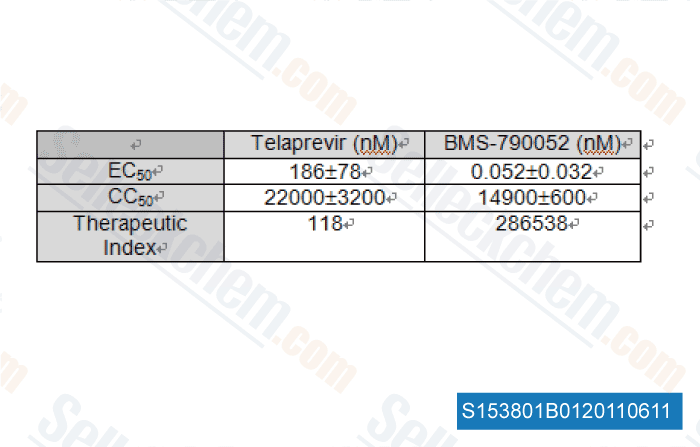
<p>The toxicity of BMS-790052 (BMS) and Telaprevir (TPV) was measured by seeding 96-well plates to 70% confluence and exposing the cells to up to 50 μM of compound for 72 hours. MTT [3-(4,5-dimethylthiazol-2-yl)-2,5-diphenyltetrazolium bromide] was added to each well at a final concentration of 500 μg/ml 4 h before dissolving crystals in 100 μl of DMSO and measuring at 550 nm UV wavelengths. The 50% cytotoxic concentration (CC50) was then calculation using the OD550 value and the following formula: log CC50=log concentration of HPP-[(HPP-50)/(HPP-LPP)×log d HPP: highest protective percentage closest to 50% LPP: Lowest protective percentage closest to 50% d: dilution factor</p>

, 2011 , Dr. Julie Sheldon,Dr Esteban Domingo and Dr Celia Perales
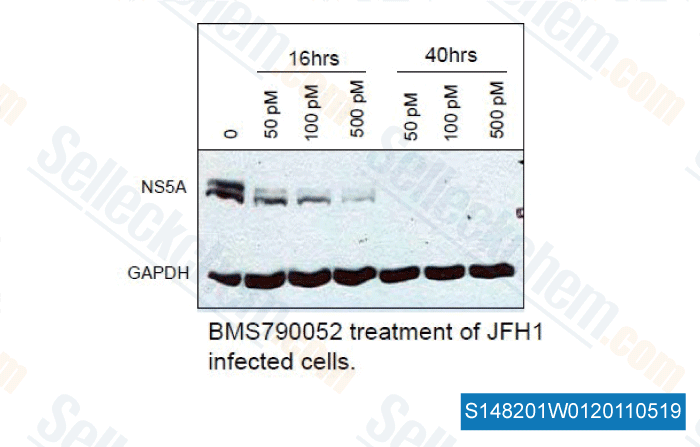
<p>Huh7.5 cells were infected with JFH-1 (2a) strain. Once the cells reached 80% infectivity they were treated with pMconcentration of BMS790052 for two different time points. Cells were collected in SDS sample loading buffer and probed for NS5A and GAPDH. After 16hrs hyperphosphorylated NS5A disappeared with increasing concentration of the drug. 40hrs of treatment resulted complete disappearance of NS5A. GAPDH is internal control.</p><div><div> </div></div><p> </p>

, 2011 , Dr. Anita Nag of Florida State University
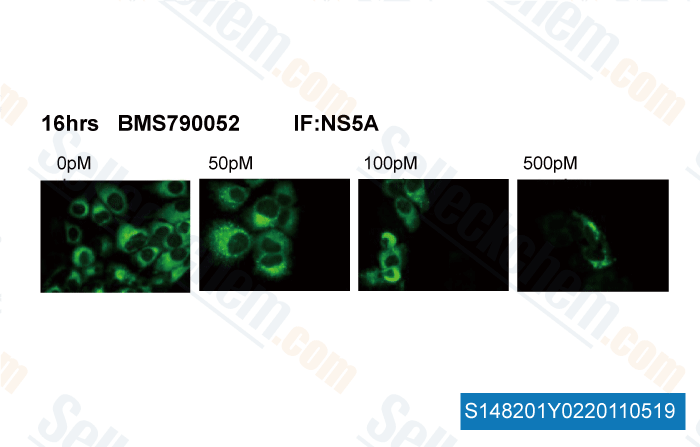
<p>80% infected HCV JFH-1 cells were treated with several concentrations of BMS790052 in pMrange. Cells were fixed after 16hrs and NS5A was probed.Cells treated with BMS790052 shows NS5A present in clusters compared to an even cytoplasmic distribution in untreated cells.</p>

, 2011 , Dr. Anita Nag of Florida State University
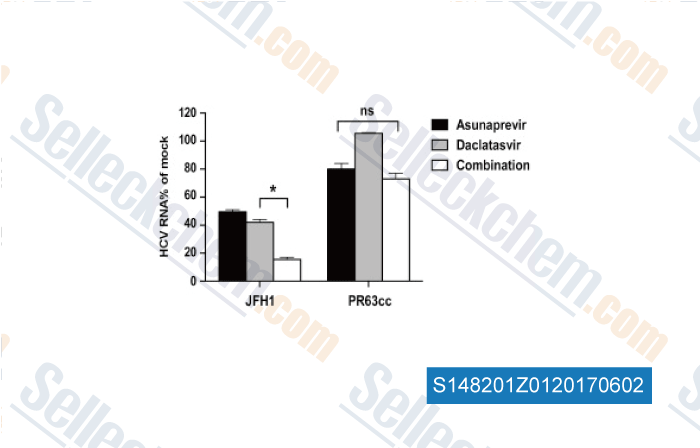
Sensitivity of PR63cc to the combinatory treatment with asunaprevir and daclatasvir. Huh7.5.1 cells infected with PR63cc or JFH1 at an MOI of 0.05 for 3 days were treated with either asunaprevir, daclatasvir or in combination for another 3 days. 40 nM asunaprevir and 0.05 nM daclatasvir, approximately the EC50 concentration of the each inhibitor for JFH1, were used. The antiviral efficiency of each compound was evaluated by quantifying the intracellular HCV RNA by RT-qPCR. Data were expressed as the percentage of mock treatment control. The error bars were calculated from two independent experiments. ns, P > 0.05. *, P < 0.05.

Daten von [ , , Antiviral Res, 2017, 139:18-24 ]

Selleck's Daclatasvir (BMS-790052) Wurde zitiert von 61 Publikationen

Rapid hepatitis C virus replication machinery removal after antiviral treatment with DAA monitored by multimodal imaging [ Structure, 2025, S0969-2126(25)00193-5] PubMed: 40553718
Hepatitis C virus-induced differential transcriptional traits in host cells after persistent infection elimination by direct-acting antivirals in cell culture [ J Med Virol, 2024, 96(7):e29787] PubMed: 38988177
Antiviral drugs prolong survival in murine recessive dystrophic epidermolysis bullosa [ EMBO Mol Med, 2024, 16(4):870-884] PubMed: 38462666
Patient-derived rhabdomyosarcoma cells recapitulate the genetic and transcriptomic landscapes of primary tumors [ iScience, 2024, 27(10):110862] PubMed: 39319271
Unraveling the dynamics of hepatitis C virus adaptive mutations and their impact on antiviral responses in primary human hepatocytes [ J Virol, 2024, e0192123.] PubMed: 38319104
Mechanisms of Action of the Host-Targeting Agent Cyclosporin A and Direct-Acting Antiviral Agents against Hepatitis C Virus [ Viruses, 2023, 15(4)981] PubMed: 37112961
Hepatitis C virus cell culture adaptive mutations enhance cell culture propagation by multiple mechanisms but boost antiviral responses in primary human hepatocytes [ bioRxiv, 2023, 2023.11.22.568224] PubMed: 38045248
Combination of antiviral drugs inhibits SARS-CoV-2 polymerase and exonuclease and demonstrates COVID-19 therapeutic potential in viral cell culture [ Commun Biol, 2022, 5(1):154] PubMed: 35194144
Going Viral: An Investigation into the Chameleonic Behaviour of Antiviral Compounds [ Chemistry, 2022, e202202798.] PubMed: 36286339
A Novel Drug to Induce Apoptosis in Advanced Prostate Cancer Cells [ STARS, 2022, 1202] PubMed: NONE

RÜCKGABERICHTLINIE
Die bedingungslose Rückgaberichtlinie von Selleck Chemical gewährleistet unseren Kunden ein reibungsloses Online-Einkaufserlebnis. Wenn Sie in irgendeiner Weise mit Ihrem Kauf unzufrieden sind, können Sie jeden Artikel innerhalb von 7 Tagen nach Erhalt zurückgeben. Im Falle von Produktqualitätsproblemen, sei es protokollbezogene oder produktbezogene Probleme, können Sie jeden Artikel innerhalb von 365 Tagen ab dem ursprünglichen Kaufdatum zurückgeben. Bitte befolgen Sie die nachstehenden Anweisungen, wenn Sie Produkte zurücksenden.

VERSAND UND LAGERUNG
Selleck-Produkte werden bei Raumtemperatur transportiert. Wenn Sie das Produkt bei Raumtemperatur erhalten, seien Sie versichert, dass die Qualitätskontrollabteilung von Selleck Experimente durchgeführt hat, um zu überprüfen, dass die normale Temperaturplatzierung von einem Monat die biologische Aktivität von Pulverprodukten nicht beeinträchtigt. Nach dem Sammeln lagern Sie das Produkt bitte gemäß den in der Datenblatt beschriebenen Anforderungen. Die meisten Selleck-Produkte sind unter den empfohlenen Bedingungen stabil.

NICHT FÜR DIE ANWENDUNG AM MENSCHEN, FÜR VETERINÄRMEDIZINISCHE DIAGNOSTIK ODER THERAPEUTISCHE ZWECKE.