
Technische Daten
| Formel | C24H25ClFN5O3 |
||||||
| Molekulargewicht | 485.94 | CAS-Nr. | 267243-28-7 | ||||
| Löslichkeit (25°C)* | In vitro | Ethanol | 9 mg/mL (18.52 mM) | ||||
| DMSO | 4 mg/mL (8.23 mM) | ||||||
| Water | Insoluble | ||||||
| In vivo (Lösungsmittel einzeln und der Reihe nach zum Produkt hinzufügen.) |
|
||||||
|
* <1 mg/ml bedeutet schwer löslich oder unlöslich. * Bitte beachten Sie, dass Selleck die Löslichkeit aller Verbindungen intern testet und die tatsächliche Löslichkeit geringfügig von veröffentlichten Werten abweichen kann. Dies ist normal und ist auf geringfügige Batch-zu-Batch-Variationen zurückzuführen. * Versand bei Raumtemperatur (Stabilitätstests zeigen, dass dieses Produkt ohne Kühlmaßnahmen versendet werden kann.) |
|||||||
Vorbereitung von Stammlösungen
Biologische Aktivität
| Beschreibung | Canertinib (CI-1033, PD183805) ist ein Pan-ErbB-Inhibitor, der auf EGFR und ErbB2 mit IC50-Werten von 1,5 nM bzw. 9,0 nM abzielt. Es zeigt keine Aktivität gegen PDGFR, FGFR, InsR, PKC oder CDK1/2/4. Diese Verbindung hat Phase-3-klinische Studien erreicht. | ||||
|---|---|---|---|---|---|
| Ziele |
|
||||
| In vitro | Canertinib (CI-1033) zeigt eine ausgezeichnete Wirksamkeit bei der irreversiblen Hemmung der ErbB2-Autophosphorylierung in MDA-MB 453-Zellen und weist auch eine hohe Permeabilität in Caco-2-Zellen auf. Diese Verbindung allein unterdrückt signifikant konstitutiv aktiviertes Akt und MAP-Kinase und hemmt in Kombination Akt, während sie eine Erhöhung der MAPK-Phosphorylierung verhindert. Es stimuliert die p27-Expression und p38-Phosphorylierung in MDA-MB-453-Zellen. CI-1033 ist hochspezifisch für die ErbB-Rezeptorfamilie und nicht empfindlich gegenüber PGFR, FGFR oder IR, selbst bei 50 μM. Es zeigt hohe Hemmwerte in A431-Zellen, die EGFR exprimieren, mit einer IC50 von 7,4 nM und unterdrückt die Heregulin-stimulierte Tyrosin-Phosphorylierung von ErbB2, ErbB3 und ErbB4 mit IC50-Werten von 5, 14 bzw. 10 nM. Die Verbindung hemmt auch die Expression von pp62c-fos als Reaktion auf Heregulin. Es wird angenommen, dass es Cys773 kovalent innerhalb der ATP-Bindungsstelle der HER2-Kinase modifiziert und den Abbau sowohl reifer als auch unreifer ErbB-2-Moleküle verstärkt. Diese Verbindung induziert eine signifikante Abnahme der messbaren Phosphorylierung der Tyrosinreste 845 und 1068 von EGFR, die für die Src- bzw. Ras/MAPK-Signalübertragung verantwortlich sind. Die entsprechenden Reste von Her-2, die Tyrosinreste 877 und 1248, werden durch sie bei einer Konzentration von 3 μM oder höher signifikant dephosphoryliert. CI könnte die EGFR-Internalisierung blockieren und die Apoptoserate in primären Osteosarkomzellen titrierbar erhöhen. Darüber hinaus hemmt es die Proliferation von TT-, TE2-, TE6- und TE10-Zellen signifikant bei 0,1 nM. |
||||
| In vivo | Canertinib (CI-1033) zeigt eine beeindruckende Aktivität gegen A431-Xenotransplantate in Nacktmäusen bei 5 mg/kg Körpergewicht. Diese Verbindung (20 bis 80 mg/kg/Tag) erzielt ein hohes Maß an Tumorregressionen in H125-Xenotransplantationsmodellen. Ihre orale Verabreichung bewirkt eine deutliche Wachstumshemmung in TT-, TE6- und TE10-Xenotransplantaten in Nacktmäusen, ohne Tiersterblichkeit und mit <10 % Gewichtsverlust. |
||||
| Merkmale | Erster Kinase-Inhibitor, der irreversible Aktivität zeigte und in klinische Studien einging (dient als Vorlage für die weitere Entwicklung). |
Protokoll (aus Referenz)
| Kinase-Assay: |
|
|---|---|
| Zell-Assay: |
|
| Tierstudie: |
|
Referenzen
|
Kundenproduktvalidierung
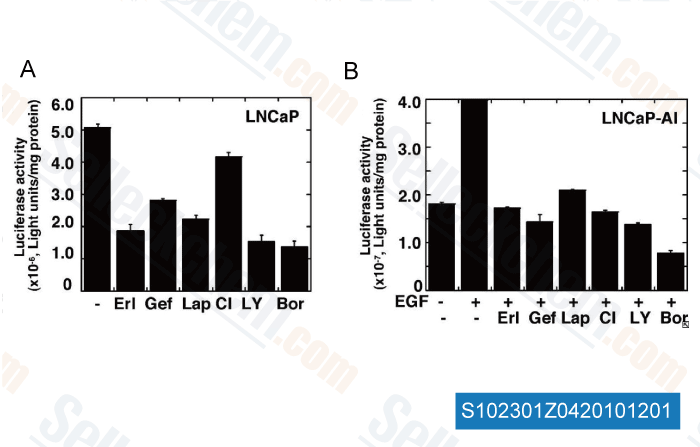
-
Daten von [ Carcinogenesis , 2010 , 31, 1948–1955 ]
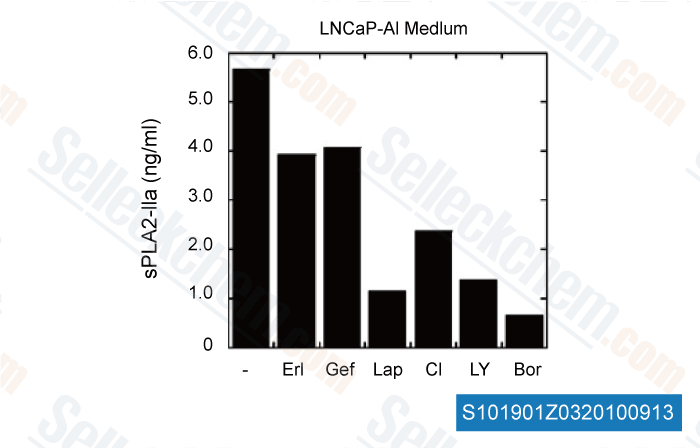
-
Daten von [ Carcinogenesis , 2010 , 31, 1948–1955 ]
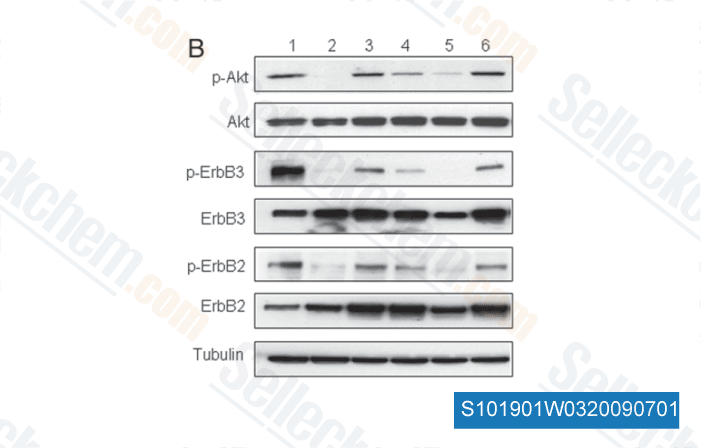
-
Daten von [ Cell Cycle , 2009 , 13, 2050-2056 ]
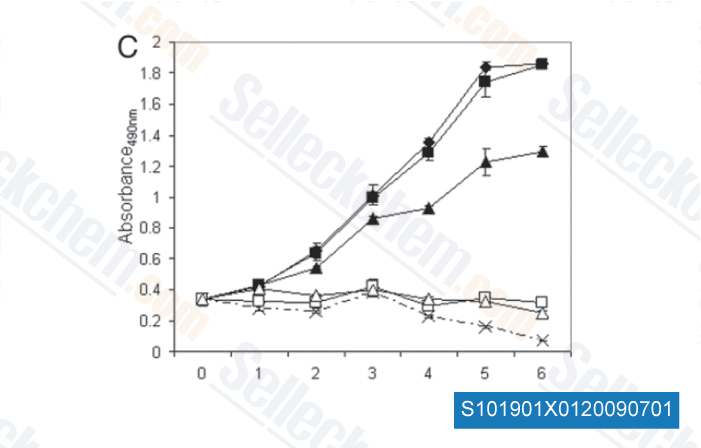
-
Daten von [ Cell Cycle , 2009 , 13, 2050-2056 ]
Sellecks Canertinib (CI-1033) Wurde zitiert von 48 Publikationen
| Epiregulin as an Alternative Ligand for Leptin Receptor Alleviates Glucose Intolerance without Change in Obesity [ Cells, 2022, 11(3)425] | PubMed: 35159237 |
| Oncogenic fusion of BCAR4 activates EGFR signaling and is sensitive to dual inhibition of EGFR/HER2 [ Front Mol Biosci, 2022, 9:952651] | PubMed: 36081848 |
| Establishment and Characterization of NCC-PMP1-C1: A Novel Patient-Derived Cell Line of Metastatic Pseudomyxoma Peritonei [ J Pers Med, 2022, 12(2)258] | PubMed: 35207746 |
| Establishment and characterization of NCC-UPS4-C1: a novel cell line of undifferentiated pleomorphic sarcoma from a patient with Li-Fraumeni syndrome [ Hum Cell, 2022, 10.1007/s13577-022-00671-y] | PubMed: 35118583 |
| Increased Microtubule Growth Triggered by Microvesicle-mediated Paracrine Signaling is Required for Melanoma Cancer Cell Invasion [ Cancer Res Commun, 2022, 2(5):366-379] | PubMed: 36875714 |
| GCN2 kinase activation by ATP-competitive kinase inhibitors [ Nat Chem Biol, 2021, 10.1038/s41589-021-00947-8] | PubMed: 34949839 |
| Acidosis-induced activation of distal nephron principal cells triggers Gdf15 secretion and adaptive proliferation of intercalated cells [ Acta Physiol (Oxf), 2021, 10.1111/apha.13661] | PubMed: 33840159 |
| Establishment and characterization of novel patient-derived cell lines from giant cell tumor of bone [ Hum Cell, 2021, 10.1007/s13577-021-00579-z] | PubMed: 34304386 |
| Establishment and characterization of NCC-MFS4-C1: a novel patient-derived cell line of myxofibrosarcoma [ Hum Cell, 2021, 34(6):1911-1918] | PubMed: 34383271 |
| Establishment and characterization of the NCC-GCTB4-C1 cell line: a novel patient-derived cell line from giant cell tumor of bone [ Hum Cell, 2021, 10.1007/s13577-021-00639-4] | PubMed: 34731453 |
RÜCKGABERICHTLINIE
Die bedingungslose Rückgaberichtlinie von Selleck Chemical gewährleistet unseren Kunden ein reibungsloses Online-Einkaufserlebnis. Wenn Sie in irgendeiner Weise mit Ihrem Kauf unzufrieden sind, können Sie jeden Artikel innerhalb von 7 Tagen nach Erhalt zurückgeben. Im Falle von Produktqualitätsproblemen, sei es protokollbezogene oder produktbezogene Probleme, können Sie jeden Artikel innerhalb von 365 Tagen ab dem ursprünglichen Kaufdatum zurückgeben. Bitte befolgen Sie die nachstehenden Anweisungen, wenn Sie Produkte zurücksenden.
VERSAND UND LAGERUNG
Selleck-Produkte werden bei Raumtemperatur transportiert. Wenn Sie das Produkt bei Raumtemperatur erhalten, seien Sie versichert, dass die Qualitätskontrollabteilung von Selleck Experimente durchgeführt hat, um zu überprüfen, dass die normale Temperaturplatzierung von einem Monat die biologische Aktivität von Pulverprodukten nicht beeinträchtigt. Nach dem Sammeln lagern Sie das Produkt bitte gemäß den in der Datenblatt beschriebenen Anforderungen. Die meisten Selleck-Produkte sind unter den empfohlenen Bedingungen stabil.
NICHT FÜR DIE ANWENDUNG AM MENSCHEN, FÜR VETERINÄRMEDIZINISCHE DIAGNOSTIK ODER THERAPEUTISCHE ZWECKE.