
Technische Daten
| Formel | C24H30N6O2 |
||||||||||||||
| Molekulargewicht | 434.53 | CAS-Nr. | 917111-44-5 | ||||||||||||
| Löslichkeit (25°C)* | In vitro | DMSO | 86 mg/mL (197.91 mM) | ||||||||||||
| Ethanol | 86 mg/mL (197.91 mM) | ||||||||||||||
| Water | Insoluble | ||||||||||||||
| In vivo (Lösungsmittel einzeln und der Reihe nach zum Produkt hinzufügen.) |
|
||||||||||||||
|
* <1 mg/ml bedeutet schwer löslich oder unlöslich. * Bitte beachten Sie, dass Selleck die Löslichkeit aller Verbindungen intern testet und die tatsächliche Löslichkeit geringfügig von veröffentlichten Werten abweichen kann. Dies ist normal und ist auf geringfügige Batch-zu-Batch-Variationen zurückzuführen. * Versand bei Raumtemperatur (Stabilitätstests zeigen, dass dieses Produkt ohne Kühlmaßnahmen versendet werden kann.) |
|||||||||||||||
Vorbereitung von Stammlösungen
Biologische Aktivität
| Beschreibung | Lexibulin (CYT997, SRI-32007) ist ein potenter microtubule-Polymerisationsinhibitor mit einer IC50 von 10-100 nM in Krebszelllinien. Diese Verbindung befindet sich in Phase 2. | ||
|---|---|---|---|
| Ziele |
|
||
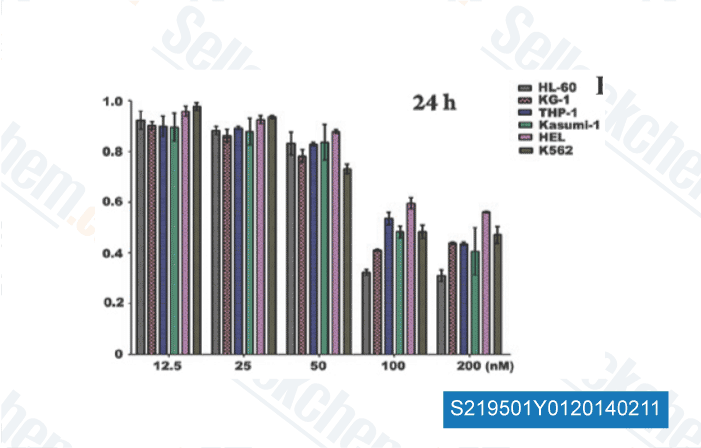
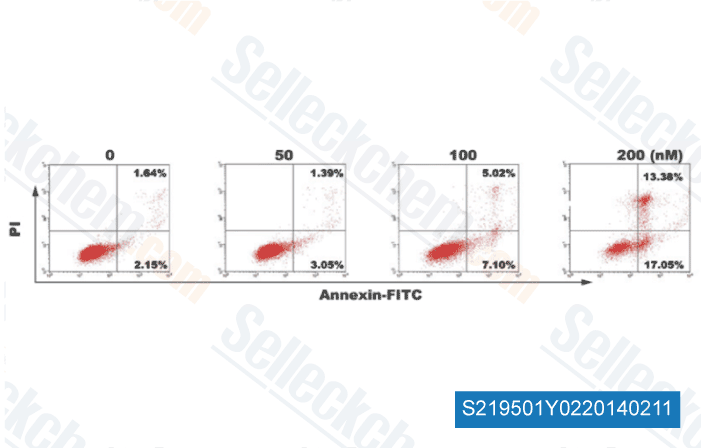
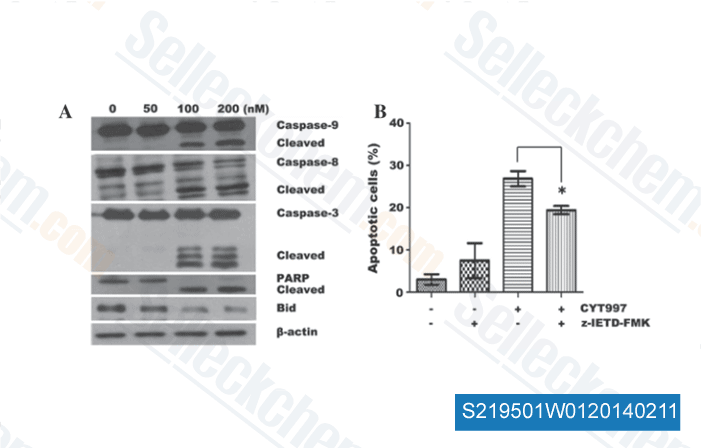
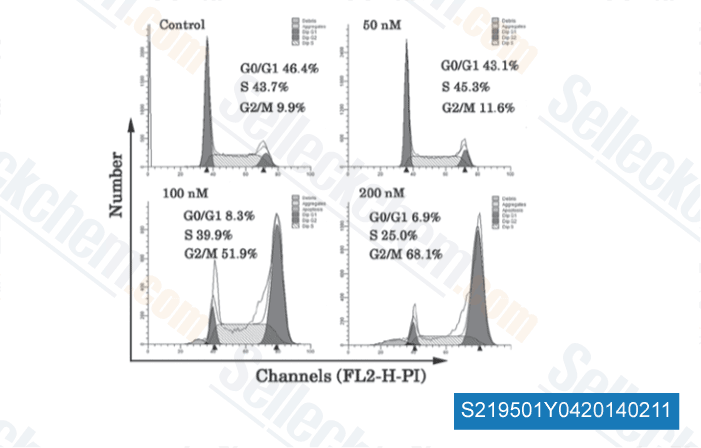
| In vitro | Die Behandlung mit Lexibulin (CYT997) (1 μM) über 24 Stunden in A549-Zellen induziert eine schnelle Reorganisation der Mikrotubuli, einschließlich der Zerstörung des bestehenden Mikrotubuli-Netzwerks und der Akkumulation von Tubulin in Plaques im Zytoplasma einiger Zellen, was zu signifikanten Veränderungen der Zellmorphologie führt, einschließlich des Verlusts der Adhäsion und der Zellrundung. Es zeigt eine starke zytotoxische Aktivität gegen eine Reihe von 16 Krebszellen mit IC50-Werten zwischen 9 nM für HepG2 und 101 nM für KHOS/NP. Insbesondere zeigt diese Verbindung eine starke Aktivität gegen HCT15-Zellen, die bekanntermaßen den Multidrug-Resistenzmechanismus Pgp (MDR+) besitzen, mit einer IC50 von 52 nM. Durch die Hemmung der Mikrotubuli-Polymerisation blockiert es den Zellzyklus an der G2-M-Grenze und induziert eine Zunahme von phosphoryliertem Bcl-2 und eine erhöhte Expression von Cyclin B1 sowie die Aktivierung von Caspase-3 und die Generierung von Poly(ADP-Ribose)-Polymerase. Seine Behandlung führt zu einem schnellen und reversiblen Anstieg der Permeabilität von HUVEC-Monolayern mit einer IC50 von ~80 nM nach 1 Stunde Exposition. Im Einklang mit der Störung des zellulären Tubulins hemmt es potent die Proliferation, induziert Zellzyklusarrest und vor allem Apoptose sowohl von menschlichen Myelomzelllinien (HMCLs) als auch von primären MM-Zellen. | ||
| In vivo | Die Halbwertszeit von Lexibulin (CYT997) bei oraler Verabreichung (2,5 Stunden) an Ratten ist etwas länger als bei intravenöser Verabreichung (1,5 Stunden), wobei die absolute orale Bioverfügbarkeit zwischen 50 % und 70 % liegt. Die orale Verabreichung dieser Verbindung induziert eine dosisabhängige Hemmung des Tumorwachstums von PC3-Xenografts bei Mäusen, potenter im Vergleich zu Paclitaxel. Es ist auch wirksam in einem orthotopen syngenen Modell unter Verwendung der Maus-Brustkrebszellen 4T1, die teilweise refraktär gegenüber Paclitaxel-Behandlung sind. Eine Einzeldosis von CYT997 (7,5 mg/kg, i.p.) reduziert den Tumordurchblutung in Lebermetastasen innerhalb von 6 Stunden signifikant, in ähnlichem Ausmaß wie die positive Kontrolle CA4P in einer Dosis von 100 mg/kg. Die Behandlung mit dieser Verbindung (15 mg/kg/Tag) verlängert die Überlebenszeit in einem murinen Modell der aggressiven systemischen Myelomatose signifikant. |
Protokoll (aus Referenz)
| Kinase-Assay:[1] |
|
|---|---|
| Zell-Assay:[1] |
|
| Tierstudie:[1] |
|
Referenzen
|
Kundenproduktvalidierung
-
Daten von [ Exp Ther Med , 2013 , 6(2), 299-304 ]
-
Daten von [ Exp Ther Med , 2013 , 6(2), 299-304 ]
-
Daten von [ Exp Ther Med , 2013 , 6(2), 299-304 ]
-
Daten von [ Exp Ther Med , 2013 , 6(2), 299-304 ]
Sellecks Lexibulin (CYT997) Wurde zitiert von 8 Publikationen
| A modular master regulator landscape controls cancer transcriptional identity [ Cell, 2021, 184(2):334-351.e20] | PubMed: 33434495 |
| HBV Core Promoter Inhibition by Tubulin Polymerization Inhibitor (SRI-32007) [ Adv Virol, 2020, 2020:8844061] | PubMed: 33110426 |
| CYT997(Lexibulin) induces apoptosis and autophagy through the activation of mutually reinforced ER stress and ROS in osteosarcoma [ J Exp Clin Cancer Res, 2019, 38(1):44] | PubMed: 30704503 |
| Intracellular reduction in ATP levels contributes to CYT997-induced suppression of metastasis of head and neck squamous carcinoma. [ J Cell Mol Med, 2019, 23(2):1174-1182] | PubMed: 30450674 |
| Survival of midbrain dopamine neurons depends on the Bcl2 factor Mcl1 [ Cell Death Discov, 2018, 4:107] | PubMed: 30479840 |
| Augmentation of the anticancer activity of CYT997 in human prostate cancer by inhibiting Src activity. [ J Hematol Oncol, 2017, 10(1):118] | PubMed: 28606127 |
| Structures of a diverse set of colchicine binding site inhibitors in complex with tubulin provide a rationale for drug discovery. [ FEBS J, 2016, 283(1):102-11] | PubMed: 26462166 |
| The microtubule depolymerizing agent CYT997 effectively kills acute myeloid leukemia cells via activation of caspases and inhibition of PI3K/Akt/mTOR pathway proteins. [XIAOHUI CHEN, et al. Exp Ther Med, 2013, 6(2):299-304] | PubMed: 24137178 |
RÜCKGABERICHTLINIE
Die bedingungslose Rückgaberichtlinie von Selleck Chemical gewährleistet unseren Kunden ein reibungsloses Online-Einkaufserlebnis. Wenn Sie in irgendeiner Weise mit Ihrem Kauf unzufrieden sind, können Sie jeden Artikel innerhalb von 7 Tagen nach Erhalt zurückgeben. Im Falle von Produktqualitätsproblemen, sei es protokollbezogene oder produktbezogene Probleme, können Sie jeden Artikel innerhalb von 365 Tagen ab dem ursprünglichen Kaufdatum zurückgeben. Bitte befolgen Sie die nachstehenden Anweisungen, wenn Sie Produkte zurücksenden.
VERSAND UND LAGERUNG
Selleck-Produkte werden bei Raumtemperatur transportiert. Wenn Sie das Produkt bei Raumtemperatur erhalten, seien Sie versichert, dass die Qualitätskontrollabteilung von Selleck Experimente durchgeführt hat, um zu überprüfen, dass die normale Temperaturplatzierung von einem Monat die biologische Aktivität von Pulverprodukten nicht beeinträchtigt. Nach dem Sammeln lagern Sie das Produkt bitte gemäß den in der Datenblatt beschriebenen Anforderungen. Die meisten Selleck-Produkte sind unter den empfohlenen Bedingungen stabil.
NICHT FÜR DIE ANWENDUNG AM MENSCHEN, FÜR VETERINÄRMEDIZINISCHE DIAGNOSTIK ODER THERAPEUTISCHE ZWECKE.