
Technische Daten
| Formel | C17H19ClN2S.HCl |
||||||
| Molekulargewicht | 355.33 | CAS-Nr. | 69-09-0 | ||||
| Löslichkeit (25°C)* | In vitro | DMSO | 71 mg/mL (199.81 mM) | ||||
| Water | 71 mg/mL (199.81 mM) | ||||||
| Ethanol | 71 mg/mL (199.81 mM) | ||||||
| In vivo (Lösungsmittel einzeln und der Reihe nach zum Produkt hinzufügen.) |
|
||||||
|
* <1 mg/ml bedeutet schwer löslich oder unlöslich. * Bitte beachten Sie, dass Selleck die Löslichkeit aller Verbindungen intern testet und die tatsächliche Löslichkeit geringfügig von veröffentlichten Werten abweichen kann. Dies ist normal und ist auf geringfügige Batch-zu-Batch-Variationen zurückzuführen. * Versand bei Raumtemperatur (Stabilitätstests zeigen, dass dieses Produkt ohne Kühlmaßnahmen versendet werden kann.) |
|||||||
Vorbereitung von Stammlösungen
Biologische Aktivität
| Beschreibung | Chlorpromazine HCl ist ein Dopamin- und Potassium Channel-Inhibitor mit einer IC50 von 6,1 und 16 μM für einwärtsgerichtete K+-Ströme und zeitunabhängige Auswärtsströme. | ||
|---|---|---|---|
| Ziele |
|
||
| In vitro | Chlorpromazine beeinflusst miniature IPSCs (mIPSCs), indem es die Bindungsrate (kon) verringert und die Ablösungsrate (koff) von GABAARs erhöht. Chlorpromazine moduliert aktivierte TRPA1-Ströme spannungsabhängig, was zu einer Blockade bei positiven Potentialen und einer erhöhten Öffnungswahrscheinlichkeit bei negativen Potentialen führt. | ||
| In vivo | Chlorpromazine reguliert unabhängig die Produktion verschiedener T-Zell-abgeleiteter Lymphokine (IL-2, IFN-gamma, IL-4, TNF und GM-CSF) herunter und die Sekretion von IL-10 in einem In-vivo-Modell der akuten Superantigen-getriebenen Immunaktivierung hoch. Die Chlorpromazine-vermittelte Amplifikation der SEB-getriebenen Chlorpromazine-Sekretion geht mit einer erhöhten IL-10-mRNA-Akkumulation einher. Chlorpromazine schützt Mäuse, normale oder adrenalektomierte, und Meerschweinchen vor der Letalität von LPS und hemmt die TNF-Serumspiegel. Chlorpromazine schützt vor LPS-Letalität, wenn es 30 Minuten (min) vor, gleichzeitig mit oder bis zu 10 min nach LPS verabreicht wird, und ist unwirksam, wenn es 30 min nach LPS gegeben wird, was dem hemmenden Effekt auf die TNF-Produktion entspricht. Chlorpromazine hemmt signifikant die LPS-Letalität und Hepatotoxizität bei Mäusen, die durch Actinomycin D für LPS-Toxizität sensibilisiert wurden, während unter diesen Bedingungen DEX inaktiv ist. Chlorpromazine schützt Gehirngewebe vor hypoxiebedingtem irreversiblem Verlust der synaptischen Übertragung bei Ratten. Chlorpromazine verzögert auch signifikant das Auftreten der hypoxiebedingten Spreading Depression (SD) bei Ratten. |
Protokoll (aus Referenz)
Referenzen
|
Kundenproduktvalidierung
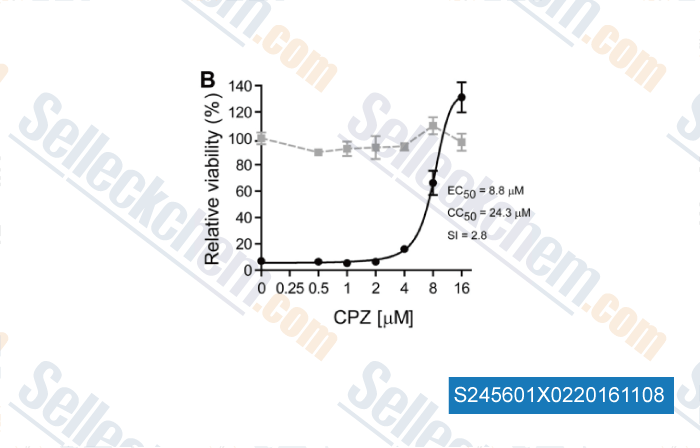
-
, , Antimicrob Agents Chemother, 2014, 58:4875-4884.
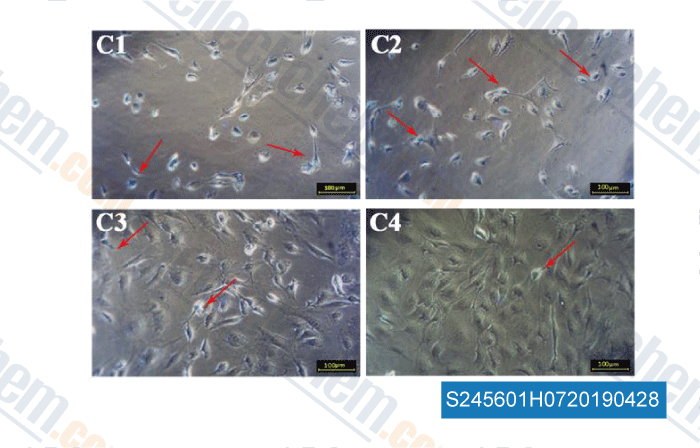
-
Daten von [ , , Acta Biomater, 2018, 71:49-60 ]
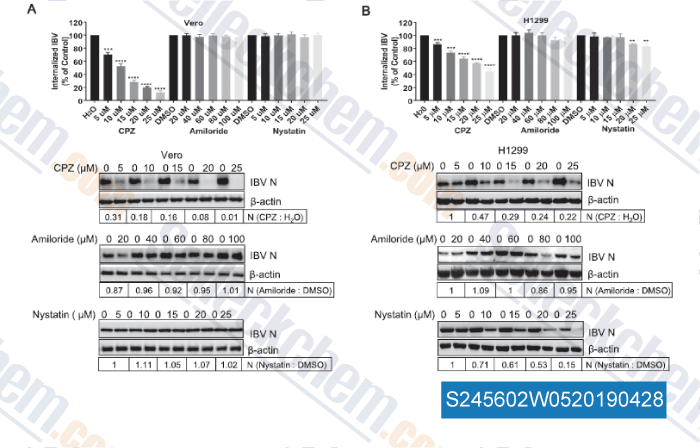
-
Daten von [ , , Virology, 2018, 528:118-136 ]
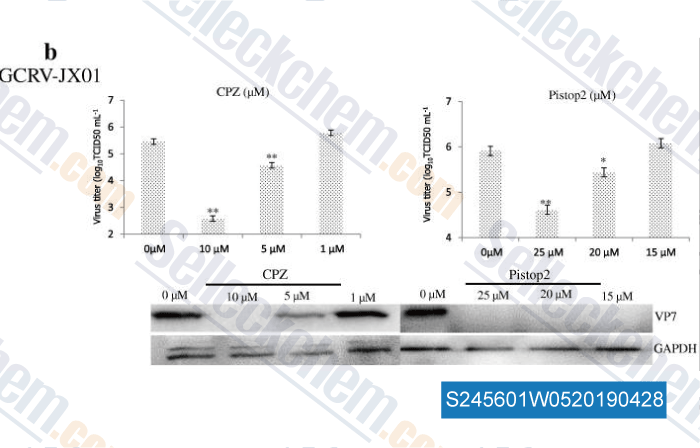
-
Daten von [ , , Virol J, 2018, 15(1):92 ]
Sellecks Chlorpromazine HCl Wurde zitiert von 24 Publikationen
| Peptide nanocarriers co-delivering an antisense oligonucleotide and photosensitizer elicit synergistic cytotoxicity [ J Colloid Interface Sci, 2024, 664:338-348] | PubMed: 38479270 |
| Tetrandrine (TET) inhibits African swine fever virus entry into cells by blocking the PI3K/Akt pathway [ Virus Res, 2024, 339:199258] | PubMed: 37923171 |
| Dextran sodium sulfate potentiates NLRP3 inflammasome activation by modulating the KCa3.1 potassium channel in a mouse model of colitis [ Cell Mol Immunol, 2022, 19(8):925-943] | PubMed: 35799057 |
| SARS-CoV-2 pseudovirus enters the host cells through spike protein-CD147 in an Arf6-dependent manner [ Emerg Microbes Infect, 2022, 11(1):1135-1144] | PubMed: 35343395 |
| Bile acids promote the caveolae-associated entry of swine acute diarrhea syndrome coronavirus in porcine intestinal enteroids [ PLoS Pathog, 2022, 18(6):e1010620] | PubMed: 35696443 |
| Channel catfish virus entry into host cells via clathrin-mediated endocytosis [ Virus Res, 2022, 315:198794] | PubMed: 35504448 |
| Porcine Deltacoronavirus (PDCoV) Entry into PK-15 Cells by Caveolae-Mediated Endocytosis [ Viruses, 2022, 14(3)496] | PubMed: 35336903 |
| Endocytic pathway inhibition attenuates extracellular vesicle-induced reduction of chemosensitivity to bortezomib in multiple myeloma cells [ Theranostics, 2021, 11(5):2364-2380] | PubMed: 33500730 |
| Modification of Metal-Organic Framework Nanoparticles Using Dental Pulp Mesenchymal Stem Cell Membranes to Target Oral Squamous Cell Carcinoma [ J Colloid Interface Sci, 2021, 601:650-660] | PubMed: 34091312 |
| Self-Monitoring and Self-Delivery of Self-Assembled Fluorescent Nanoparticles in Cancer Therapy [ Int J Nanomedicine, 2021, 16:2487-2499] | PubMed: 33824587 |
RÜCKGABERICHTLINIE
Die bedingungslose Rückgaberichtlinie von Selleck Chemical gewährleistet unseren Kunden ein reibungsloses Online-Einkaufserlebnis. Wenn Sie in irgendeiner Weise mit Ihrem Kauf unzufrieden sind, können Sie jeden Artikel innerhalb von 7 Tagen nach Erhalt zurückgeben. Im Falle von Produktqualitätsproblemen, sei es protokollbezogene oder produktbezogene Probleme, können Sie jeden Artikel innerhalb von 365 Tagen ab dem ursprünglichen Kaufdatum zurückgeben. Bitte befolgen Sie die nachstehenden Anweisungen, wenn Sie Produkte zurücksenden.
VERSAND UND LAGERUNG
Selleck-Produkte werden bei Raumtemperatur transportiert. Wenn Sie das Produkt bei Raumtemperatur erhalten, seien Sie versichert, dass die Qualitätskontrollabteilung von Selleck Experimente durchgeführt hat, um zu überprüfen, dass die normale Temperaturplatzierung von einem Monat die biologische Aktivität von Pulverprodukten nicht beeinträchtigt. Nach dem Sammeln lagern Sie das Produkt bitte gemäß den in der Datenblatt beschriebenen Anforderungen. Die meisten Selleck-Produkte sind unter den empfohlenen Bedingungen stabil.
NICHT FÜR DIE ANWENDUNG AM MENSCHEN, FÜR VETERINÄRMEDIZINISCHE DIAGNOSTIK ODER THERAPEUTISCHE ZWECKE.