
Technische Daten
| Formel | C20H25NO4 |
||||||||||||||
| Molekulargewicht | 343.42 | CAS-Nr. | 153259-65-5 | ||||||||||||
| Löslichkeit (25°C)* | In vitro | DMSO | 69 mg/mL (200.92 mM) | ||||||||||||
| Ethanol | 50 mg/mL (145.59 mM) | ||||||||||||||
| Water | Insoluble | ||||||||||||||
| In vivo (Lösungsmittel einzeln und der Reihe nach zum Produkt hinzufügen.) |
|
||||||||||||||
|
* <1 mg/ml bedeutet schwer löslich oder unlöslich. * Bitte beachten Sie, dass Selleck die Löslichkeit aller Verbindungen intern testet und die tatsächliche Löslichkeit geringfügig von veröffentlichten Werten abweichen kann. Dies ist normal und ist auf geringfügige Batch-zu-Batch-Variationen zurückzuführen. * Versand bei Raumtemperatur (Stabilitätstests zeigen, dass dieses Produkt ohne Kühlmaßnahmen versendet werden kann.) |
|||||||||||||||
Vorbereitung von Stammlösungen
Biologische Aktivität
| Beschreibung | Cilomomilast (SB-207499) ist ein potenter PDE4-Inhibitor mit einer IC50 von etwa 110 nM, besitzt entzündungshemmende Aktivität und eine geringe Aktivität im zentralen Nervensystem. Phase 3. | ||||
|---|---|---|---|---|---|
| Ziele |
|
||||
| In vitro | Cilomilast bewirkt eine konzentrationsabhängige Zunahme des cAMP-Gehalts in U937-Zellen. Diese Verbindung bewirkt eine konzentrationsabhängige Zunahme des cAMP-Gehalts in U937-Zellen. In isolierten menschlichen Monozyten sind es und (R)-Rolipram bei der Unterdrückung der LPS-induzierten TNF-α-Bildung mit -log (IC50) von 7,0 bzw. 7,2 gleich wirksam. Sowohl diese Verbindung als auch (R)-Rolipram bewirken eine moderate Prävention der fMLP-induzierten Degranulation menschlicher Neutrophile. Es und (R)-Rolipram sind bei der Unterdrückung der Neutrophilenaktivierung mit -log (IC50) von 7,1 bzw. 6,4 gleich wirksam. Diese Chemikalie verringert signifikant die Expression von TNF-α in der Kornea und von IL-1α, IL-1β und TNF-α in der Konjunktiva im Vergleich zur Vehikelkontrolle. Ihre Behandlung verringert markedly die Präsenz von CD11b+-Antigen-präsentierenden Zellen in der zentralen und peripheren Kornea und führt zu einer verminderten konjunktivalen Expression der Zytokine IL-6, IL-23 und IL-17. Darüber hinaus verringert sie die Expression von IL-17 und IL-23 in den drainierenden Lymphknoten. Es reduziert die TLR4-Expression, die IL-8-Freisetzung und die chemotaktische Aktivität von Neutrophilen, sowie es erhöhte die IP-10-Freisetzung und die chemotaktische Aktivität von Lymphozyten. | ||||
| In vivo | Cilomilast hemmt die humane TNFα-Produktion mit einer oralen ED50 von 4,9 mg/kg. Im Gegensatz zu ihrer gleich potenten Aktivität gegen die TNFα-Produktion ist diese Verbindung (ED50 = 2,3 mg/kg, p.o.) 10-mal weniger potent als R-Rolipram (ED50 = 0,23 mg/kg, p.o.) bei der Umkehrung der Reserpin-induzierten Hypothermie, einem Modell für antidepressive Aktivität. In Zeitverlaufstudien unterdrückt diese Chemikalie (30 mg/kg, p.o.) die TNFα-Produktion für mindestens 10 Stunden. Die Fähigkeit dieser Verbindung, die Interleukin-4-Produktionin vivo zu modulieren, wird in einem chronischen Oxazolon-induzierten Kontaktsensibilisierungsmodell an Balb/c-Mäusen bewertet. Die topische Verabreichung dieser Chemikalie (1000 μg) hemmt die intraläsionalen Konzentrationen von Interleukin-4. Oral verabreichtes Cilomilast hemmt dosisabhängig die Produktion von Interleukin-4, TNF-α und Cysteinylleukotrienen sowie die Leukozyteninfiltration in der bronchoalveolären Spülflüssigkeit aus den Atemwegen von Ovalbumin-sensibilisierten Brown Norway-Ratten . | ||||
| Merkmale | Cilomilast wird seit vielen Jahren zur Behandlung der chronisch obstruktiven Lungenerkrankung (COPD) eingesetzt. |
Protokoll (aus Referenz)
| Zell-Assay:[2] |
|
|---|---|
| Tierstudie:[1] |
|
Referenzen
|
Kundenproduktvalidierung
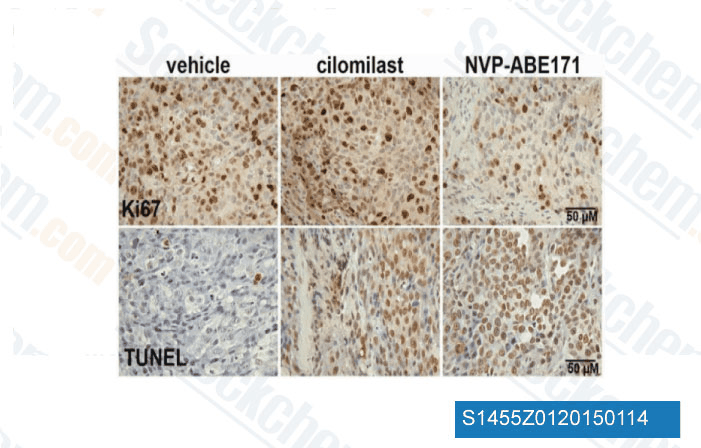
-
Daten von [ Mol Cancer Res , 2014 , 10.1158/1541-7786.MCR-14-0110 ]
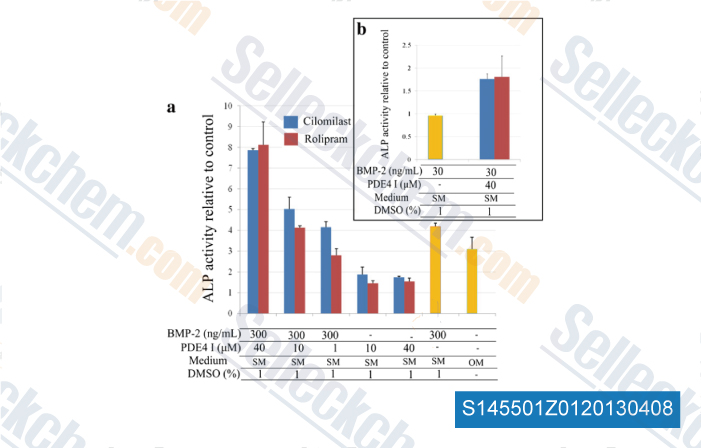
-
Daten von [ Biochimie , 2012 , 94, 2360e2365 ]
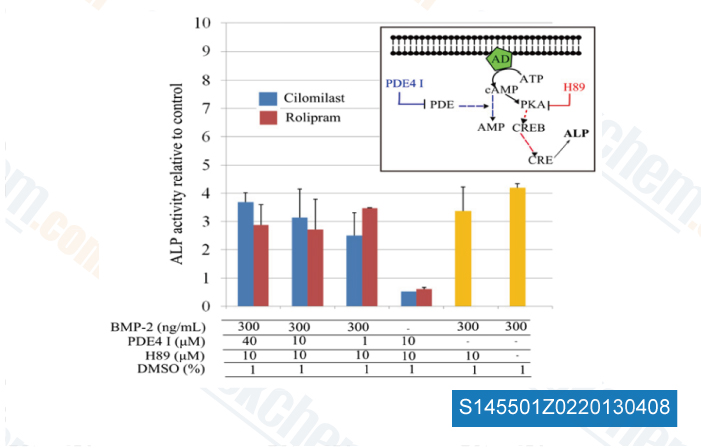
-
Daten von [ Biochimie , 2012 , 94, 2360e2365 ]
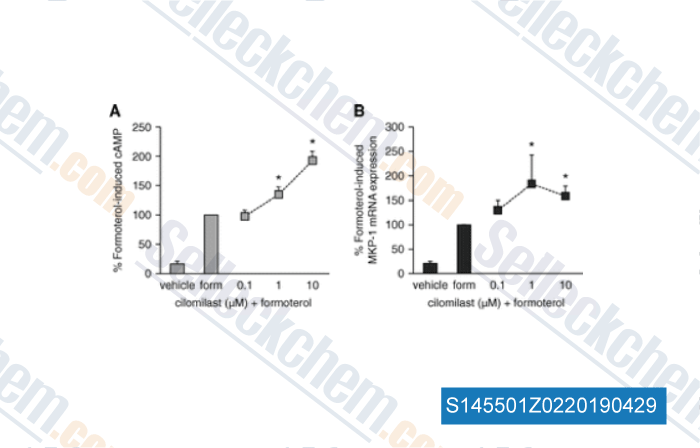
-
Daten von [ , , Am J Respir Cell Mol Biol, 2015, 52(5):634-40 ]
Sellecks Cilomilast Wurde zitiert von 9 Publikationen
| Aberrant TCF21 upregulation in adenomyosis impairs endometrial decidualization by increasing PDE4C expression [ Biochim Biophys Acta Mol Basis Dis, 2025, 1871(1):167526] | PubMed: 39326465 |
| Inhibition of PDE4/PDE4B improves renal function and ameliorates inflammation in cisplatin-induced acute kidney injury. [ Am J Physiol Renal Physiol, 2020, 318(3):F576-F588] | PubMed: 31961716 |
| A multi-targeted liquid chromatography–mass spectrometryscreening procedure for the detection in human urine of drugsnon-prohibited in sport commonly used by the athletes [Mazzarino M, et al. J Pharm Biomed Anal, 2016, 117:47-60] | PubMed: 26342446 |
| Inhibitors of Phosphodiesterase 4, but Not Phosphodiesterase 3, Increase β2-Agonist–Induced Expression of Antiinflammatory Mitogen-Activated Protein Kinase Phosphatase 1 in Airway Smooth Muscle Cells [Patel BS Am J Respir Cell Mol Biol, 2015, 52(5):634-40] | PubMed: 25296132 |
| Phosphodiesterase 4D inhibitors limit prostate cancer growth potential [ Mol Cancer Res, 2015, 13(1):149-60] | PubMed: 25149359 |
| Phosphodiesterase 4D Inhibitors Limit Prostate Cancer Growth Potential [Powers GL, et al. Mol Cancer Res, 2015, 13(1):149-60] | |
| Inhibitors of Phosphodiesterase 4, but Not Phosphodiesterase 3, Increase b2-Agonist–Induced Expression of Antiinflammatory Mitogen-Activated Protein Kinase Phosphatase 1 in Airway Smooth Muscle Cells [Patel BS, et al. AM J Resp Cell Mol, 2014, 10.1165/rcmb.2014-0344OC] | |
| Monitoring phosphodiesterase‐4 inhibitors using liquid chromatography/(tandem) mass spectrometry in sports drug testing [Thevis M Rapid Commun Mass Spectrom, 2013, 27(9):993-1004] | PubMed: 23592202 |
| Cilomilast enhances osteoblast differentiation of mesenchymal stem cells and bone formation induced by bone morphogenetic protein 2. [Munisso MC, et al. Biochimie, 2012, 94(11):2360-5] | PubMed: 22706281 |
RÜCKGABERICHTLINIE
Die bedingungslose Rückgaberichtlinie von Selleck Chemical gewährleistet unseren Kunden ein reibungsloses Online-Einkaufserlebnis. Wenn Sie in irgendeiner Weise mit Ihrem Kauf unzufrieden sind, können Sie jeden Artikel innerhalb von 7 Tagen nach Erhalt zurückgeben. Im Falle von Produktqualitätsproblemen, sei es protokollbezogene oder produktbezogene Probleme, können Sie jeden Artikel innerhalb von 365 Tagen ab dem ursprünglichen Kaufdatum zurückgeben. Bitte befolgen Sie die nachstehenden Anweisungen, wenn Sie Produkte zurücksenden.
VERSAND UND LAGERUNG
Selleck-Produkte werden bei Raumtemperatur transportiert. Wenn Sie das Produkt bei Raumtemperatur erhalten, seien Sie versichert, dass die Qualitätskontrollabteilung von Selleck Experimente durchgeführt hat, um zu überprüfen, dass die normale Temperaturplatzierung von einem Monat die biologische Aktivität von Pulverprodukten nicht beeinträchtigt. Nach dem Sammeln lagern Sie das Produkt bitte gemäß den in der Datenblatt beschriebenen Anforderungen. Die meisten Selleck-Produkte sind unter den empfohlenen Bedingungen stabil.
NICHT FÜR DIE ANWENDUNG AM MENSCHEN, FÜR VETERINÄRMEDIZINISCHE DIAGNOSTIK ODER THERAPEUTISCHE ZWECKE.