
Technische Daten
| Formel | C22H23N3O4.HCl |
||||||
| Molekulargewicht | 429.90 | CAS-Nr. | 183319-69-9 | ||||
| Löslichkeit (25°C)* | In vitro | DMSO | 4 mg/mL (9.3 mM) | ||||
| Water | Insoluble | ||||||
| Ethanol | Insoluble | ||||||
| In vivo (Lösungsmittel einzeln und der Reihe nach zum Produkt hinzufügen.) |
|
||||||
|
* <1 mg/ml bedeutet schwer löslich oder unlöslich. * Bitte beachten Sie, dass Selleck die Löslichkeit aller Verbindungen intern testet und die tatsächliche Löslichkeit geringfügig von veröffentlichten Werten abweichen kann. Dies ist normal und ist auf geringfügige Batch-zu-Batch-Variationen zurückzuführen. * Versand bei Raumtemperatur (Stabilitätstests zeigen, dass dieses Produkt ohne Kühlmaßnahmen versendet werden kann.) |
|||||||
Vorbereitung von Stammlösungen
Biologische Aktivität
| Beschreibung | Erlotinib HCl ist ein EGFR-Inhibitor mit einer IC50 von 2 nM in zellfreien Assays, >1000-fach empfindlicher für EGFR als menschliches c-Src oder v-Abl. | ||
|---|---|---|---|
| Ziele |
|
||
| In vitro | Erlotinib HCl hemmt die EGFR-Aktivierung in intakten Zellen, einschließlich menschlicher HNS-Kopf- und Hals-Tumorzellen (IC50 20 nM), DiFi-Darmkrebszellen und MDA MB-468-Brustkrebszellen. Diese Verbindung (1 μM) induziert Apoptose in DiFi-Darmkrebszellen. Sie hemmt das Wachstum einer Reihe von NSCLC-Zelllinien, darunter A549, H322, H3255, H358 H661, H1650, H1975, H1299, H596, mit einer IC50 im Bereich von 29 nM bis >20 μM. Diese Chemikalie (2 μM) hemmt signifikant das Wachstum von AsPC-1- und BxPC-3-Pankreaszellen. Die Wirkungen dieser Verbindung in Kombination mit Gemcitabin werden bei KRAS-mutierten Pankreaskrebszellen als additiv angesehen. Zehn Mikromolar dieser Chemikalie hemmt die EGFR-Phosphorylierung an den Stellen Y845 (Src-abhängige Phosphorylierung) und Y1068 (Autophosphorylierung). Die Kombination damit könnte die Rapamycin-stimulierte Akt-Aktivität herunterregulieren und einen synergistischen Effekt auf die Zellwachstumshemmung erzielen. | ||
| In vivo | Bei Dosen von 100 mg/kg verhindert Erlotinib HCl die EGF-induzierte Autophosphorylierung von EGFR in menschlichen HN5-Tumoren, die als Xenotransplantate in athymischen Mäusen wachsen, und die des hepatischen EGFR der behandelten Mäuse vollständig. Diese Verbindung (100 mg/kg) hemmt H460a- und A549-Tumormodelle mit einer Hemmungsrate von 71 und 93%. |
Protokoll (aus Referenz)
| Kinase-Assay:[1] |
|
|---|---|
| Zell-Assay:[2] |
|
| Tierstudie:[6] |
|
Referenzen
|
Kundenproduktvalidierung
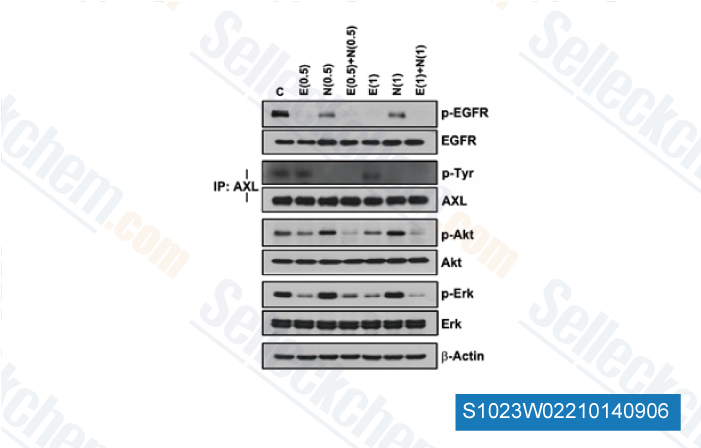
-
Daten von [ Cancer Res , 2014 , 4(1):253-62 ]
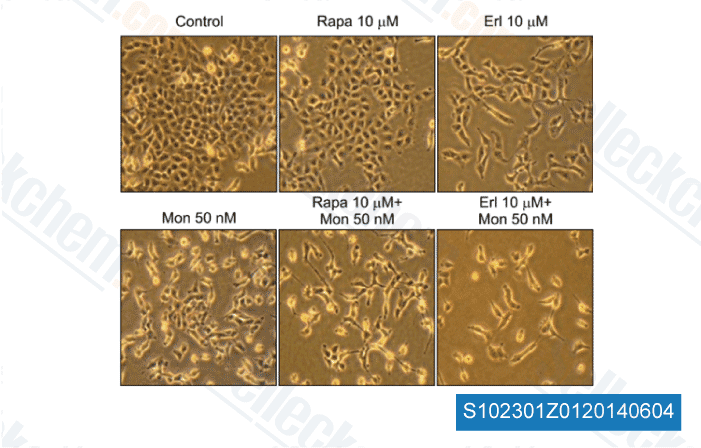
-
Daten von [ Tuberc Respir Dis , 2013 , 75(1), 9-17 ]
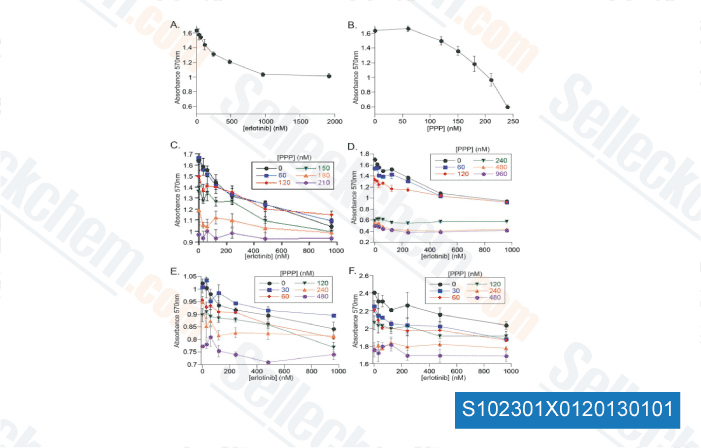
-
Daten von [ Head Neck , 2013 , 35, 86-93 ]
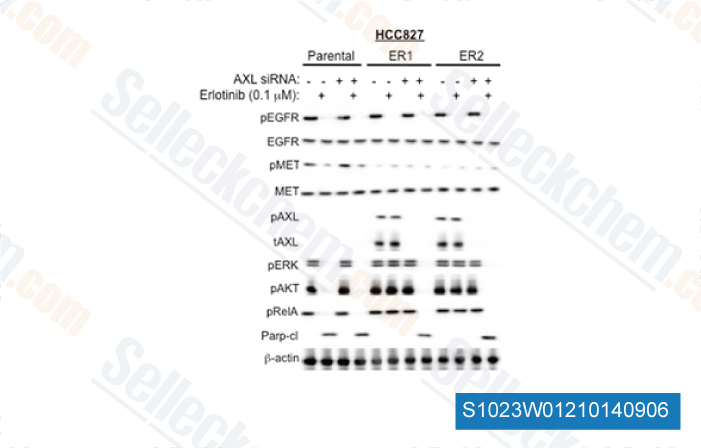
-
Daten von [ Nat Genet , 2012 , 44(8):852-60 ]
Sellecks Erlotinib (CP-358774) Hydrochloride Wurde zitiert von 586 Publikationen
| Lysosomal EGFR acts as a Rheb-GEF independent of its kinase activity to activate mTORC1 [ Cell Res, 2025, 10.1038/s41422-025-01110-x] | PubMed: 40259053 |
| Identifying potential risk genes for clear cell renal cell carcinoma with deep reinforcement learning [ Nat Commun, 2025, 16(1):3591] | PubMed: 40234405 |
| Reciprocal regulation of MMP-28 and EGFR is required for sustaining proliferative signaling in PDAC [ J Exp Clin Cancer Res, 2025, 44(1):68] | PubMed: 39994761 |
| Integration of 3D bioprinting and multi-algorithm machine learning identified glioma susceptibilities and microenvironment characteristics [ Cell Discov, 2024, 10(1):39] | PubMed: 38594259 |
| RAB22A sorts epithelial growth factor receptor (EGFR) from early endosomes to recycling endosomes for microvesicles release [ J Extracell Vesicles, 2024, 13(7):e12494] | PubMed: 39051763 |
| Metabolic imaging distinguishes ovarian cancer subtypes and detects their early and variable responses to treatment [ Oncogene, 2024, 10.1038/s41388-024-03231-w] | PubMed: 39639170 |
| Hepatocellular RECK as a Critical Regulator of Metabolic Dysfunction-Associated Steatohepatitis Development [ Cell Mol Gastroenterol Hepatol, 2024, S2352-345X(24)00119-X] | PubMed: 38797477 |
| Establishment, characterization, and biobanking of 36 pancreatic cancer organoids: prediction of metastasis in resectable pancreatic cancer [ Cell Oncol (Dordr), 2024, 10.1007/s13402-024-00939-5] | PubMed: 38619751 |
| The deubiquitinase USP9X regulates RIT1 protein abundance and oncogenic phenotypes [ iScience, 2024, 27(8):110499] | PubMed: 39161959 |
| Patient-derived rhabdomyosarcoma cells recapitulate the genetic and transcriptomic landscapes of primary tumors [ iScience, 2024, 27(10):110862] | PubMed: 39319271 |
RÜCKGABERICHTLINIE
Die bedingungslose Rückgaberichtlinie von Selleck Chemical gewährleistet unseren Kunden ein reibungsloses Online-Einkaufserlebnis. Wenn Sie in irgendeiner Weise mit Ihrem Kauf unzufrieden sind, können Sie jeden Artikel innerhalb von 7 Tagen nach Erhalt zurückgeben. Im Falle von Produktqualitätsproblemen, sei es protokollbezogene oder produktbezogene Probleme, können Sie jeden Artikel innerhalb von 365 Tagen ab dem ursprünglichen Kaufdatum zurückgeben. Bitte befolgen Sie die nachstehenden Anweisungen, wenn Sie Produkte zurücksenden.
VERSAND UND LAGERUNG
Selleck-Produkte werden bei Raumtemperatur transportiert. Wenn Sie das Produkt bei Raumtemperatur erhalten, seien Sie versichert, dass die Qualitätskontrollabteilung von Selleck Experimente durchgeführt hat, um zu überprüfen, dass die normale Temperaturplatzierung von einem Monat die biologische Aktivität von Pulverprodukten nicht beeinträchtigt. Nach dem Sammeln lagern Sie das Produkt bitte gemäß den in der Datenblatt beschriebenen Anforderungen. Die meisten Selleck-Produkte sind unter den empfohlenen Bedingungen stabil.
NICHT FÜR DIE ANWENDUNG AM MENSCHEN, FÜR VETERINÄRMEDIZINISCHE DIAGNOSTIK ODER THERAPEUTISCHE ZWECKE.