
Technische Daten
| Formel | C19H33NO2.HCl |
||||||
| Molekulargewicht | 343.9 | CAS-Nr. | 162359-56-0 | ||||
| Löslichkeit (25°C)* | In vitro | DMSO | 69 mg/mL (200.63 mM) | ||||
| Water | 69 mg/mL (200.63 mM) | ||||||
| Ethanol | 69 mg/mL (200.63 mM) | ||||||
| In vivo (Lösungsmittel einzeln und der Reihe nach zum Produkt hinzufügen.) |
|
||||||
|
* <1 mg/ml bedeutet schwer löslich oder unlöslich. * Bitte beachten Sie, dass Selleck die Löslichkeit aller Verbindungen intern testet und die tatsächliche Löslichkeit geringfügig von veröffentlichten Werten abweichen kann. Dies ist normal und ist auf geringfügige Batch-zu-Batch-Variationen zurückzuführen. * Versand bei Raumtemperatur (Stabilitätstests zeigen, dass dieses Produkt ohne Kühlmaßnahmen versendet werden kann.) |
|||||||
Vorbereitung von Stammlösungen
Biologische Aktivität
| Beschreibung | Fingolimod (FTY720, Fingolimod Hydrochloride) HCl ist ein S1P-Antagonist mit einer IC50 von 0,033 nM in K562- und NK-Zellen. Bitte verwenden Sie zur Verdünnung Kochsalzlösung anstelle von PBS. PBS kann zur Ausfällung führen. | ||
|---|---|---|---|
| Ziele |
|
||
| In vitro | Die hemmende Wirkung von S1P wird durch verschiedene Konzentrationen von FTY720 mit einem IC50-Effekt von 173 nM aufgehoben. Darüber hinaus hat FTY720 (10 nM) allein keinen Einfluss auf die Expression kostimulatorischer Moleküle. FTY720 hebt die durch S1P induzierte erhöhte Expression von HLA-I sowohl für die Prozentsätze der Zellen als auch für den MFI auf, wenn der Effekt von S1P mit dem Effekt der Kombination von S1P mit FTY720 verglichen wird. Mittlere und hochdosierte FTY720-P erhöhen auch die TGF-β1-Spiegel. Die TGF-β1- und Foxp3-mRNA-Expression sind in der hochdosierten FTY720-P-Gruppe hochreguliert. Die Proliferation von Effektor-T-Zellen wird in der mittleren und hochdosierten FTY720-P-Gruppe bei einem Treg/Teff-Zellverhältnis von 1:1 signifikant unterdrückt. Bei einem Verhältnis von 1:1 wird die Proliferation von Effektor-T-Zellen auch in der hochdosierten FTY720-Gruppe unterdrückt. |
||
| In vivo | FTY720 ist bei Ph+, aber nicht bei Ph- ALL-Xenotransplantaten unter Verwendung eines frühen Krankheitsmodells wirksam. FTY720 führt zu einer signifikanten Reduktion der Krankheitslast in den Ph+ ALL-Xenotransplantaten unter Verwendung eines frühen Krankheitsmodells. Ph+ menschliche ALL-Xenotransplantate sprechen auf FTY720 mit einer 80%igen Reduktion der Gesamterkrankung an, wenn die Behandlung frühzeitig begonnen wurde. Im Gegensatz dazu führt die Behandlung von Mäusen mit FTY720 nicht zu einer reduzierten Leukämie im Vergleich zu Kontrollen unter Verwendung von vier separaten menschlichen Ph- ALL-Xenotransplantaten. |
Protokoll (aus Referenz)
| Zell-Assay: |
|
|---|---|
| Tierstudie: |
|
Referenzen
|
Kundenproduktvalidierung
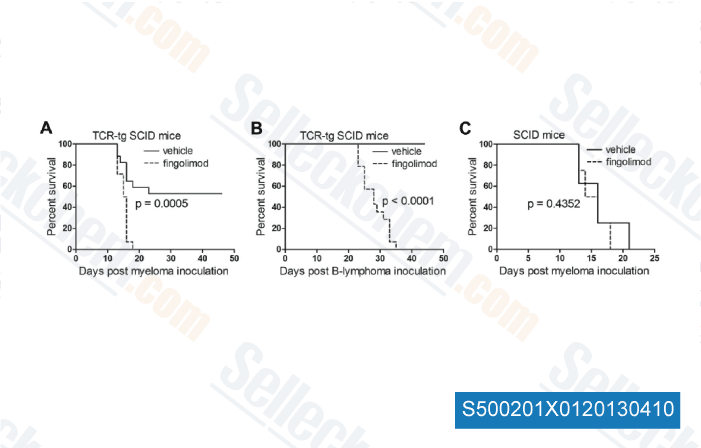
-
Daten von [ Blood , 2012 , 119, 2176-2177 ]
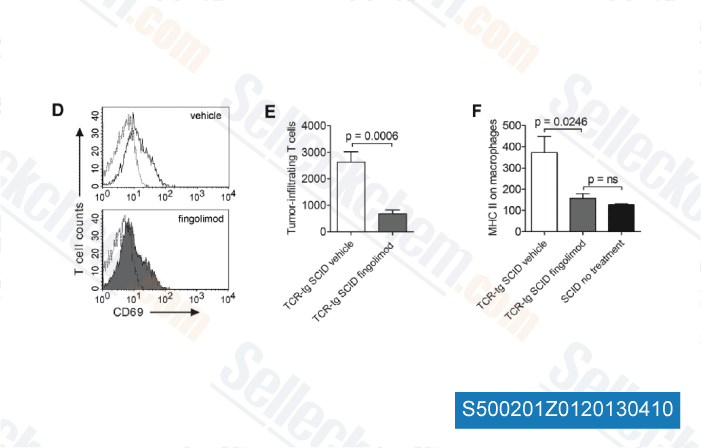
-
Daten von [ Blood , 2012 , 119, 2176-2177 ]
![<p>FTY720 treatment of ECM decreases lymphocyte numbers and granzyme A mRNA in the brain. (A) Relative CD8+ and (B) CD4+ T-cell numbers isolated from the brains of mice infected for 6 d. Numbers were decreased in animals treated with FTY720 1 d before infection and 1 d p.i. (CD4+: P < 0.5 and P < 0.001, CD8+: P < 0.5 and P < 0.01 respectively, KW and DMC, two pooled IE, n ≥ 4/group/IE) (C) GZMA mRNA levels were decreased in the brains of FTY720-treated animals compared with control animals: for (FTY720 [–1], P < 0.05, FTY720 [+1] P > 0.05 and FTY720 [+3], P < 0.01; KW and DMC, two pooled IE, n ≥ 3/group/IE).</p>](https://file.selleckchem.com/downloads/review/700px/FTY720-S500201X0220110801.gif)
-
Daten von [ Mol Med , 2011 , 17, 717- 725 ]
Sellecks FTY720 (Fingolimod) Hydrochloride Wurde zitiert von 139 Publikationen
| Fc-optimized CD40 agonistic antibody elicits tertiary lymphoid structure formation and systemic antitumor immunity in metastatic cancer [ Cancer Cell, 2025, S1535-6108(25)00319-8] | PubMed: 40816292 |
| A pan-immunotherapy signature to predict intratumoral CD8+ T cell expansions [ Nat Commun, 2025, 16(1):9175] | PubMed: 41115883 |
| S1PR1-biased activation drives the resolution of endothelial dysfunction-associated inflammatory diseases by maintaining endothelial integrity [ Nat Commun, 2025, 16(1):1826] | PubMed: 39979282 |
| PLZF-expressing CD4+ T cells promote tissue-resident memory T cells in breaking immune tolerance in allergic asthma via IL-15/IL-15Rα signaling [ Cell Commun Signal, 2025, 23(1):138] | PubMed: 40089783 |
| PP2A attenuates α-amanitin-induced liver injury by promoting autophagy and inhibiting apoptosis in mouse models [ Chem Biol Interact, 2025, 417:111558] | PubMed: 40379039 |
| Helminth infection induces neuroimmune remodeling and clinical remission in a mouse model of multiple sclerosis [ bioRxiv, 2025, 2025.09.02.672458] | PubMed: 40950041 |
| Intratumoral delivery of lipid nanoparticle-formulated mRNA encoding IL-21, IL-7, and 4-1BBL induces systemic anti-tumor immunity [ Nat Commun, 2024, 15(1):10635] | PubMed: 39639025 |
| Anti-PD-1 therapy triggers Tfh cell-dependent IL-4 release to boost CD8 T cell responses in tumor-draining lymph nodes [ J Exp Med, 2024, 221(4)e20232104] | PubMed: 38417020 |
| A dual-STING-activating nanosystem expands cancer immunotherapeutic temporal window [ Cell Rep Med, 2024, S2666-3791(24)00544-5] | PubMed: 39454571 |
| SPHK1 promotes bladder cancer metastasis via PD-L2/c-Src/FAK signaling cascade [ Cell Death Dis, 2024, 15(9):678] | PubMed: 39284838 |
RÜCKGABERICHTLINIE
Die bedingungslose Rückgaberichtlinie von Selleck Chemical gewährleistet unseren Kunden ein reibungsloses Online-Einkaufserlebnis. Wenn Sie in irgendeiner Weise mit Ihrem Kauf unzufrieden sind, können Sie jeden Artikel innerhalb von 7 Tagen nach Erhalt zurückgeben. Im Falle von Produktqualitätsproblemen, sei es protokollbezogene oder produktbezogene Probleme, können Sie jeden Artikel innerhalb von 365 Tagen ab dem ursprünglichen Kaufdatum zurückgeben. Bitte befolgen Sie die nachstehenden Anweisungen, wenn Sie Produkte zurücksenden.
VERSAND UND LAGERUNG
Selleck-Produkte werden bei Raumtemperatur transportiert. Wenn Sie das Produkt bei Raumtemperatur erhalten, seien Sie versichert, dass die Qualitätskontrollabteilung von Selleck Experimente durchgeführt hat, um zu überprüfen, dass die normale Temperaturplatzierung von einem Monat die biologische Aktivität von Pulverprodukten nicht beeinträchtigt. Nach dem Sammeln lagern Sie das Produkt bitte gemäß den in der Datenblatt beschriebenen Anforderungen. Die meisten Selleck-Produkte sind unter den empfohlenen Bedingungen stabil.
NICHT FÜR DIE ANWENDUNG AM MENSCHEN, FÜR VETERINÄRMEDIZINISCHE DIAGNOSTIK ODER THERAPEUTISCHE ZWECKE.