
Technische Daten
| Formel | C21H20ClNO5 |
||||||
| Molekulargewicht | 401.84 | CAS-Nr. | 146426-40-6 | ||||
| Löslichkeit (25°C)* | In vitro | DMSO | 80 mg/mL (199.08 mM) | ||||
| Water | Insoluble | ||||||
| Ethanol | Insoluble | ||||||
| In vivo (Lösungsmittel einzeln und der Reihe nach zum Produkt hinzufügen.) |
|
||||||
|
* <1 mg/ml bedeutet schwer löslich oder unlöslich. * Bitte beachten Sie, dass Selleck die Löslichkeit aller Verbindungen intern testet und die tatsächliche Löslichkeit geringfügig von veröffentlichten Werten abweichen kann. Dies ist normal und ist auf geringfügige Batch-zu-Batch-Variationen zurückzuführen. * Versand bei Raumtemperatur (Stabilitätstests zeigen, dass dieses Produkt ohne Kühlmaßnahmen versendet werden kann.) |
|||||||
Vorbereitung von Stammlösungen
Biologische Aktivität
| Beschreibung | Flavopiridol (Alvocidib) konkurriert mit ATP, um CDKs zu hemmen, einschließlich CDK1, CDK2, CDK4, CDK6 und CDK9 mit IC50-Werten im Bereich von 20-100 nM. Es ist selektiver für CDK1, 2, 4, 6, 9 im Vergleich zu CDK7. Flavopiridol hemmt ursprünglich EGFR und PKA. Flavopiridol induziert autophagy und ER-Stress. Flavopiridol blockiert die HIV-1-Replikation. Phase 1/2. | |||||||||||
|---|---|---|---|---|---|---|---|---|---|---|---|---|
| Ziele |
|
|||||||||||
| In vitro | Flavopiridol (Alvocidib) zeigt weniger Aktivität gegen nicht verwandte Kinasen wie MAP, PAK, PKC und EGFR mit einer IC50 von >14 μM. Es hemmt signifikant das Koloniewachstum von HCT116-, A2780-, PC3- und Mia PaCa-2-Zellen mit einer IC50 von 13 nM, 15 nM, 10 nM bzw. 36 nM. Diese Verbindung hemmt auch potent die Aktivität der Glykogensynthasekinase-3 (GSK-3) mit einer IC50 von 280 nM. Im Vergleich zu anderen CDKs hemmt es die Aktivität von CDK7 weniger potent mit einer IC50 von 875 nM. Bei 0,5 μM hemmt es sowohl pSer807/811 Rb als auch pThr199 NPM, während milde Veränderungen bei pThr821 Rb beobachtet werden. Es verringert auch den gesamten RNA-Polymerase-II-Spiegel sowie die Phosphorylierung der RNA-Polymerase II an den CTD-Wiederholungen bei Ser2 Ser5. Als Breitband-CDK-Inhibitor kann es den Cell Cycle in G1 oder G2 hemmen. Bei 0,3 μM induziert es einen G1-Arrest in MCF-7- oder MDA-MB-468-Zellen durch Hemmung der CDK4- oder CDK2-Kinaseaktivität. Es zeigt eine potente Zytotoxizität gegen eine Vielzahl von Tumorzelllinien mit IC50-Werten von 16 nM für LNCAP bis 130 nM für K562. | |||||||||||
| In vivo | Die Verabreichung von S1230 mit 7,5 mg/kg über 7 Tage zeigt eine leichte Antitumoraktivität gegen P388-Mausleukämie, was zu einem %T/C-Wert von 110 führt, und ist aktiv gegen das subkutan in Nacktmäuse implantierte humane A2780-Ovarialkarzinom, wobei ein 1,5 log cell kill (LCK) erzeugt wird. Die S1230-Behandlung mit 1-2,5 mg/kg über 10 Tage unterdrückt signifikant die kollageninduzierte Arthritis bei Mäusen dosisabhängig, indem sie die synoviale Hyperplasie und Gelenkzerstörung hemmt, während die Serumkonzentrationen von Anti-Kollagen Typ II (CII) Antikörpern und proliferative Reaktionen auf CII aufrechterhalten bleiben. In p21-intakten Hct116-Xenotransplantaten in Nacktmäusen hemmt die Verabreichung von CPT-11 (100 mg/kg) gefolgt von S1230 (3 mg/kg) 7 und 16 Stunden später die Tumorregression signifikant um 86 % bzw. 82 %, was eine >2-fache Hemmung im Vergleich zu CPT-11 allein um 40 % zeigt. Die Kombination führt zu einer kompletten Ansprechrate (CR) von ~30 %, im Gegensatz zu CPT-11 allein, wo keine CR gefunden wird. | |||||||||||
| Merkmale | Erster CDK-Inhibitor, der in humanen klinischen Studien eingesetzt wurde. |
Protokoll (aus Referenz)
| Kinase-Assay: |
|
|---|---|
| Zell-Assay: |
|
| Tierstudie: |
|
Referenzen
|
Kundenproduktvalidierung
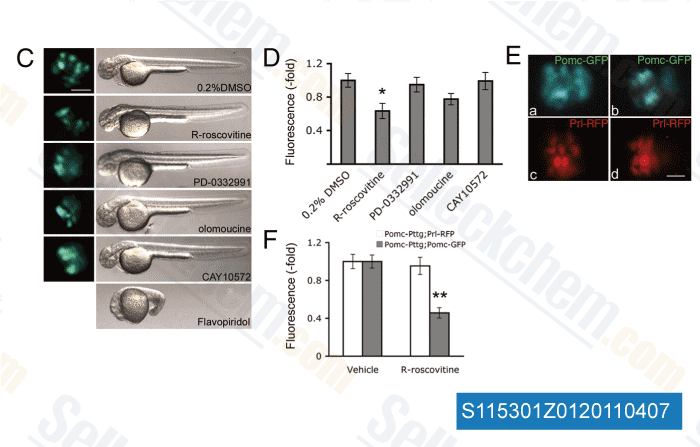
-
Daten von [ PNAS , 2011 , 108, 8417 ]
![(A) After mitotic arrest and treatment with the proteasome inhibitor MG132, HeLa cells were treated with the indicated kinase inhibitors The cells were harvested, and the lysates were separated by SDS-PAGE and immunoblotted for phosphorylated RV[S/T]F (p-RV[S/T]F, top). The blot was quantified using ImageJ software and normalized to the mitotic sample (bottom). MLN8054, Aurora A and Aurora B inhibitor; ZM447439 and hesperadin, Aurora B inhibitors; BI2536, PLK1 inhibitor; flavopiridol, CDK1 inhibitor. n = 3. **P < 0.01, paired Student’s t test.](https://file.selleckchem.com/downloads/review/700px/flavopiridol-S123001W0420180614.gif)
-
Daten von [ , , Science, 2018, 11(530), doi: 10.1126/scisignal.aai8669 ]
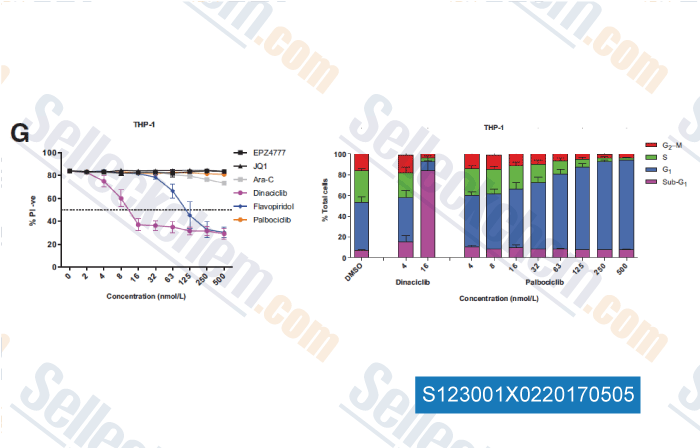
-
Daten von [ , , Cancer Res, 2016, 76(5):1158-69 ]
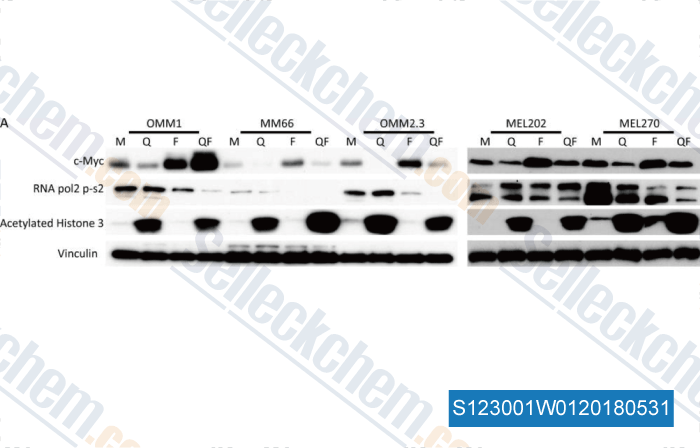
-
Daten von [ , , Oncotarget, 2018, 9(5): 6174-6187 ]
Sellecks Flavopiridol (Alvocidib, HMR-1275) Wurde zitiert von 149 Publikationen
| SLFN11-mediated ribosome biogenesis impairment induces TP53-independent apoptosis [ Mol Cell, 2025, S1097-2765(25)00042-5] | PubMed: 39909041 |
| Combined therapy with DR5-targeting antibody-drug conjugate and CDK inhibitors as a strategy for advanced colorectal cancer [ Cell Rep Med, 2025, S2666-3791(25)00231-9] | PubMed: 40449480 |
| Maternal CENP-C restores centromere symmetry in mammalian zygotes to ensure proper chromosome segregation [ Dev Cell, 2025, S1534-5807(25)00537-4] | PubMed: 40997799 |
| Identification of modulators of the ALT pathway through a native FISH-based optical screen [ Cell Rep, 2025, 44(1):115114] | PubMed: 39729394 |
| Identifying Age-Modulating Compounds Using a Novel Computational Framework for Evaluating Transcriptional Age [ Aging Cell, 2025, e70075] | PubMed: 40307992 |
| Protection of infant mice against pertussis, tuberculosis and influenza by co-administration of nasal pertussis vaccine candidate BPZE1 and BCG [ iScience, 2025, 28(7):112839] | PubMed: 40612502 |
| Replication-competent adenovirus reporters utilizing endogenous viral expression architecture [ J Virol, 2025, 99(10):e0114625] | PubMed: 40928252 |
| BET degraders reveal BRD4 disruption of 7SK and P-TEFb is critical for effective reactivation of latent HIV in CD4+ T-cells [ J Virol, 2025, 99(4):e0177724] | PubMed: 40067013 |
| Repurposing flavopiridol as an inhaled therapeutic for pulmonary fibrosis [ Eur J Pharmacol, 2025, 1005:178058] | PubMed: 40816528 |
| Bacterial ubiquitin ligase engineered for small molecule and protein target identification [ bioRxiv, 2025, 2025.03.20.644192] | PubMed: 40166235 |
RÜCKGABERICHTLINIE
Die bedingungslose Rückgaberichtlinie von Selleck Chemical gewährleistet unseren Kunden ein reibungsloses Online-Einkaufserlebnis. Wenn Sie in irgendeiner Weise mit Ihrem Kauf unzufrieden sind, können Sie jeden Artikel innerhalb von 7 Tagen nach Erhalt zurückgeben. Im Falle von Produktqualitätsproblemen, sei es protokollbezogene oder produktbezogene Probleme, können Sie jeden Artikel innerhalb von 365 Tagen ab dem ursprünglichen Kaufdatum zurückgeben. Bitte befolgen Sie die nachstehenden Anweisungen, wenn Sie Produkte zurücksenden.
VERSAND UND LAGERUNG
Selleck-Produkte werden bei Raumtemperatur transportiert. Wenn Sie das Produkt bei Raumtemperatur erhalten, seien Sie versichert, dass die Qualitätskontrollabteilung von Selleck Experimente durchgeführt hat, um zu überprüfen, dass die normale Temperaturplatzierung von einem Monat die biologische Aktivität von Pulverprodukten nicht beeinträchtigt. Nach dem Sammeln lagern Sie das Produkt bitte gemäß den in der Datenblatt beschriebenen Anforderungen. Die meisten Selleck-Produkte sind unter den empfohlenen Bedingungen stabil.
NICHT FÜR DIE ANWENDUNG AM MENSCHEN, FÜR VETERINÄRMEDIZINISCHE DIAGNOSTIK ODER THERAPEUTISCHE ZWECKE.