
Technische Daten
| Formel | C23H27N7O3S2 |
||||||
| Molekulargewicht | 513.64 | CAS-Nr. | 957054-30-7 | ||||
| Löslichkeit (25°C)* | In vitro | DMSO | 100 mg/mL (194.68 mM) | ||||
| Water | Insoluble | ||||||
| Ethanol | Insoluble | ||||||
| In vivo (Lösungsmittel einzeln und der Reihe nach zum Produkt hinzufügen.) |
|
||||||
|
* <1 mg/ml bedeutet schwer löslich oder unlöslich. * Bitte beachten Sie, dass Selleck die Löslichkeit aller Verbindungen intern testet und die tatsächliche Löslichkeit geringfügig von veröffentlichten Werten abweichen kann. Dies ist normal und ist auf geringfügige Batch-zu-Batch-Variationen zurückzuführen. * Versand bei Raumtemperatur (Stabilitätstests zeigen, dass dieses Produkt ohne Kühlmaßnahmen versendet werden kann.) |
|||||||
Vorbereitung von Stammlösungen
Biologische Aktivität
| Beschreibung | Pictilisib (GDC-0941, RG7321) ist ein potenter Inhibitor von PI3Kα/δ mit einer IC50 von 3 nM in zellfreien Assays, mit moderater Selektivität gegenüber p110β (11-fach) und p110γ (25-fach). Pictilisib (GDC-0941) induziert Autophagy und Apoptosis. Phase 2. | ||||||||||
|---|---|---|---|---|---|---|---|---|---|---|---|
| Ziele |
|
||||||||||
| In vitro | Pictilisib (GDC-0941) ist gleich wirksam gegen PI3Kα und PI3Kδ sowie gegen PI3Kα-Mutanten E545-K und H1047-R und zeigt eine moderate Selektivität gegenüber PI3Kβ (10-fach) und PI3Kγ (25-fach) sowie eine höhere Selektivität gegenüber Mitgliedern der PI3K-Klasse II, III und IV, einschließlich C2β, Vps34, DNA-PK und mTOR. Es hemmt potent die Phosphorylierung von Akt in U87MG-, PC3- und MDA-MB-361-Zellen mit einer IC50 von 46 nM, 37 nM bzw. 28 nM. Diese Verbindung hemmt die Proliferation von U87MG-, A2780-, PC3- und MDA-MB-361-Zellen mit einer IC50 von 0,95 μM, 0,14 μM, 0,28 μM bzw. 0,72 μM. Es hemmt die Proliferation von HER2-amplifizierten Zellen, die PIK3CA-Mutationen aufweisen, mit einer IC50 von <500 nM und hemmt effektiv sowohl die Proliferation als auch die Viabilität von HER2-amplifizierten Brustkrebszellen. Es hemmt signifikant das Wachstum von HCT116-, DLD1- und HT29-Zellen mit einer GI50 von 1081 nM, 1070 nM bzw. 157 nM. Es hemmt auch die Proliferation von Tumorzellen, induziert Apoptose und unterdrückt die Keimzellpopulation. |
||||||||||
| In vivo | Pictilisib (GDC-0941) zeigt einen begrenzten mikrosomalen Metabolismus, was zu einer oralen Bioverfügbarkeit von 78% führt . Die Verabreichung dieser Verbindung in einer Dosis von 75 mg/kg/Tag zeigt eine signifikante hemmende Wirkung gegen etablierte humane U87MG-Glioblastom-Xenotransplantate in weiblichen NCr-athymischen Mäusen, mit einer Tumorwachstumshemmung von 83%. Die orale Verabreichung von 150 mg/kg/Tag hemmt das Wachstum von HER2-amplifizierten MDA-MB-361.1-Xenotransplantaten in Mäusen und verzögert signifikant die Tumorprogression, verbunden mit einer potent induzierten Apoptose in Tumoren. Die Behandlung damit (75 mg/kg/Tag) über 2 Wochen führt zu einer Reduktion des Tumorvolumens von spontanen B-Zell-Follikulären Lymphomen, die sich in PTEN+/-LKB1+/hypo-Mäusen entwickeln, um ca. 40%, begleitet von einer Ablation der Phosphorylierung von Akt-, S6K- und SGK-Proteinkinasen (Serum- und Glukokortikoid-Proteinkinase). |
Protokoll (aus Referenz)
| Kinase-Assay: |
|
|---|---|
| Zell-Assay: |
|
| Tierstudie: |
|
Referenzen
|
Kundenproduktvalidierung
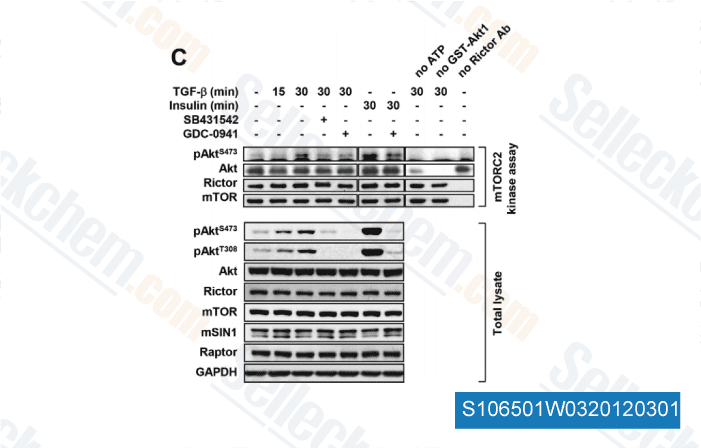
-
Daten von [ J Cell Sci , 2012 , 125(Pt 5), 1259-73 ]
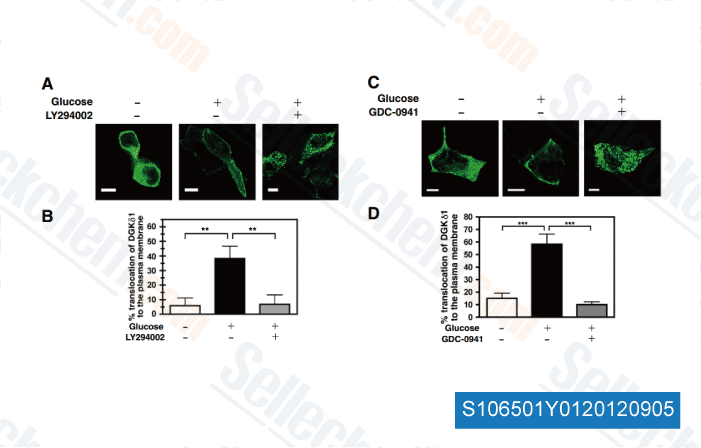
-
Daten von [ Biochim Biophys Acta , 2012 , 1823, 2210-6 ]
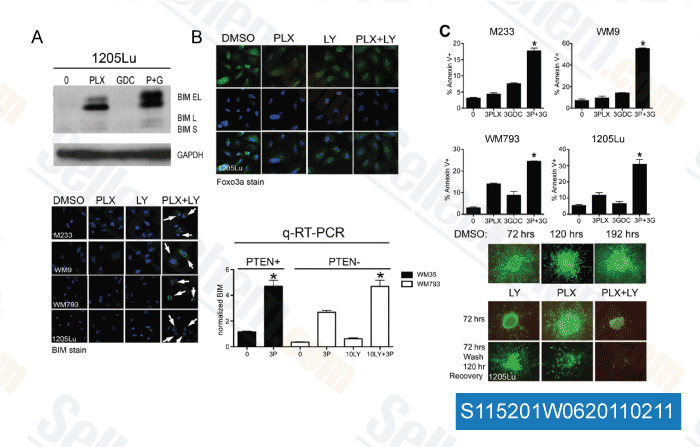
-
Daten von [ Cancer Res , 2011 , 71, 2750-2760 ]
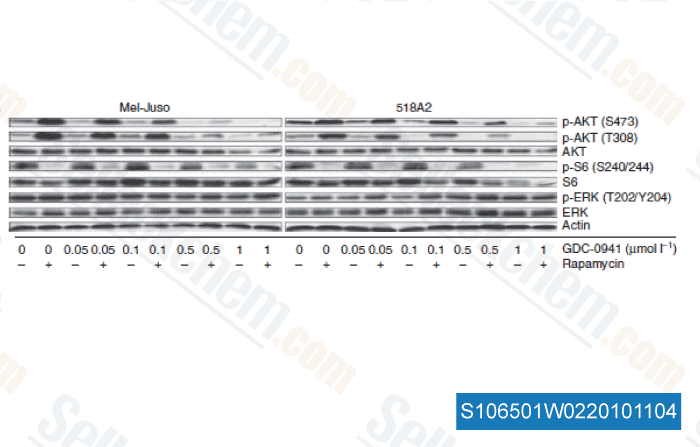
-
Daten von [ J Inves Der , 2010 , 131, 495-503 ]
Sellecks Pictilisib (GDC-0941) Wurde zitiert von 461 Publikationen
| Targeting PI3K inhibitor resistance in breast cancer with metabolic drugs [ Signal Transduct Target Ther, 2025, 10(1):92] | PubMed: 40113784 |
| Spike-in enhanced phosphoproteomics uncovers synergistic signaling responses to MEK inhibition in colon cancer cells [ Nat Commun, 2025, 16(1):4884] | PubMed: 40419504 |
| Axial nephron fate switching demonstrates a plastic system tunable on demand [ Nat Commun, 2025, 16(1):7912] | PubMed: 40855070 |
| EGFR TKIs suppress MUC1 glycosylation through the PI3K/AKT/SP1/C1GALT1 pathway to enhance TnMUC1 CAR-T efficacy in EGFR-mutant NSCLC [ Cell Rep Med, 2025, S2666-3791(25)00272-1] | PubMed: 40562040 |
| Heterogeneous Activation of Signaling Pathways and Therapeutic Vulnerabilities in KSHV-Associated Primary Effusion Lymphoma Cell Lines [ J Med Virol, 2025, 97(8):e70534] | PubMed: 40751690 |
| Separase Inhibition Enhances Gefitinib Sensitivity of Lung Cancer via PTBP1/TAK1/RIPK1-Mediated PANoptosis [ MedComm (2020), 2025, 6(11):e70432] | PubMed: 41122447 |
| Lactate shuttle between cytotrophoblast and syncytiotrophoblast in the placenta enhances ferroptosis resistance and maintains placental homeostasis: implications for early pregnancy loss [ Cell Commun Signal, 2025, 23(1):438] | PubMed: 41088442 |
| Anthrax ET activates Rac1 and RTK signaling to induce F-actin reorganization and endothelial permeability [ iScience, 2025, 28(11):113682] | PubMed: 41158867 |
| Anti-Influenza Activity of 6BIGOE: Improved Pharmacological Profile After Encapsulation in PLGA Nanoparticles [ Int J Mol Sci, 2025, 26(9)4235] | PubMed: 40362470 |
| Cartilage Oligomeric Matrix Protein Promotes Radiation Resistance in Non-Small Cell Lung Cancer In Vitro [ Int J Mol Sci, 2025, 26(6)2465] | PubMed: 40141111 |
RÜCKGABERICHTLINIE
Die bedingungslose Rückgaberichtlinie von Selleck Chemical gewährleistet unseren Kunden ein reibungsloses Online-Einkaufserlebnis. Wenn Sie in irgendeiner Weise mit Ihrem Kauf unzufrieden sind, können Sie jeden Artikel innerhalb von 7 Tagen nach Erhalt zurückgeben. Im Falle von Produktqualitätsproblemen, sei es protokollbezogene oder produktbezogene Probleme, können Sie jeden Artikel innerhalb von 365 Tagen ab dem ursprünglichen Kaufdatum zurückgeben. Bitte befolgen Sie die nachstehenden Anweisungen, wenn Sie Produkte zurücksenden.
VERSAND UND LAGERUNG
Selleck-Produkte werden bei Raumtemperatur transportiert. Wenn Sie das Produkt bei Raumtemperatur erhalten, seien Sie versichert, dass die Qualitätskontrollabteilung von Selleck Experimente durchgeführt hat, um zu überprüfen, dass die normale Temperaturplatzierung von einem Monat die biologische Aktivität von Pulverprodukten nicht beeinträchtigt. Nach dem Sammeln lagern Sie das Produkt bitte gemäß den in der Datenblatt beschriebenen Anforderungen. Die meisten Selleck-Produkte sind unter den empfohlenen Bedingungen stabil.
NICHT FÜR DIE ANWENDUNG AM MENSCHEN, FÜR VETERINÄRMEDIZINISCHE DIAGNOSTIK ODER THERAPEUTISCHE ZWECKE.