
Technische Daten
| Formel | C18H11N3O2S |
||||||||||||||
| Molekulargewicht | 333.36 | CAS-Nr. | 958852-01-2 | ||||||||||||
| Löslichkeit (25°C)* | In vitro | DMSO | 2 mg/mL (5.99 mM) | ||||||||||||
| Water | Insoluble | ||||||||||||||
| Ethanol | Insoluble | ||||||||||||||
| In vivo (Lösungsmittel einzeln und der Reihe nach zum Produkt hinzufügen.) |
|
||||||||||||||
|
* <1 mg/ml bedeutet schwer löslich oder unlöslich. * Bitte beachten Sie, dass Selleck die Löslichkeit aller Verbindungen intern testet und die tatsächliche Löslichkeit geringfügig von veröffentlichten Werten abweichen kann. Dies ist normal und ist auf geringfügige Batch-zu-Batch-Variationen zurückzuführen. * Versand bei Raumtemperatur (Stabilitätstests zeigen, dass dieses Produkt ohne Kühlmaßnahmen versendet werden kann.) |
|||||||||||||||
Vorbereitung von Stammlösungen
Biologische Aktivität
| Beschreibung | GSK1059615 ist ein dualer Inhibitor von PI3Kα/β/δ/γ (reversibel) und mTOR mit einer IC50 von 0,4 nM/0,6 nM/2 nM/5 nM bzw. 12 nM. Phase 1. | ||||||||||
|---|---|---|---|---|---|---|---|---|---|---|---|
| Ziele |
|
||||||||||
| In vitro | Das Pyridinylchinolin-Derivat GSK1059615 ist ein neuartiger, ATP-kompetitiver und reversibler Inhibitor der Klasse I der PI3Ks. Diese Verbindung hemmt die PI3K-Signalübertragung, induziert G1-Arrest und Apoptose, insbesondere in Brusttumorzellen. Daten, die in einer anderen Übersicht zusammengefasst wurden, zeigen auch, dass dieser Inhibitor PI3Kα, β, γ und δ hemmt, mit Ki von 0,42 nM, 0,6 nM, 0,47 nM bzw. 1,7 nM. Ein weiterer Bericht zeigt, dass diese Chemikalie PI3Kα mit einer IC50 von 2 nM hemmt. In T47D- und BT474-Krebszellen hemmt es die Phosphorylierung von Akt an S473 mit einer IC50 von 40 nM. | ||||||||||
| In vivo | In Xenograft-Mausmodellen von BT474- oder HCC1954-Brustkrebszellen hemmt GSK1059615 (25 mg/kg) das Tumorwachstum wirksam. | ||||||||||
| Merkmale | Ein neuartiger, ATP-kompetitiver und reversibler Inhibitor sowohl von PI3Kα, β, δ und γ als auch von mTOR. |
Protokoll (aus Referenz)
| Kinase-Assay:[4] |
|
|---|---|
| Zell-Assay:[4] |
|
Referenzen
|
Kundenproduktvalidierung
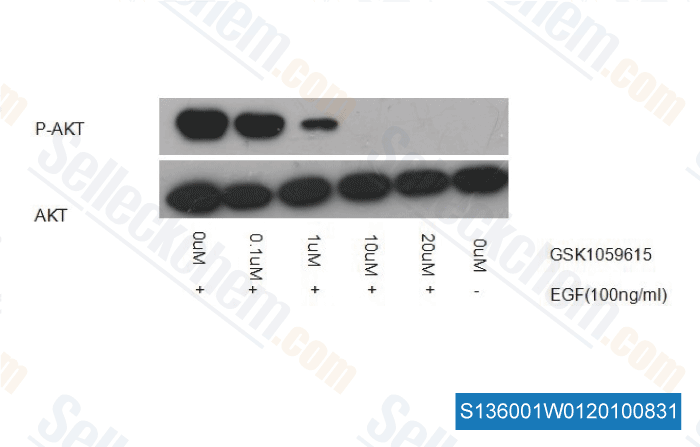
-
, , Dr. Zhang of Tianjin Medical University
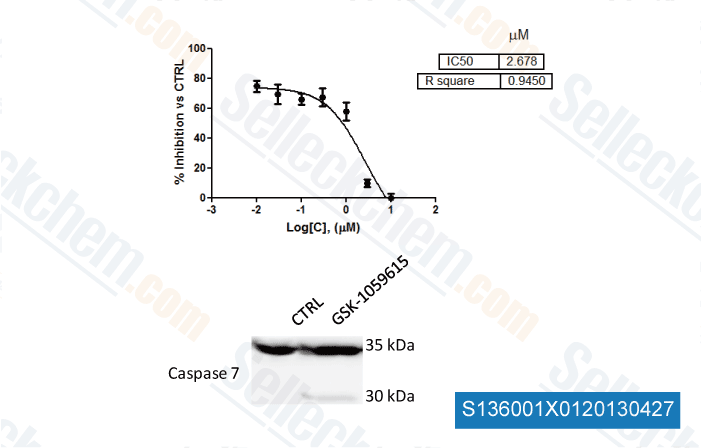
-
, , Antonino Maria Spartà from University of Bologn
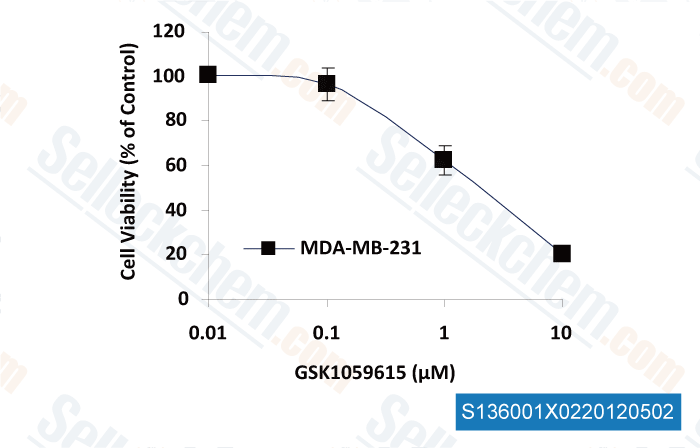
-
, , Dr. Yong-Weon Yi from Georgetown University Medical Center
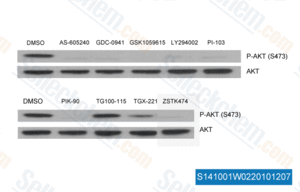
-
, , Saraswati Sukumar of Johns Hopkins University School of Medicine
Sellecks GSK1059615 Wurde zitiert von 15 Publikationen
| PIK-75 overcomes venetoclax resistance via blocking PI3K-AKT signaling and MCL-1 expression in mantle cell lymphoma [ Am J Cancer Res, 2022, 12(3):1102-1115] | PubMed: 35411248 |
| Phytochemicals inhibit migration of triple negative breast cancer cells by targeting kinase signaling. [ BMC Cancer, 2020, 20(1):4] | PubMed: 31898540 |
| Lethal Poisoning of Cancer Cells by Respiratory Chain Inhibition plus Dimethyl α-Ketoglutarate [ Cell Rep, 2019, 27(3):820-834] | PubMed: 30995479 |
| FRET biosensor-based kinase inhibitor screen for ERK and AKT activity reveals differential kinase dependencies for proliferation in TNBC cells. [ Biochem Pharmacol, 2019, 169:113640] | PubMed: 31536726 |
| [ ACS Pharmacol Transl Sci, 2019, ] | PubMed: 32259061 |
| Inhibition of RPTOR overcomes resistance to EGFR inhibition in triple-negative breast cancer cells [ Int J Oncol, 2018, 52(3):828-840] | PubMed: 29344641 |
| Development of a test that measures real-time HER2 signaling function in live breast cancer cell lines and primary cells. [Huang Y, et al. BMC Cancer, 2017, 17(1):199] | PubMed: 28302091 |
| Single and Combination Drug Screening with Aqueous Biphasic Tumor Spheroids [ SLAS Discov, 2017, 22(5):507-515] | PubMed: 28324660 |
| Gerosuppression by pan-mTOR inhibitors [ Aging (Albany NY), 2016, 8(12):3535-3551] | PubMed: 28077803 |
| Multiparametric Analysis of Oncology Drug Screening with Aqueous Two-Phase Tumor Spheroids. [ Mol Pharm, 2016, 13(11):3724-3735] | PubMed: 27653969 |
RÜCKGABERICHTLINIE
Die bedingungslose Rückgaberichtlinie von Selleck Chemical gewährleistet unseren Kunden ein reibungsloses Online-Einkaufserlebnis. Wenn Sie in irgendeiner Weise mit Ihrem Kauf unzufrieden sind, können Sie jeden Artikel innerhalb von 7 Tagen nach Erhalt zurückgeben. Im Falle von Produktqualitätsproblemen, sei es protokollbezogene oder produktbezogene Probleme, können Sie jeden Artikel innerhalb von 365 Tagen ab dem ursprünglichen Kaufdatum zurückgeben. Bitte befolgen Sie die nachstehenden Anweisungen, wenn Sie Produkte zurücksenden.
VERSAND UND LAGERUNG
Selleck-Produkte werden bei Raumtemperatur transportiert. Wenn Sie das Produkt bei Raumtemperatur erhalten, seien Sie versichert, dass die Qualitätskontrollabteilung von Selleck Experimente durchgeführt hat, um zu überprüfen, dass die normale Temperaturplatzierung von einem Monat die biologische Aktivität von Pulverprodukten nicht beeinträchtigt. Nach dem Sammeln lagern Sie das Produkt bitte gemäß den in der Datenblatt beschriebenen Anforderungen. Die meisten Selleck-Produkte sind unter den empfohlenen Bedingungen stabil.
NICHT FÜR DIE ANWENDUNG AM MENSCHEN, FÜR VETERINÄRMEDIZINISCHE DIAGNOSTIK ODER THERAPEUTISCHE ZWECKE.