
Technische Daten
| Formel | C21H27N7O3 |
||||||
| Molekulargewicht | 425.48 | CAS-Nr. | 937174-76-0 | ||||
| Löslichkeit (25°C)* | In vitro | DMSO | 21 mg/mL (49.35 mM) | ||||
| Water | Insoluble | ||||||
| Ethanol | Insoluble | ||||||
| In vivo (Lösungsmittel einzeln und der Reihe nach zum Produkt hinzufügen.) |
|
||||||
|
* <1 mg/ml bedeutet schwer löslich oder unlöslich. * Bitte beachten Sie, dass Selleck die Löslichkeit aller Verbindungen intern testet und die tatsächliche Löslichkeit geringfügig von veröffentlichten Werten abweichen kann. Dies ist normal und ist auf geringfügige Batch-zu-Batch-Variationen zurückzuführen. * Versand bei Raumtemperatur (Stabilitätstests zeigen, dass dieses Produkt ohne Kühlmaßnahmen versendet werden kann.) |
|||||||
Vorbereitung von Stammlösungen
Biologische Aktivität
| Beschreibung | GSK690693 ist ein pan-Akt-Inhibitor, der Akt1/2/3 mit IC50 von 2 nM/13 nM/9 nM in zellfreien Assays hemmt und auch empfindlich gegenüber der AGC-Kinase-Familie ist: PKA, PrkX und PKC-Isoenzyme. GSK690693 hemmt auch potent AMPK und DAPK3 aus der CAMK-Familie mit IC50 von 50 nM bzw. 81 nM. GSK690693 beeinflusst die Aktivität von Unc-51-like autophagy activating kinase 1 (ULK1) und hemmt robust die STING-abhängige IRF3-Aktivierung. Phase 1. | |||||||||||
|---|---|---|---|---|---|---|---|---|---|---|---|---|
| Ziele |
|
|||||||||||
| In vitro | GSK690693 ist sehr selektiv für die Akt-Isoformen gegenüber der Mehrheit der Kinasen in anderen Familien. Allerdings ist diese Verbindung weniger selektiv für Mitglieder der AGC-Kinase-Familie, einschließlich PKA, PrkX und PKC-Isoenzyme, mit IC50 von 24 nM, 5 nM bzw. 2-21 nM. Es hemmt auch potent AMPK und DAPK3 aus der CAMK-Familie mit IC50 von 50 nM bzw. 81 nM, und PAK4, 5 und 6 aus der STE-Familie mit IC50 von 10 nM, 52 nM bzw. 6 nM. Diese Chemikalie hemmt die Phosphorylierung von GSK3β in Tumorzellen mit IC50-Werten von 43 nM bis 150 nM. Ihre Behandlung führt zu einer dosisabhängigen Zunahme der nukleären Akkumulation des Transkriptionsfaktors FOXO3A. Diese Verbindung hemmt potent die Proliferation von T47D-, ZR-75-1-, BT474-, HCC1954-, MDA-MB-453- und LNCaP-Zellen mit IC50 von 72 nM, 79 nM, 86 nM, 119 nM, 975 nM bzw. 147 nM. Ihre Behandlung induziert Apoptose bei Konzentrationen >100 nM sowohl in LNCaP- als auch in BT474-Zellen. Im Einklang mit der Rolle von AKT beim Überleben von Zellen induziert es Apoptose in empfindlichen ALL-Zelllinien. |
|||||||||||
| In vivo | Eine einzige Verabreichung von GSK690693 hemmt die GSK3β-Phosphorylierung in menschlichen Brustkarzinom- (BT474) Xenografts dosis- und zeitabhängig. In ähnlicher Weise induziert diese Verbindung eine Reduktion der Phosphorylierung der Akt-Substrate PRAS40 und FKHR/FKHRL1. Sie führt auch zu einem akuten Anstieg des Blutzuckerspiegels, der 8 bis 10 Stunden nach der Medikamentenverabreichung auf den Ausgangswert zurückkehrt. Die Verabreichung dieser Chemikalie induziert in vivo Reduktionen der phosphorylierten Akt-Substrate und hemmt potent das Wachstum von menschlichen SKOV-3-Ovarial-, LNCaP-Prostata- sowie BT474- und HCC-1954-Brustkarzinom-Xenografts, mit einer maximalen Hemmung von 58 % bis 75 % bei einer Dosis von 30 mg/kg/Tag. Diese Verbindung zeigt Wirksamkeit unabhängig vom Mechanismus der Akt-Aktivierung. Sie ist am effektivsten bei der Verzögerung der Tumorprogression in Lck-MyrAkt2-Mäusen, die eine membrangebundene, konstitutiv aktive Form von Akt exprimieren. |
Protokoll (aus Referenz)
| Kinase-Assay: |
|
|---|---|
| Zell-Assay: |
|
| Tierstudie: |
|
Referenzen
|
Kundenproduktvalidierung
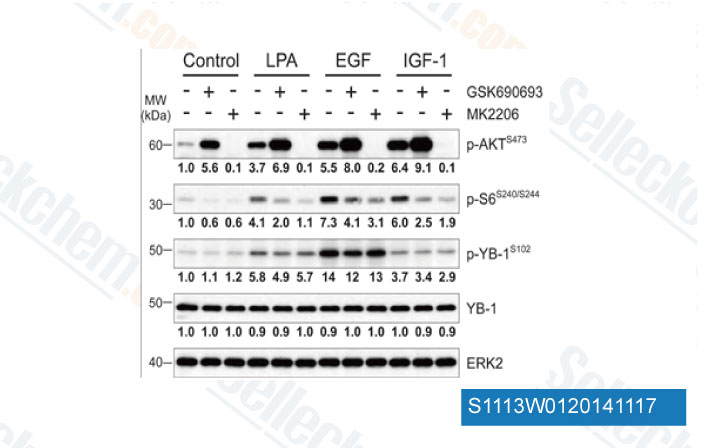
-
Daten von [ Oncogene , 2014 , 33(22), 2846-56 ]
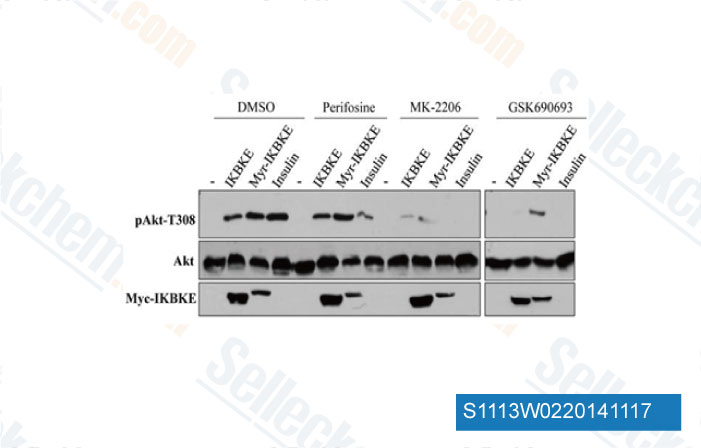
-
Daten von [ J Biol Chem , 2011 , 286(43), 37389-98 ]
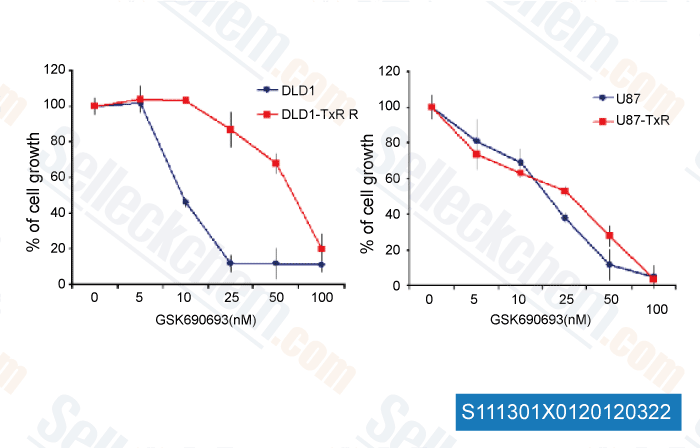
-
, , Dr. Milica Pesic of Institute for Biological Research
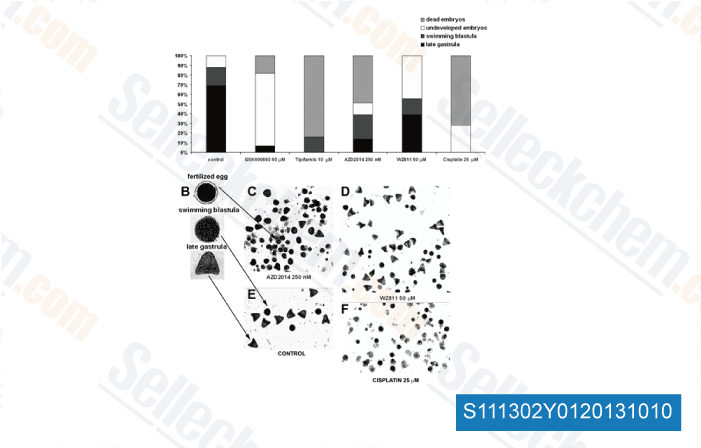
-
, , Dr. Milica Pesic from Institute for Biological Research
Sellecks GSK690693 Wurde zitiert von 127 Publikationen
| Endothelial cell-derived SDF-1α elicits stemness traits of glioblastoma via dual-regulation of GLI1 [ Theranostics, 2025, 15(18):9819-9837] | PubMed: 41041071 |
| High fructose promotes MYCN-amplified neuroblastoma progression through NgBR-ACSS2-mediated biosynthesis of acetyl-CoA [ Cell Rep, 2025, 44(7):115947] | PubMed: 40616844 |
| Staphylococcus aureus utilizes vimentin to internalize human keratinocytes [ Front Cell Infect Microbiol, 2025, 15:1543186] | PubMed: 40061451 |
| Low-Dose Perifosine, a Phase II Phospholipid Akt Inhibitor, Selectively Sensitizes Drug-Resistant ABCB1-Overexpressing Cancer Cells [ Biomol Ther (Seoul), 2025, 33(1):170-181] | PubMed: 39632683 |
| TBK1-Zyxin signaling controls tumor-associated macrophage recruitment to mitigate antitumor immunity [ EMBO J, 2024, 10.1038/s44318-024-00244-9] | PubMed: 39304793 |
| RIG-I is an intracellular checkpoint that limits CD8+ T-cell antitumour immunity [ EMBO Mol Med, 2024, 10.1038/s44321-024-00136-9] | PubMed: 39322862 |
| RIG-I is an intracellular checkpoint that limits CD8+ T-cell antitumor immunity [ EMBO Mol Med, 2024, 16: 3005 - 3025] | PubMed: None |
| Hyperglycemia-induced Sirt3 downregulation increases microglial aerobic glycolysis and inflammation in diabetic neuropathic pain pathogenesis [ CNS Neurosci Ther, 2024, 30(8):e14913] | PubMed: 39123294 |
| TMEM176B Promotes EMT via FGFR/JNK Signalling in Development and Tumourigenesis of Lung Adenocarcinoma [ Cancers (Basel), 2024, 16(13)2447] | PubMed: 39001509 |
| Kinase inhibitor pulldown assay (KiP) for clinical proteomics [ Clin Proteomics, 2024, 21(1):3] | PubMed: 38225548 |
RÜCKGABERICHTLINIE
Die bedingungslose Rückgaberichtlinie von Selleck Chemical gewährleistet unseren Kunden ein reibungsloses Online-Einkaufserlebnis. Wenn Sie in irgendeiner Weise mit Ihrem Kauf unzufrieden sind, können Sie jeden Artikel innerhalb von 7 Tagen nach Erhalt zurückgeben. Im Falle von Produktqualitätsproblemen, sei es protokollbezogene oder produktbezogene Probleme, können Sie jeden Artikel innerhalb von 365 Tagen ab dem ursprünglichen Kaufdatum zurückgeben. Bitte befolgen Sie die nachstehenden Anweisungen, wenn Sie Produkte zurücksenden.
VERSAND UND LAGERUNG
Selleck-Produkte werden bei Raumtemperatur transportiert. Wenn Sie das Produkt bei Raumtemperatur erhalten, seien Sie versichert, dass die Qualitätskontrollabteilung von Selleck Experimente durchgeführt hat, um zu überprüfen, dass die normale Temperaturplatzierung von einem Monat die biologische Aktivität von Pulverprodukten nicht beeinträchtigt. Nach dem Sammeln lagern Sie das Produkt bitte gemäß den in der Datenblatt beschriebenen Anforderungen. Die meisten Selleck-Produkte sind unter den empfohlenen Bedingungen stabil.
NICHT FÜR DIE ANWENDUNG AM MENSCHEN, FÜR VETERINÄRMEDIZINISCHE DIAGNOSTIK ODER THERAPEUTISCHE ZWECKE.