
Technische Daten
| Formel | C33H38N4O6.HCl.3H2O |
||||||
| Molekulargewicht | 677.18 | CAS-Nr. | 136572-09-3 | ||||
| Löslichkeit (25°C)* | In vitro | DMSO | 100 mg/mL (147.67 mM) | ||||
| Ethanol | 5 mg/mL (7.38 mM) | ||||||
| Water | Insoluble | ||||||
| In vivo (Lösungsmittel einzeln und der Reihe nach zum Produkt hinzufügen.) |
|
||||||
|
* <1 mg/ml bedeutet schwer löslich oder unlöslich. * Bitte beachten Sie, dass Selleck die Löslichkeit aller Verbindungen intern testet und die tatsächliche Löslichkeit geringfügig von veröffentlichten Werten abweichen kann. Dies ist normal und ist auf geringfügige Batch-zu-Batch-Variationen zurückzuführen. * Versand bei Raumtemperatur (Stabilitätstests zeigen, dass dieses Produkt ohne Kühlmaßnahmen versendet werden kann.) |
|||||||
Vorbereitung von Stammlösungen
Biologische Aktivität
| Beschreibung | Irinotecan HCl Trihydrate ist ein Hydrochlorid-Trihydrat von Irinotecan (Camptosar, Campto, CPT-11), einem Topoisomerase I-Inhibitor mit einer IC50 von 15,8 bzw. 5,17 μM für LoVo-Zellen und HT-29-Zellen. | |
|---|---|---|
| Ziele |
|
|
| In vitro | Irinotecan wird durch Carboxylesterasen zu SN-38 aktiviert, um mit seinem Target, Topoisomerase I, interagieren zu können. Irinotecan induziert ähnliche Mengen an spaltbaren Komplexen bei seiner IC50 in LoVo-Zellen und HT-29-Zelllinien. SN-38 induziert eine konzentrationsabhängige Bildung von spaltbaren Komplexen, die sich in LoVo-Zellen und HT-29-Zelllinien nicht signifikant unterscheidet. Die Zellakkumulation von Irinotecan ist deutlich unterschiedlich und erreicht in HT-29-Zellen durchweg höhere Werte als in LoVo-Zellen. Der Lacton-E-Ring von Irinotecan und SN-38 hydrolysiert reversibel in wässrigen Lösungen, und die Umwandlung zwischen den Lacton- und Carboxylatformen ist pH- und temperaturabhängig. Die Leber ist hauptsächlich für die Aktivierung von Irinotecan zu SN-38 verantwortlich. Bei gleichen Konzentrationen von Irinotecan und SN-38-Glucuronid ist die Rate der Beta-Glucuronidase-vermittelten SN-38-Produktion sowohl in Tumor- als auch in Normalgewebe höher als die aus Irinotecan gebildete. Irinotecan wird auch in Darm, Plasma und Tumorgewebe zu SN-38 umgewandelt. Irinotecan ist in SCLC-Zelllinien signifikant aktiver als in NSCLC-Zelllinien, während mit SN-38 kein signifikanter Unterschied zwischen histologischen Typen beobachtet wird. | |
| In vivo | In COLO 320-Xenografts induziert Irinotecan eine maximale Wachstumshemmung von 92 %. Eine Einzeldosis von Irinotecan erhöht signifikant die Mengen an Topoisomerase I, die kovalent an DNA in Magen, Zwölffingerdarm, Dickdarm und Leber gebunden sind. Gleichzeitig zeigt die mit Irinotecan behandelte Gruppe signifikant höhere Mengen an DNA-Strangbrüchen in Dickdarmmukosazellen im Vergleich zur Kontrollgruppe. | |
| Merkmale | Irinotecan ist ein Prodrug, das zur Behandlung von metastasierendem Darmkrebs eingesetzt wird. |
Protokoll (aus Referenz)
| Zell-Assay: |
|
|---|---|
| Tierstudie: |
|
Referenzen
|
Kundenproduktvalidierung
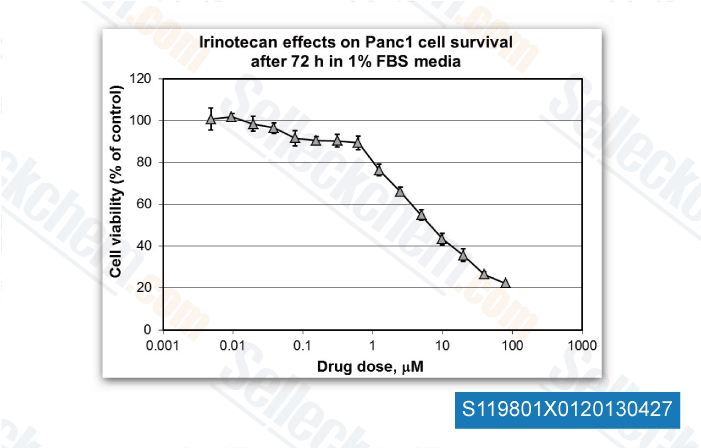
-
Dr. Edita Aksamitiene from Thomas Jefferson University, , Dr. Mikhail Menshikov of Cardiology Research Center
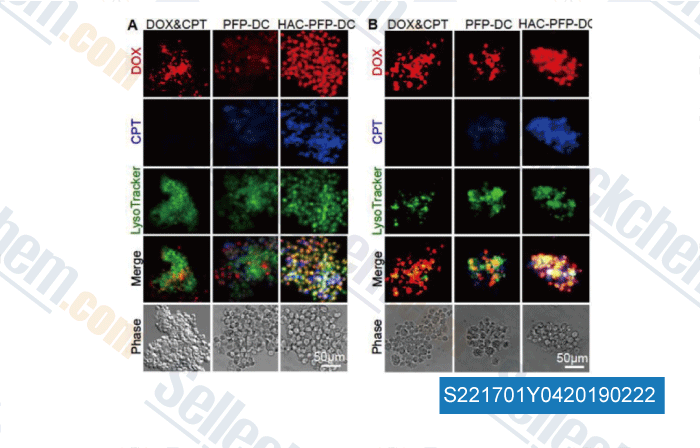
-
Daten von [ , , Biomaterials, 2015, 72:74-89 ]
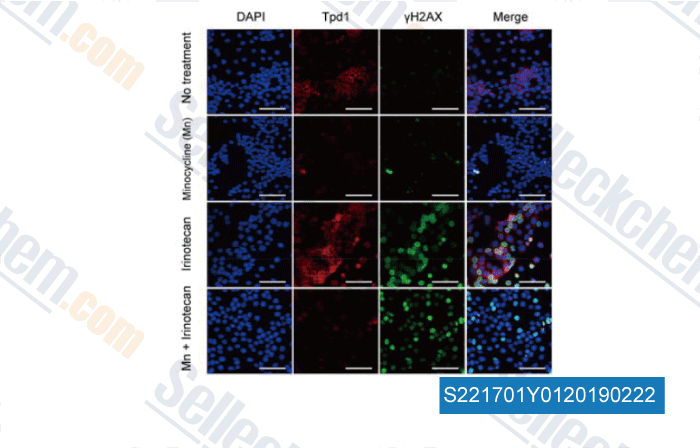
-
Daten von [ , , Mol Cancer Ther, 2018, 17(2):508-520 ]
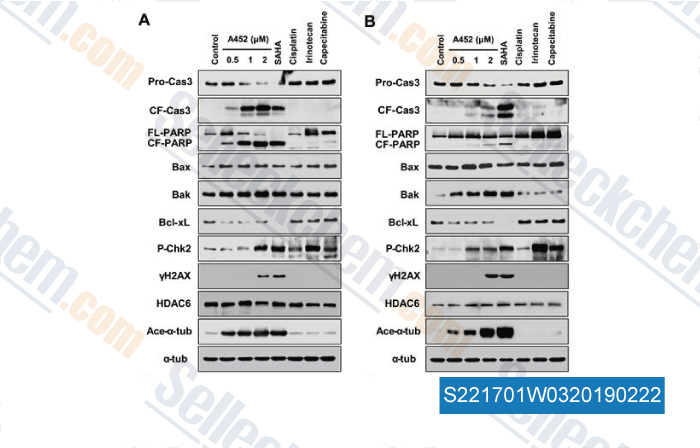
-
Daten von [ , , Carcinogenesis, 2018, 39(1):72-83 ]
Sellecks Irinotecan Hydrochloride Trihydrate Wurde zitiert von 90 Publikationen
| NSUN5 Mediates Resistance to Doxorubicin via Up-regulation of DNA Damage Repair Proteins BRCA2 and BRIP1 in Colorectal Cancer [ Am J Pathol, 2025, S0002-9440(25)00252-4] | PubMed: 40713976 |
| The novel SMYD3 inhibitor EM127 impairs DNA repair response to chemotherapy-induced DNA damage and reverses cancer chemoresistance [ J Exp Clin Cancer Res, 2024, 43(1):151] | PubMed: 38812026 |
| Establishment, characterization, and biobanking of 36 pancreatic cancer organoids: prediction of metastasis in resectable pancreatic cancer [ Cell Oncol (Dordr), 2024, 10.1007/s13402-024-00939-5] | PubMed: 38619751 |
| CHD1L Inhibitor OTI-611 Synergizes with Chemotherapy to Enhance Antitumor Efficacy and Prolong Survival in Colorectal Cancer Mouse Models [ Int J Mol Sci, 2024, 25(23)13160] | PubMed: 39684869 |
| Effects of simulated microgravity on colorectal cancer organoids growth and drug response [ Sci Rep, 2024, 14(1):25526] | PubMed: 39462078 |
| Assessment of stromal SCD-induced drug resistance of PDAC using 3D-printed zPDX model chips [ iScience, 2023, 26(1):105723] | PubMed: 36590169 |
| Artesunate ameliorates irinotecan-induced intestinal injury by suppressing cellular senescence and significantly enhances anti-tumor activity [ Int Immunopharmacol, 2023, 119:110205] | PubMed: 37104917 |
| Cutoff value of IC50 for drug sensitivity in patient-derived tumor organoids in colorectal cancer [ iScience, 2023, 26(7):107116] | PubMed: 37426352 |
| The role of pregnane X receptor (PXR-in cancer drug resistance and identification of novel PXR antagonists [ Tübingen, 2023, ] | PubMed: None |
| p53 controls choice between apoptotic and non-apoptotic death following DNA damage [ bioRxiv, 2023, 2023.01.17.524444] | PubMed: 36712034 |
RÜCKGABERICHTLINIE
Die bedingungslose Rückgaberichtlinie von Selleck Chemical gewährleistet unseren Kunden ein reibungsloses Online-Einkaufserlebnis. Wenn Sie in irgendeiner Weise mit Ihrem Kauf unzufrieden sind, können Sie jeden Artikel innerhalb von 7 Tagen nach Erhalt zurückgeben. Im Falle von Produktqualitätsproblemen, sei es protokollbezogene oder produktbezogene Probleme, können Sie jeden Artikel innerhalb von 365 Tagen ab dem ursprünglichen Kaufdatum zurückgeben. Bitte befolgen Sie die nachstehenden Anweisungen, wenn Sie Produkte zurücksenden.
VERSAND UND LAGERUNG
Selleck-Produkte werden bei Raumtemperatur transportiert. Wenn Sie das Produkt bei Raumtemperatur erhalten, seien Sie versichert, dass die Qualitätskontrollabteilung von Selleck Experimente durchgeführt hat, um zu überprüfen, dass die normale Temperaturplatzierung von einem Monat die biologische Aktivität von Pulverprodukten nicht beeinträchtigt. Nach dem Sammeln lagern Sie das Produkt bitte gemäß den in der Datenblatt beschriebenen Anforderungen. Die meisten Selleck-Produkte sind unter den empfohlenen Bedingungen stabil.
NICHT FÜR DIE ANWENDUNG AM MENSCHEN, FÜR VETERINÄRMEDIZINISCHE DIAGNOSTIK ODER THERAPEUTISCHE ZWECKE.