
Technische Daten
| Formel | C21H28Cl2N6O2 |
||||||||||||||
| Molekulargewicht | 467.39 | CAS-Nr. | 875320-31-3 | ||||||||||||
| Löslichkeit (25°C)* | In vitro | DMSO | 93 mg/mL (198.97 mM) | ||||||||||||
| Water | Insoluble | ||||||||||||||
| Ethanol | Insoluble | ||||||||||||||
| In vivo (Lösungsmittel einzeln und der Reihe nach zum Produkt hinzufügen.) |
|
||||||||||||||
|
* <1 mg/ml bedeutet schwer löslich oder unlöslich. * Bitte beachten Sie, dass Selleck die Löslichkeit aller Verbindungen intern testet und die tatsächliche Löslichkeit geringfügig von veröffentlichten Werten abweichen kann. Dies ist normal und ist auf geringfügige Batch-zu-Batch-Variationen zurückzuführen. * Versand bei Raumtemperatur (Stabilitätstests zeigen, dass dieses Produkt ohne Kühlmaßnahmen versendet werden kann.) |
|||||||||||||||
Vorbereitung von Stammlösungen
Biologische Aktivität
| Beschreibung | Quisinostat (JNJ-26481585) 2HCl ist ein neuartiger HDAC-Inhibitor der zweiten Generation mit der höchsten Potenz für HDAC1 mit einer IC50 von 0,11 nM in einem zellfreien Assay, einer moderaten Potenz gegenüber HDACs 2, 4, 10 und 11; einer mehr als 30-fachen Selektivität gegenüber HDACs 3, 5, 8 und 9 und der geringsten Potenz gegenüber HDACs 6 und 7. Phase 2. | |||||||||||
|---|---|---|---|---|---|---|---|---|---|---|---|---|
| Ziele |
|
|||||||||||
| In vitro | JNJ-26481585 zeigt ein breites Spektrum antiproliferativer Aktivität in soliden und hämatologischen Krebszelllinien, wie allen Lungen-, Brust-, Darm-, Prostata-, Gehirn- und Eierstocktumorzelllinien, mit IC50-Werten im Bereich von 3,1-246 nM, was potenter ist als R306465, CRA-24781 oder Mocetinostat in verschiedenen getesteten menschlichen Krebszelllinien. Eine aktuelle Studie zeigt, dass JNJ-26481585 den Tod von Myelomzellen bei niedrigen nanomolaren Konzentrationen fördert, indem es zu einer Mcl-1-Depletion und Hsp72-Induktion führt. |
|||||||||||
| In vivo | In einem HDAC1-sensitiven A2780-Ovarialtumor-Screeningmodell führt die Dosierung von JNJ-26481585 in seiner maximal tolerierten Dosis (10 mg/kg i.p. und 40 mg/kg p.o.) über 3 Tage zu einer HDAC1-regulierten Fluoreszenz, die die Tumorzellwachstumshemmung vorhersagt. Darüber hinaus zeigt JNJ-26481585 auch potentere Hemmeffekte auf das Wachstum von C170HM2 kolorektalen Lebermetastasen. |
|||||||||||
| Merkmale | Ein oral bioverfügbarer HDAC-Inhibitor der zweiten Generation auf Hydroxamsäurebasis. |
Protokoll (aus Referenz)
| Kinase-Assay: |
|
|---|---|
| Zell-Assay: Cell proliferation assays |
|
| Tierstudie: |
|
Referenzen
|
Kundenproduktvalidierung
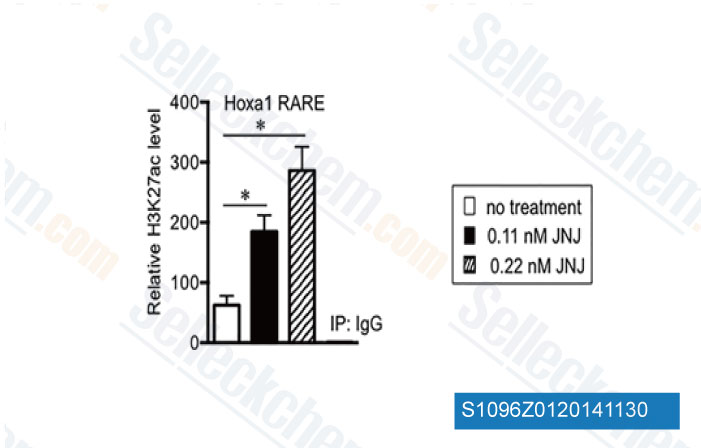
-
Daten von [ J Biol Chem , 2014 , 289(28), 19519-30 ]
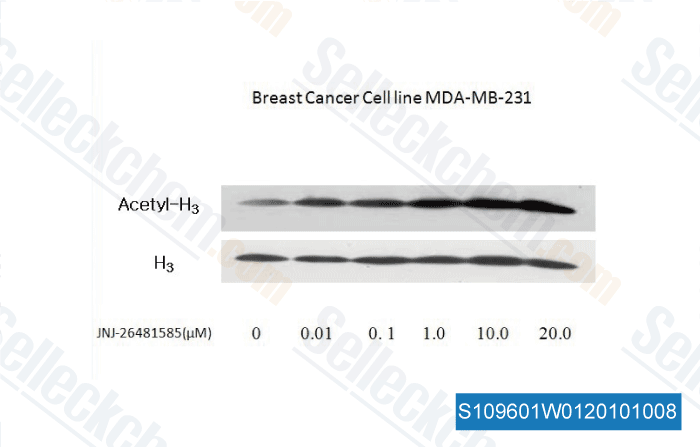
-
, , Dr. Zhang of Tianjin Medical University
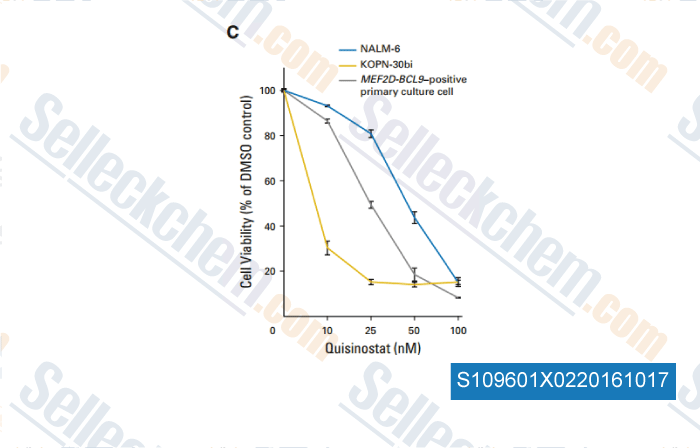
-
Daten von [ , , J Clin Oncol, 2016, 34(28):3451-9. ]
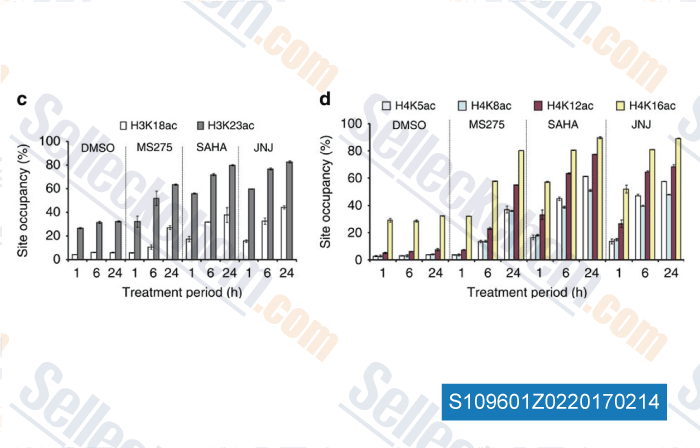
-
Daten von [ , , Nat Commun, 2015, 6:8648. ]
Sellecks Quisinostat (JNJ-26481585) Dihydrochloride Wurde zitiert von 61 Publikationen
| Ferroptosis-induced SUMO2 lactylation counteracts ferroptosis by enhancing ACSL4 degradation in lung adenocarcinoma [ Cell Discov, 2025, 11(1):81] | PubMed: 41057295 |
| ΔNp63 regulates MDSC survival and metabolism in triple-negative breast cancer [ iScience, 2024, 27(4):109366] | PubMed: 38510127 |
| Global isonicotinylome analysis identified SMAD3 isonicotinylation promotes liver cancer cell epithelial-mesenchymal transition and invasion [ iScience, 2024, 27(9):110775] | PubMed: 39286495 |
| The Roles and Regulatory Mechanisms of Tight Junction Protein Cingulin and Transcription Factor Forkhead Box Protein O1 in Human Lung [ Int J Mol Sci, 2024, 25(3):1411.] | PubMed: 38338691 |
| The Roles and Regulatory Mechanisms of Tight Junction Protein Cingulin and Transcription Factor Forkhead Box Protein O1 in Human Lung Adenocarcinoma A549 Cells and Normal Lung Epithelial Cells [ Int J Mol Sci, 2024, 25(3)1411] | PubMed: 38338691 |
| New synergistic combination therapy approaches with HDAC inhibitor quisinostat, cisplatin or PARP inhibitor talazoparib for urothelial carcinoma [ J Cell Mol Med, 2024, 28(9):e18342] | PubMed: 38693852 |
| Combination Therapies with CDK4/6 Inhibitors to Treat KRAS-Mutant Pancreatic Cancer [ Cancer Res, 2023, 83(1):141-157] | PubMed: 36346366 |
| Quisinostat is a brain-penetrant radiosensitizer in glioblastoma [ JCI Insight, 2023, 8(22)e167081] | PubMed: 37991020 |
| CUDC-907, a dual PI3K/histone deacetylase inhibitor, increases meta-iodobenzylguanidine uptake (123/131I-mIBG) in vitro and in vivo: a promising candidate for advancing theranostics in neuroendocrine tumors [ J Transl Med, 2023, 21(1):604] | PubMed: 37679770 |
| Therapeutic HDAC inhibition in hypermutant diffuse intrinsic pontine glioma [ Neoplasia, 2023, 43:100921] | PubMed: 37603953 |
RÜCKGABERICHTLINIE
Die bedingungslose Rückgaberichtlinie von Selleck Chemical gewährleistet unseren Kunden ein reibungsloses Online-Einkaufserlebnis. Wenn Sie in irgendeiner Weise mit Ihrem Kauf unzufrieden sind, können Sie jeden Artikel innerhalb von 7 Tagen nach Erhalt zurückgeben. Im Falle von Produktqualitätsproblemen, sei es protokollbezogene oder produktbezogene Probleme, können Sie jeden Artikel innerhalb von 365 Tagen ab dem ursprünglichen Kaufdatum zurückgeben. Bitte befolgen Sie die nachstehenden Anweisungen, wenn Sie Produkte zurücksenden.
VERSAND UND LAGERUNG
Selleck-Produkte werden bei Raumtemperatur transportiert. Wenn Sie das Produkt bei Raumtemperatur erhalten, seien Sie versichert, dass die Qualitätskontrollabteilung von Selleck Experimente durchgeführt hat, um zu überprüfen, dass die normale Temperaturplatzierung von einem Monat die biologische Aktivität von Pulverprodukten nicht beeinträchtigt. Nach dem Sammeln lagern Sie das Produkt bitte gemäß den in der Datenblatt beschriebenen Anforderungen. Die meisten Selleck-Produkte sind unter den empfohlenen Bedingungen stabil.
NICHT FÜR DIE ANWENDUNG AM MENSCHEN, FÜR VETERINÄRMEDIZINISCHE DIAGNOSTIK ODER THERAPEUTISCHE ZWECKE.