
Technische Daten
| Formel | C19H13F2N7 |
||||||
| Molekulargewicht | 377.35 | CAS-Nr. | 943540-75-8 | ||||
| Löslichkeit (25°C)* | In vitro | DMSO | 50 mg/mL (132.5 mM) | ||||
| Ethanol | 2 mg/mL (5.3 mM) | ||||||
| Water | Insoluble | ||||||
| In vivo (Lösungsmittel einzeln und der Reihe nach zum Produkt hinzufügen.) |
|
||||||
|
* <1 mg/ml bedeutet schwer löslich oder unlöslich. * Bitte beachten Sie, dass Selleck die Löslichkeit aller Verbindungen intern testet und die tatsächliche Löslichkeit geringfügig von veröffentlichten Werten abweichen kann. Dies ist normal und ist auf geringfügige Batch-zu-Batch-Variationen zurückzuführen. * Versand bei Raumtemperatur (Stabilitätstests zeigen, dass dieses Produkt ohne Kühlmaßnahmen versendet werden kann.) |
|||||||
Vorbereitung von Stammlösungen
Biologische Aktivität
| Beschreibung | JNJ-38877605 ist ein ATP-kompetitiver Inhibitor von c-Met mit einem IC50-Wert von 4 nM, 600-fach selektiver für c-Met als 200 andere Tyrosin- und Serin-Threonin-Kinasen. Phase 1. | ||
|---|---|---|---|
| Ziele |
|
||
| In vitro | JNJ-38877605 zeigt eine mehr als 600-fache Selektivität für c-Met im Vergleich zu über 200 anderen diversen Tyrosin- und Serin-Threonin-Kinasen und hemmt in vitro auch die HGF-stimulierte und konstitutiv aktivierte c-Met-Phosphorylierung. In EBC1-, GTL16-, NCI-H1993- und MKN45-Zellen führt diese Verbindung (500 nM) zu einer signifikanten Reduktion der Phosphorylierung von Met und RON, einem weiteren Schlüsselakteur im invasiven Wachstum. Eine aktuelle Studie zeigt, dass diese Chemikalie an der Modulation der Sekretion von IL-8, GROa, uPAR und IL-6 in GTL16-Zellen beteiligt ist. | ||
| In vivo | Bei Mäusen mit etablierten GTL16-Xenotransplantaten führt JNJ-38877605, oral mit 40 mg/kg/Tag über 72 Stunden verabreicht, zu einem statistisch signifikanten Rückgang der Plasmaspiegel von humanem IL-8 (von 0,150 ng/mL auf 0,050 ng/mL) und GROα (von 0,080 ng/mL auf 0,030 ng/mL). Gleichzeitig sinken die Konzentrationen von uPAR im Blut bei gleicher Dosis um mehr als 50 %. |
Protokoll (aus Referenz)
| Tierstudie:[3] |
|
|---|
Referenzen
|
Kundenproduktvalidierung
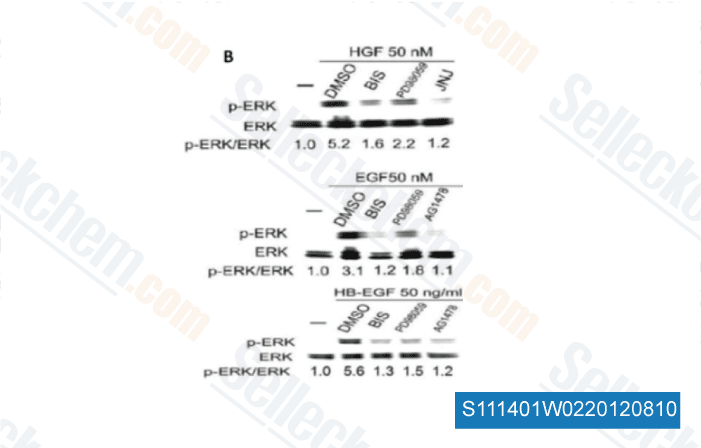
-
Daten von [ PLoS One , 2012 , 7, e44937 ]
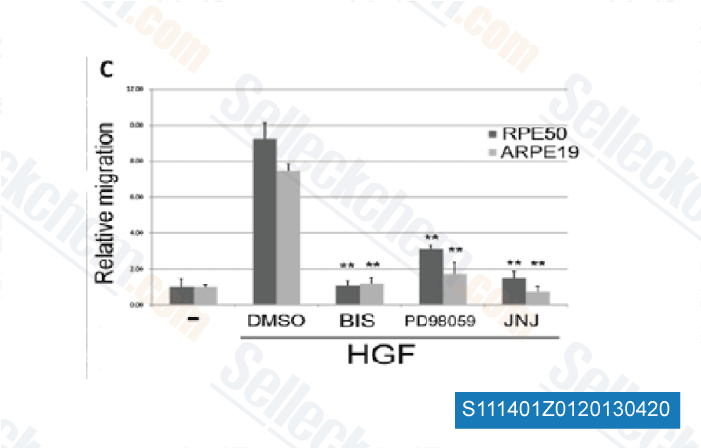
-
Daten von [ PLoS One , 2012 , 7, e44937 ]
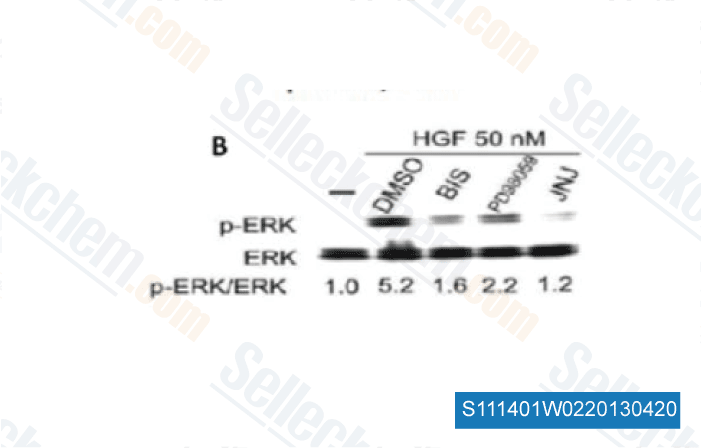
-
Daten von [ PLoS One , 2012 , 7, e44937 ]
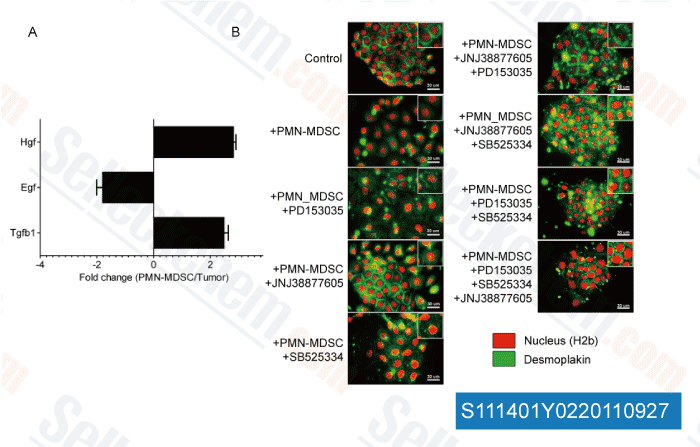
-
Daten von [ PLoS Biol , 2011 , 9, e1001162 ]
Sellecks JNJ-38877605 Wurde zitiert von 54 Publikationen
| Combined Therapy Targeting MET and Pro-HGF Activation Shows Significant Therapeutic Effect Against Liver Metastasis of CRPC [ Int J Mol Sci, 2025, 26(5)2308] | PubMed: 40076928 |
| Functional genomics reveals an off-target dependency of drug synergy in gastric cancer therapy [ Gastric Cancer, 2024, 10.1007/s10120-024-01537-y] | PubMed: 39033209 |
| The Receptor Tyrosine Kinase c-Met Promotes Lipid Accumulation in 3T3-L1 Adipocytes [ Int J Mol Sci, 2023, 24(9)8086] | PubMed: 37175792 |
| Temporal mapping and pharmacological manipulation of signaling architecture of Tyrosine kinases in Traumatic Brain Injury (TBI) [ oparu, 2023, 10.18725/OPARU-47820] | PubMed: None |
| Integrative analysis of drug response and clinical outcome in acute myeloid leukemia [ Cancer Cell, 2022, S1535-6108(22)00312-9] | PubMed: 35868306 |
| Precision Combination Therapies Based on Recurrent Oncogenic Coalterations [ Cancer Discov, 2022, 12(6):1542-1559] | PubMed: 35412613 |
| Efficacy of CAR-T immunotherapy in MET overexpressing tumors not eligible for anti-MET targeted therapy [ J Exp Clin Cancer Res, 2022, 41(1):309] | PubMed: 36271379 |
| MACC1 promotes pancreatic cancer metastasis by interacting with the EMT regulator SNAI1 [ Cell Death Dis, 2022, 13(11):923] | PubMed: 36333284 |
| STAT3 inhibition suppresses adaptive survival of ALK-rearranged lung cancer cells through transcriptional modulation of apoptosis [ NPJ Precis Oncol, 2022, 6(1):11] | PubMed: 35228642 |
| MET Oncogene Controls Invasive Growth by Coupling with NMDA Receptor [ Cancers (Basel), 2022, 14(18)4408] | PubMed: 36139568 |
RÜCKGABERICHTLINIE
Die bedingungslose Rückgaberichtlinie von Selleck Chemical gewährleistet unseren Kunden ein reibungsloses Online-Einkaufserlebnis. Wenn Sie in irgendeiner Weise mit Ihrem Kauf unzufrieden sind, können Sie jeden Artikel innerhalb von 7 Tagen nach Erhalt zurückgeben. Im Falle von Produktqualitätsproblemen, sei es protokollbezogene oder produktbezogene Probleme, können Sie jeden Artikel innerhalb von 365 Tagen ab dem ursprünglichen Kaufdatum zurückgeben. Bitte befolgen Sie die nachstehenden Anweisungen, wenn Sie Produkte zurücksenden.
VERSAND UND LAGERUNG
Selleck-Produkte werden bei Raumtemperatur transportiert. Wenn Sie das Produkt bei Raumtemperatur erhalten, seien Sie versichert, dass die Qualitätskontrollabteilung von Selleck Experimente durchgeführt hat, um zu überprüfen, dass die normale Temperaturplatzierung von einem Monat die biologische Aktivität von Pulverprodukten nicht beeinträchtigt. Nach dem Sammeln lagern Sie das Produkt bitte gemäß den in der Datenblatt beschriebenen Anforderungen. Die meisten Selleck-Produkte sind unter den empfohlenen Bedingungen stabil.
NICHT FÜR DIE ANWENDUNG AM MENSCHEN, FÜR VETERINÄRMEDIZINISCHE DIAGNOSTIK ODER THERAPEUTISCHE ZWECKE.