
Technische Daten
| Formel | C15H12F2N6O3S |
||||||||||
| Molekulargewicht | 394.36 | CAS-Nr. | 443797-96-4 | ||||||||
| Löslichkeit (25°C)* | In vitro | DMSO | 79 mg/mL (200.32 mM) | ||||||||
| Ethanol | 3 mg/mL (7.6 mM) | ||||||||||
| Water | Insoluble | ||||||||||
| In vivo (Lösungsmittel einzeln und der Reihe nach zum Produkt hinzufügen.) |
|
||||||||||
|
* <1 mg/ml bedeutet schwer löslich oder unlöslich. * Bitte beachten Sie, dass Selleck die Löslichkeit aller Verbindungen intern testet und die tatsächliche Löslichkeit geringfügig von veröffentlichten Werten abweichen kann. Dies ist normal und ist auf geringfügige Batch-zu-Batch-Variationen zurückzuführen. * Versand bei Raumtemperatur (Stabilitätstests zeigen, dass dieses Produkt ohne Kühlmaßnahmen versendet werden kann.) |
|||||||||||
Vorbereitung von Stammlösungen
Biologische Aktivität
| Beschreibung | JNJ-7706621 ist ein Pan-CDK-Inhibitor mit der höchsten Potenz auf CDK1/2 mit einem IC50 von 9 nM/4 nM und zeigt in zellfreien Assays eine >6-fache Selektivität für CDK1/2 gegenüber CDK3/4/6. Er hemmt auch potent Aurora A/B und hat keine Aktivität auf Plk1 und Wee1. | |||||||||||
|---|---|---|---|---|---|---|---|---|---|---|---|---|
| Ziele |
|
|||||||||||
| In vitro | JNJ-7706621 zeigt auch eine gewisse Hemmung von VEGF-R2, FGF-R2 und GSK3β mit einem IC50 von 154-254 nM. Diese Verbindung zeigt eine hemmende Wirkung auf eine Reihe menschlicher Krebszelltypen, einschließlich HeLa, HCT-116, SK-OV-3, PC3, DU145, A375, MDA-MB-231, MES-SA und MES-SA/Dx5, mit einem IC50 von 112-514 nM, unabhängig vom p53-, Retinoblastom- oder P-Glykoprotein-Status. Es ist um ein Vielfaches weniger potent bei der Hemmung des Wachstums normaler Zelltypen, einschließlich MRC-5, HASMC, HUVEC und HMVEC, mit einem IC50 von 3,67-5,42 μM. In HeLa- oder U937-Zellen verzögert diese Chemikalie (0,5-3 μM) den Austritt aus der G1-Phase, arretiert Zellen in der G2-M-Phase, induziert Endoreduplikation, aktiviert Apoptose und reduziert die Koloniebildung. In einer HeLa-Zelllinie führt eine inkrementelle Behandlung mit steigenden Konzentrationen dieser Verbindung zu einer 16-fachen Resistenz, die durch ABCG2 vermittelt werden kann. | |||||||||||
| In vivo | Im Maus-Xenograft-Modell des A375-Melanom-Menschentumors verursacht JNJ-7706621 (100 oder 125 mg/kg) eine Tumorrückbildung. | |||||||||||
| Merkmale | Ein Breitspektrum-Inhibitor. |
Protokoll (aus Referenz)
| Kinase-Assay:[1] |
|
|---|---|
| Zell-Assay:[3] |
|
| Tierstudie:[1] |
|
Referenzen
|
Kundenproduktvalidierung
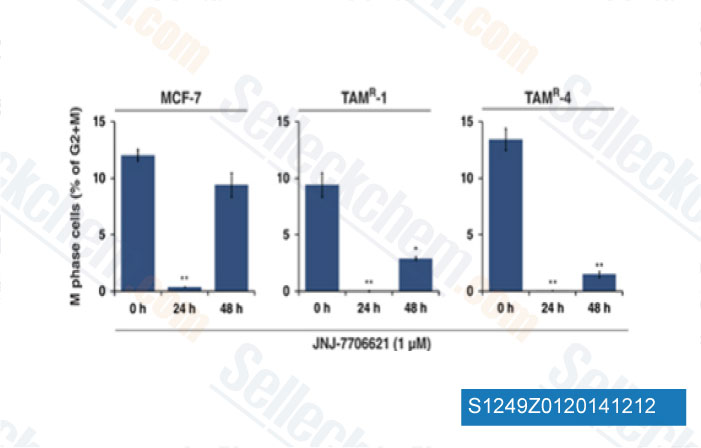
-
Daten von [ Oncogene , 2014 , 10.1038/onc.2014.351 ]
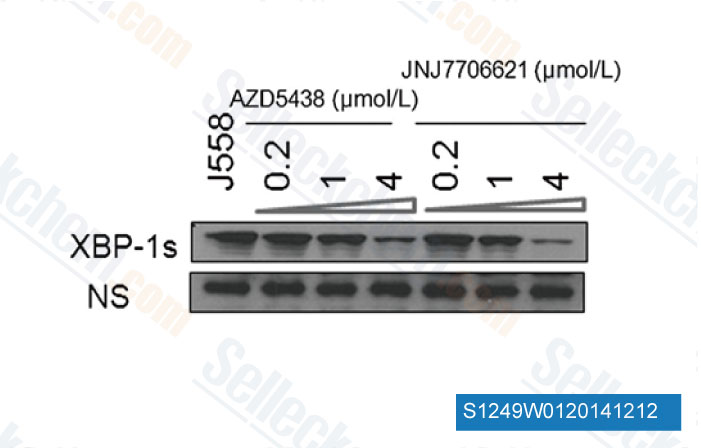
-
Daten von [ Mol Cancer Ther , 2014 , 13(3), 662-74 ]
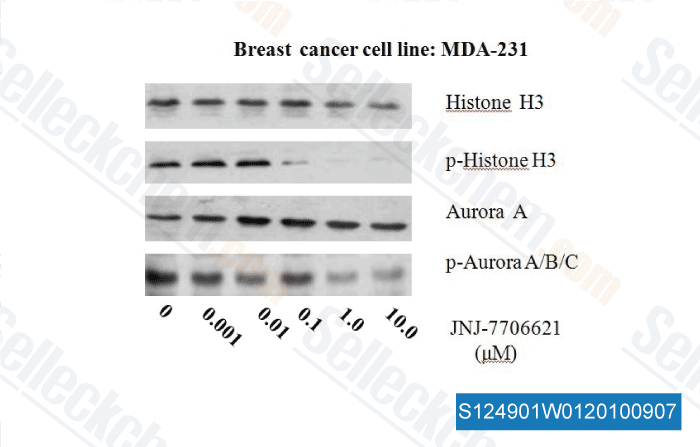
-
, , Dr. Zhang of Tianjin Medical University
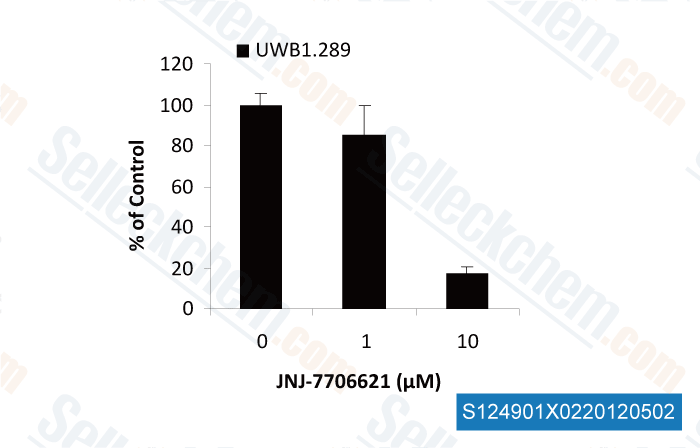
-
, , Dr. Yong-Weon Yi from Georgetown University Medical Center
Sellecks JNJ-7706621 Wurde zitiert von 30 Publikationen
| Combined therapy with DR5-targeting antibody-drug conjugate and CDK inhibitors as a strategy for advanced colorectal cancer [ Cell Rep Med, 2025, S2666-3791(25)00231-9] | PubMed: 40449480 |
| CDK1-mediated phosphorylation of LDHA fuels mitosis through LDHB-dependent lactate oxidation [ EMBO Rep, 2025, 10.1038/s44319-025-00573-8] | PubMed: 40940446 |
| Molecular basis of JAK kinase regulation guiding therapeutic approaches: Evaluating the JAK3 pseudokinase domain as a drug target [ Adv Biol Regul, 2025, 95:101072] | PubMed: 39755448 |
| Inactivation of TACC2 epigenetically represses CDKN1A and confers sensitivity to CDK inhibitors [ Med, 2025, S2666-6340(24)00482-3] | PubMed: 39793578 |
| Inhibitors of One or More Cellular Aurora Kinases Impair the Replication of Herpes Simplex Virus 1 and Other DNA and RNA Viruses with Diverse Genomes and Life Cycles [ Microbiol Spectr, 2023, 11(1):e0194322] | PubMed: 36537798 |
| Integrative analysis of drug response and clinical outcome in acute myeloid leukemia [ Cancer Cell, 2022, S1535-6108(22)00312-9] | PubMed: 35868306 |
| Nascent transcriptome reveals orchestration of zygotic genome activation in early embryogenesis [ Curr Biol, 2022, 32(19):4314-4324.e7] | PubMed: 36007528 |
| Inhibition of IκB Kinase Is a Potential Therapeutic Strategy to Circumvent Resistance to Epidermal Growth Factor Receptor Inhibition in Triple-Negative Breast Cancer Cells [ Cancers (Basel), 2022, 14(21)5215] | PubMed: 36358633 |
| Dual Inhibition of AKT and MEK Pathways Potentiates the Anti-Cancer Effect of Gefitinib in Triple-Negative Breast Cancer Cells [ Cancers (Basel), 2021, 13(6)1205] | PubMed: 33801977 |
| Trapping KSHV in Latency-Exploring Kinase Inhibitors as a Class of Anti-Virals that Target the KSHV Lytic Cycle [ ProQuest, 2021, 28714138] | PubMed: None |
RÜCKGABERICHTLINIE
Die bedingungslose Rückgaberichtlinie von Selleck Chemical gewährleistet unseren Kunden ein reibungsloses Online-Einkaufserlebnis. Wenn Sie in irgendeiner Weise mit Ihrem Kauf unzufrieden sind, können Sie jeden Artikel innerhalb von 7 Tagen nach Erhalt zurückgeben. Im Falle von Produktqualitätsproblemen, sei es protokollbezogene oder produktbezogene Probleme, können Sie jeden Artikel innerhalb von 365 Tagen ab dem ursprünglichen Kaufdatum zurückgeben. Bitte befolgen Sie die nachstehenden Anweisungen, wenn Sie Produkte zurücksenden.
VERSAND UND LAGERUNG
Selleck-Produkte werden bei Raumtemperatur transportiert. Wenn Sie das Produkt bei Raumtemperatur erhalten, seien Sie versichert, dass die Qualitätskontrollabteilung von Selleck Experimente durchgeführt hat, um zu überprüfen, dass die normale Temperaturplatzierung von einem Monat die biologische Aktivität von Pulverprodukten nicht beeinträchtigt. Nach dem Sammeln lagern Sie das Produkt bitte gemäß den in der Datenblatt beschriebenen Anforderungen. Die meisten Selleck-Produkte sind unter den empfohlenen Bedingungen stabil.
NICHT FÜR DIE ANWENDUNG AM MENSCHEN, FÜR VETERINÄRMEDIZINISCHE DIAGNOSTIK ODER THERAPEUTISCHE ZWECKE.