
Technische Daten
| Formel | C18H22BrN5O3 |
||||||||||
| Molekulargewicht | 436.3 | CAS-Nr. | 911222-45-2 | ||||||||
| Löslichkeit (25°C)* | In vitro | DMSO | 29 mg/mL (66.46 mM) | ||||||||
| Water | Insoluble | ||||||||||
| Ethanol | Insoluble | ||||||||||
| In vivo (Lösungsmittel einzeln und der Reihe nach zum Produkt hinzufügen.) |
|
||||||||||
|
* <1 mg/ml bedeutet schwer löslich oder unlöslich. * Bitte beachten Sie, dass Selleck die Löslichkeit aller Verbindungen intern testet und die tatsächliche Löslichkeit geringfügig von veröffentlichten Werten abweichen kann. Dies ist normal und ist auf geringfügige Batch-zu-Batch-Variationen zurückzuführen. * Versand bei Raumtemperatur (Stabilitätstests zeigen, dass dieses Produkt ohne Kühlmaßnahmen versendet werden kann.) |
|||||||||||
Vorbereitung von Stammlösungen
Biologische Aktivität
| Beschreibung | Rabusertib (LY2603618, IC-83) ist ein hochselektiver Chk1-Inhibitor mit potenzieller Antitumoraktivität in einem zellfreien Assay. IC50=7 nM, was eine etwa 100-fach höhere Wirksamkeit gegen Chk1 als gegen jede der anderen evaluierten Proteinkinasen zeigt. Rabusertib (LY2603618) induziert Zellzyklusarrest, DNA-Schadensantwort und autophagy in Krebszellen. Rabusertib (LY2603618) induziert Bak-abhängige apoptosis in AML-Zelllinien. | ||
|---|---|---|---|
| Ziele |
|
||
| In vitro | Chk1 ist eine ATP-abhängige Serin-Threonin-Kinase und eine Schlüsselkomponente im DNA-Replikationsüberwachungs-Checkpoint-System, das durch Doppelstrangbrüche (DSBs) aktiviert wird. Chk1 trägt zu allen derzeit definierten Zellzyklus-Checkpoints bei, einschließlich G1/S, Intra-S-Phase, G2/M und dem mitotischen Spindel-Checkpoint. Durch die Hemmung der Aktivität von chk1 verhindert diese Verbindung die Reparatur von DNA, die durch DNA-schädigende Mittel verursacht wird, wodurch die Antitumorwirksamkeit verschiedener Chemotherapeutika potenziert wird. Präklinische Daten zu dieser Verbindung wurden jedoch bisher nicht veröffentlicht. Die Hemmung von Chk1 soll die Wirkung von Antimetaboliten verstärken. Diese chemische Behandlung beeinträchtigt die DNA-Synthese, erhöht DNA-Schäden (durch mitotische Defekte), induziert apoptosis und hat eine synergistische Aktivität, insbesondere in p53-mutierten Tumorzellen. |
||
| In vivo | In Xenograft-Modellen verzögert diese Verbindung das Tumorwachstum, wenn sie in Kombination verabreicht wird. |
Protokoll (aus Referenz)
| Zell-Assay: |
|
|---|---|
| Tierstudie: |
|
Referenzen
|
Kundenproduktvalidierung
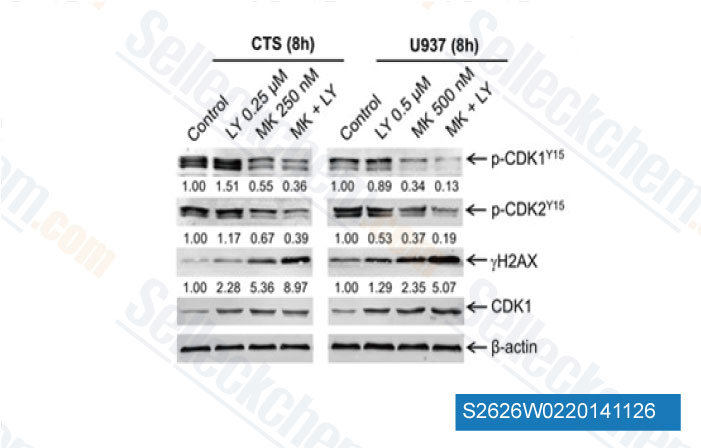
-
Daten von [ J Hematol Oncol , 2014 , 7, 53 ]
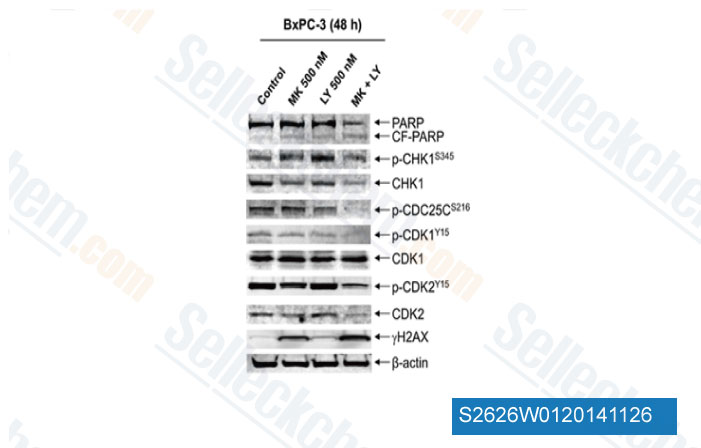
-
Daten von [ Cancer Lett , 2014 , 10.1016/j.canlet.2014.10.015 ]
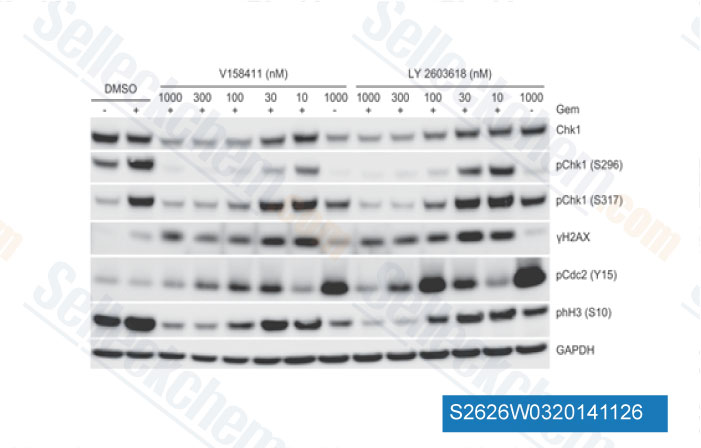
-
Daten von [ BMC Cancer , 2014 , 14, 483 ]
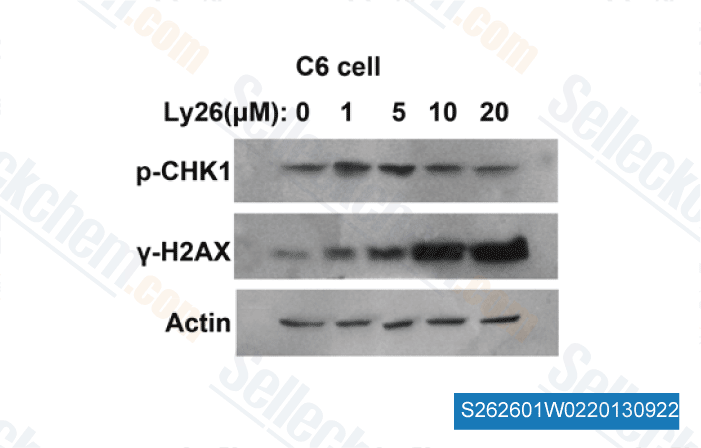
-
, , Customer W, F. Z
Sellecks Rabusertib (LY2603618) Wurde zitiert von 101 Publikationen
| DNA polymerase α/primase extraction from chromatin by VCP/p97 restricts ATR activation during unperturbed DNA replication [ Nat Commun, 2025, 16(1):5706] | PubMed: 40593507 |
| KLF5 loss sensitizes cells to ATR inhibition and is synthetic lethal with ARID1A deficiency [ Nat Commun, 2025, 16(1):480] | PubMed: 39779698 |
| USP37 counteracts HLTF to protect damaged replication forks and promote survival of BRCA1-deficient cells and PARP inhibitor resistance [ Nucleic Acids Res, 2025, 53(12)gkaf544] | PubMed: 40548939 |
| ATR promotes mTORC1 activity via de novo cholesterol synthesis [ EMBO Rep, 2025, 26(14):3574-3593] | PubMed: 40514450 |
| The ribotoxic stress response drives UV-mediated cell death [ Cell, 2024, 187(14):3652-3670.e40] | PubMed: 38843833 |
| Synergistic induction of mitotic pyroptosis and tumor remission by inhibiting proteasome and WEE family kinases [ Signal Transduct Target Ther, 2024, 9(1):181.] | PubMed: 38992067 |
| The MYCN oncoprotein is an RNA-binding accessory factor of the nuclear exosome targeting complex [ Mol Cell, 2024, S1097-2765(24)00285-5] | PubMed: 38703770 |
| FOXP1 phosphorylation antagonizes its O-GlcNAcylation in regulating ATR activation in response to replication stress [ EMBO J, 2024, 44(2):457-483.] | PubMed: 39623140 |
| Synthetic lethality between ATR and POLA1 reveals a potential new target for individualized cancer therapy [ Neoplasia, 2024, 57:101038] | PubMed: 39128273 |
| mTORC1 activity oscillates throughout the cell cycle promoting mitotic entry and differentially influencing autophagy induction [ bioRxiv, 2024, 2024.02.06.579216] | PubMed: 38370755 |
RÜCKGABERICHTLINIE
Die bedingungslose Rückgaberichtlinie von Selleck Chemical gewährleistet unseren Kunden ein reibungsloses Online-Einkaufserlebnis. Wenn Sie in irgendeiner Weise mit Ihrem Kauf unzufrieden sind, können Sie jeden Artikel innerhalb von 7 Tagen nach Erhalt zurückgeben. Im Falle von Produktqualitätsproblemen, sei es protokollbezogene oder produktbezogene Probleme, können Sie jeden Artikel innerhalb von 365 Tagen ab dem ursprünglichen Kaufdatum zurückgeben. Bitte befolgen Sie die nachstehenden Anweisungen, wenn Sie Produkte zurücksenden.
VERSAND UND LAGERUNG
Selleck-Produkte werden bei Raumtemperatur transportiert. Wenn Sie das Produkt bei Raumtemperatur erhalten, seien Sie versichert, dass die Qualitätskontrollabteilung von Selleck Experimente durchgeführt hat, um zu überprüfen, dass die normale Temperaturplatzierung von einem Monat die biologische Aktivität von Pulverprodukten nicht beeinträchtigt. Nach dem Sammeln lagern Sie das Produkt bitte gemäß den in der Datenblatt beschriebenen Anforderungen. Die meisten Selleck-Produkte sind unter den empfohlenen Bedingungen stabil.
NICHT FÜR DIE ANWENDUNG AM MENSCHEN, FÜR VETERINÄRMEDIZINISCHE DIAGNOSTIK ODER THERAPEUTISCHE ZWECKE.