
Technische Daten
| Formel | C21H20N2O5 |
||||||
| Molekulargewicht | 380.39 | CAS-Nr. | 172732-68-2 | ||||
| Löslichkeit (25°C)* | In vitro | DMSO | 76 mg/mL (199.79 mM) | ||||
| Ethanol | 1 mg/mL (2.62 mM) | ||||||
| Water | Insoluble | ||||||
| In vivo (Lösungsmittel einzeln und der Reihe nach zum Produkt hinzufügen.) |
|
||||||
|
* <1 mg/ml bedeutet schwer löslich oder unlöslich. * Bitte beachten Sie, dass Selleck die Löslichkeit aller Verbindungen intern testet und die tatsächliche Löslichkeit geringfügig von veröffentlichten Werten abweichen kann. Dies ist normal und ist auf geringfügige Batch-zu-Batch-Variationen zurückzuführen. * Versand bei Raumtemperatur (Stabilitätstests zeigen, dass dieses Produkt ohne Kühlmaßnahmen versendet werden kann.) |
|||||||
Vorbereitung von Stammlösungen
Biologische Aktivität
| Beschreibung | Varespladib (LY315920) ist ein potenter und selektiver humaner nicht-pankreatischer sekretorischer Phospholipase A2 (hnsPLA)-Inhibitor mit einer IC50 von 7 nM und hat Phase 3 erreicht. | ||
|---|---|---|---|
| Ziele |
|
||
| In vitro | Varespladib (LY315920) zeigt eine signifikante Hemmwirkung auf die sPLA2-Aktivität im Serum verschiedener Spezies, einschließlich Ratte, Kaninchen, Meerschweinchen und Mensch, mit IC50-Werten von 8,1 nM, 5,0 nM, 3,2 nM bzw. 6,2 nM. In BAL-Zellen, die mit humaner sPLA2 stimuliert wurden, reduziert diese Verbindung in Dosen von 0,1 μM–3 μM die Bildung von Thromboxan, das durch humane sPLA2 vermittelt wird, dosisabhängig mit einer IC50 von ca. 0,8 μM. In der humanen Bindehautepithelzelllinie (HCjE) hemmt es (10 μM) die durch All-trans-Retinsäure (RA) induzierte Expression von membranassoziiertem Mucin MUC16 nach 24 Stunden um 100 % und nach 48 Stunden um 99 %. | ||
| In vivo | Ex vivo hemmt LY315920 in Dosen von 3 mg/kg bis 30 mg/kg i.v. die human sPLA2-induzierte Freisetzung von Thromboxan aus Meerschweinchen-BAL-Zellen mit einer ED50 von 16,1 mg/kg. In transgenen Mäusen, die humane sPLA2 exprimieren, hebt sowohl die orale als auch die i.v.-Verabreichung dieser Verbindung (0,3 mg/kg–3 mg/kg) die Serum-sPLA2-Aktivität dosis- und zeitabhängig auf. | ||
| Merkmale | Ein potenter und selektiver sekretorischer Phospholipase A2-Inhibitor. |
Protokoll (aus Referenz)
| Tierstudie:[2] |
|
|---|
Referenzen
|
Kundenproduktvalidierung
-
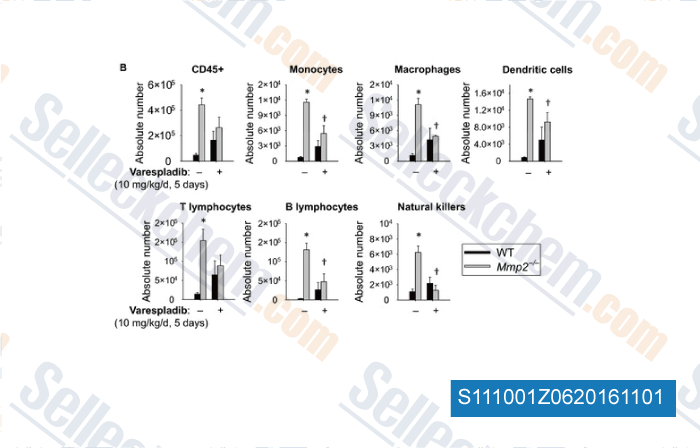
, , J Am Heart Assoc, 2015, 4:e002553.
-
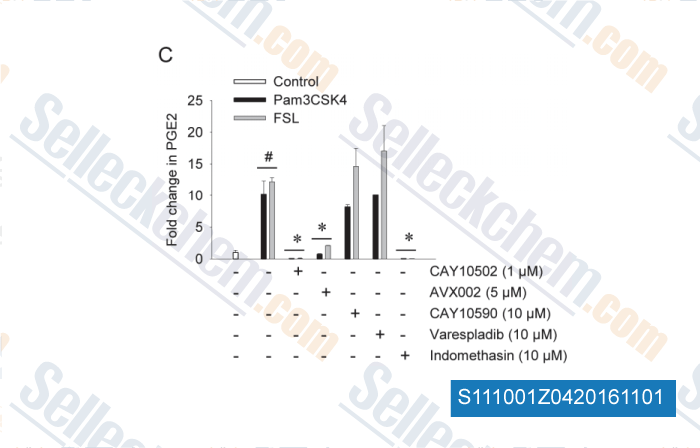
, , PLoS One, 2015, 10(4):e0119088.
-
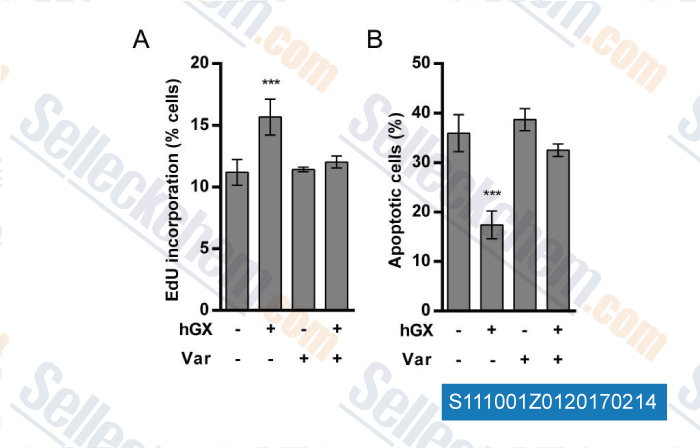
Daten von [ , , Mol Cancer, 2013, 12(1):111. ]
Sellecks Varespladib (LY315920) Wurde zitiert von 10 Publikationen
| Exploring Lysophosphatidylcholine as a Biomarker in Ischemic Stroke: The Plasma-Brain Disjunction [ Int J Mol Sci, 2024, 25(19)10649] | PubMed: 39408978 |
| The Candida albicans toxin candidalysin mediates distinct epithelial inflammatory responses through p38 and EGFR-ERK pathways [ Front Immunol, 2022, 13:824746] | PubMed: 35392090 |
| Substrate-Specific Inhibition Constants for Phospholipase A2 Acting on Unique Phospholipid Substrates in Mixed Micelles and Membranes Using Lipidomics [ J Med Chem, 2019, 62(4):1999-2007] | PubMed: 30615445 |
| Accumulation of 8,9-unsaturated sterols drives oligodendrocyte formation and remyelination [Hubler Z, et al. Nature, 2018, 560(7718):372-376] | PubMed: 30046109 |
| Novel Role for Matrix Metalloproteinase 9 in Modulation of Cholesterol Metabolism [ J Am Heart Assoc, 2016, 5(10)e004228] | PubMed: 27694328 |
| Identification of a Novel Heart–Liver Axis: Matrix Metalloproteinase-2 Negatively Regulates Cardiac Secreted Phospholipase A2 to Modulate Lipid Metabolism and Inflammation in the Liver [Hernandez-Anzaldo S, et al. J Am Heart Assoc, 2015, 4:e002553] | PubMed: 26567374 |
| Matrix metalloproteinase-2 negatively regulates cardiac secreted phospholipase A2 to modulate inflammation and Fever. [Berry E, et al. J Am Heart Assoc, 2015, 4(4)] | PubMed: 25820137 |
| Cytosolic Phospholipase A2 Modulates TLR2 Signaling in Synoviocytes [Sommerfelt RM, et al. PLoS One, 2015, 10(4):e0119088] | PubMed: 25893499 |
| Novel role of group VIB Ca2+-independent phospholipase A2F in leukocyte-endothelial cell interactions: An intravital microscopic study in rat mesentery [Kojima M, et al. J Trauma Acute Care Surg, 2015, 79(5):782-9] | PubMed: 26496102 |
| Group X secreted phospholipase A(2) induces lipid droplet formation and prolongs breast cancer cell survival. [Pucer A, et al. Mol Cancer, 2013, 12(1):111] | PubMed: 24070020 |
RÜCKGABERICHTLINIE
Die bedingungslose Rückgaberichtlinie von Selleck Chemical gewährleistet unseren Kunden ein reibungsloses Online-Einkaufserlebnis. Wenn Sie in irgendeiner Weise mit Ihrem Kauf unzufrieden sind, können Sie jeden Artikel innerhalb von 7 Tagen nach Erhalt zurückgeben. Im Falle von Produktqualitätsproblemen, sei es protokollbezogene oder produktbezogene Probleme, können Sie jeden Artikel innerhalb von 365 Tagen ab dem ursprünglichen Kaufdatum zurückgeben. Bitte befolgen Sie die nachstehenden Anweisungen, wenn Sie Produkte zurücksenden.
VERSAND UND LAGERUNG
Selleck-Produkte werden bei Raumtemperatur transportiert. Wenn Sie das Produkt bei Raumtemperatur erhalten, seien Sie versichert, dass die Qualitätskontrollabteilung von Selleck Experimente durchgeführt hat, um zu überprüfen, dass die normale Temperaturplatzierung von einem Monat die biologische Aktivität von Pulverprodukten nicht beeinträchtigt. Nach dem Sammeln lagern Sie das Produkt bitte gemäß den in der Datenblatt beschriebenen Anforderungen. Die meisten Selleck-Produkte sind unter den empfohlenen Bedingungen stabil.
NICHT FÜR DIE ANWENDUNG AM MENSCHEN, FÜR VETERINÄRMEDIZINISCHE DIAGNOSTIK ODER THERAPEUTISCHE ZWECKE.