
Technische Daten
| Formel | C32H31F2N3O2.3HCl |
||||||||||
| Molekulargewicht | 636.99 | CAS-Nr. | 167465-36-3 | ||||||||
| Löslichkeit (25°C)* | In vitro | DMSO | 100 mg/mL (156.98 mM) | ||||||||
| Water | 28 mg/mL (43.95 mM) | ||||||||||
| Ethanol | Insoluble | ||||||||||
| In vivo (Lösungsmittel einzeln und der Reihe nach zum Produkt hinzufügen.) |
|
||||||||||
|
* <1 mg/ml bedeutet schwer löslich oder unlöslich. * Bitte beachten Sie, dass Selleck die Löslichkeit aller Verbindungen intern testet und die tatsächliche Löslichkeit geringfügig von veröffentlichten Werten abweichen kann. Dies ist normal und ist auf geringfügige Batch-zu-Batch-Variationen zurückzuführen. * Versand bei Raumtemperatur (Stabilitätstests zeigen, dass dieses Produkt ohne Kühlmaßnahmen versendet werden kann.) |
|||||||||||
Vorbereitung von Stammlösungen
Biologische Aktivität
| Beschreibung | Zosuquidar 3HCl ist ein potenter Modulator der P-glycoprotein-vermittelten Multidrug-Resistenz mit einem Ki von 60 nM in einem zellfreien Assay. Phase 3. | ||
|---|---|---|---|
| Ziele |
|
||
| In vitro | LY335979 hemmt kompetitiv die Gleichgewichtsbindung von Pgp, indem es die [3H]Azidopin-Photoaffinitätsmarkierung des Pgp in CEM/VLB100-Plasmamembranen blockiert. LY335979 allein zeigt die Zytotoxizität gegenüber medikamentenempfindlichen und MDR-Zelllinien mit IC50-Werten von 6 μM bis 16 μM und bewirkt seine Fähigkeit, die Resistenz der Onkolytika gegenüber den MDR-Zelllinien P388/ADR, MCF7/ADR, 2780AD oder UCLA-P3.003VLB bei Konzentrationen von 0,1 und 0,5 μM vollständig umzukehren. LY335979 stellt die Medikamentenempfindlichkeit in P-gp-exprimierenden Leukämiezelllinien wie K562/HHT40, K562/HHT90, K562/DOX und HL60/DNR signifikant wieder her und erhöht die Zytotoxizität von Anthrazyklinen und Ozogamicin (Mylotarg) in primären AML-Blasten mit aktivem P-gp. Ein aktueller Artikel zeigt, dass LY335979 den apikal gerichteten Transport von (Z)-Endoxifen in den ABCB1-transduzierten Zellen vollständig hemmt. |
Protokoll (aus Referenz)
| Kinase-Assay: |
|
|---|---|
| Zell-Assay: |
|
| Tierstudie: |
|
Referenzen
|
Kundenproduktvalidierung
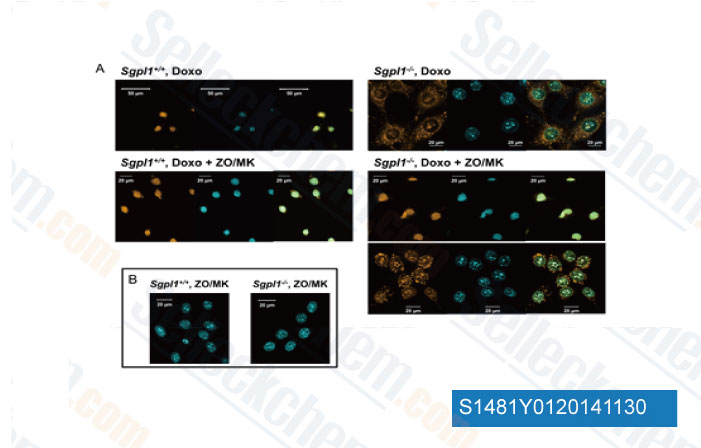
-
Daten von [ J Lipid Res , 2014 , 10.1194/jlr.M052761 ]
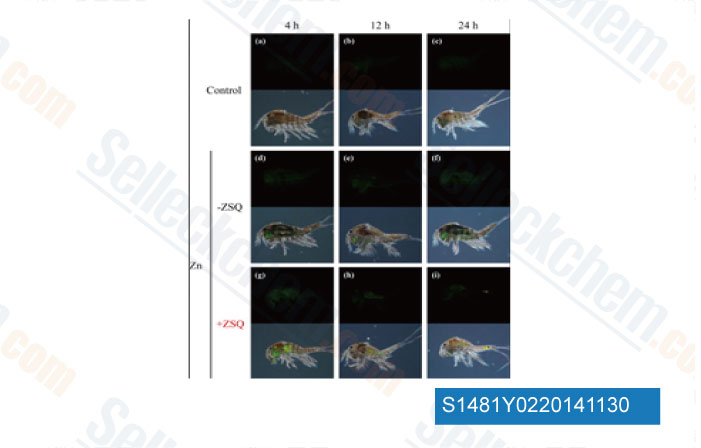
-
Daten von [ Aquat Toxicol , 2014 , 156C, 135-147 ]
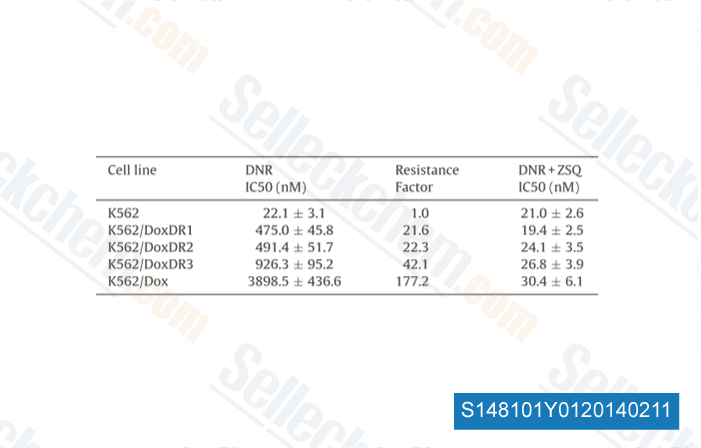
-
Daten von [ Pharmacol Res , 2013 , 67(1), 79-83 ]
![Inhibition of B-A steady state fluxes of digoxin and rhodamine 123 by increasing concentrations of zosuquidar (ZSQ). The iP-gp cell monolayers were investigated for digoxin (A) and rhodamine 123 (B) transport in the presence of increasing concentrations of zosuquidar (0.002–2.0 μM). The cells were preincubated with zosuquidar 10 min before addition of 3.12 μM rhodamine 123 or tracer amount of [3H]-digoxin at the abluminal site for B-A transport in a period of 120 min. The fluxes were estimated from the linear part of the accumulation curves. Values are presented as means ± SEM of three individual cell passages with two individual permeable supports (n =3, total N = 6).](https://file.selleckchem.com/downloads/review/700px/Zosuquidar-S148101X0620181107.gif)
-
Daten von [ , , Eur J Pharm Sci, 2018, 112:112-121 ]
Sellecks Zosuquidar 3HCl Wurde zitiert von 34 Publikationen
| Development of PROTACs for targeted degradation of oncogenic TRK fusions [ bioRxiv, 2025, 2025.06.18.660465] | PubMed: 40666929 |
| Inhibition of the transmembrane transporter ABCB1 overcomes resistance to doxorubicin in patient-derived organoid models of HCC [ Hepatol Commun, 2024, 8(5)e0437] | PubMed: 38696353 |
| Functional Blood-Brain Barrier Model with Tight Connected Minitissue by Liquid Substrates Culture [ Adv Healthc Mater, 2022, e2201984] | PubMed: 36394091 |
| Overcoming Resistance to Anti–Nectin-4 Antibody-Drug Conjugate [ Mol Cancer Ther, 2022, 21 (7): 1227–1235.] | PubMed: None |
| Overcoming Resistance to Anti-nectin-4 Antibody-Drug Conjugate [ Mol Cancer Ther, 2022, molcanther.0013.2022] | PubMed: 35534238 |
| Brain endothelial cells metabolize glutamate via glutamate dehydrogenase to replenish TCA-intermediates and produce ATP under hypoglycemic conditions [ J Neurochem, 2021, 157(6):1861-1875] | PubMed: 33025588 |
| Heat Shock Protein Inhibitor 17-Allyamino-17-Demethoxygeldanamycin, a Potent Inductor of Apoptosis in Human Glioma Tumor Cell Lines, Is a Weak Substrate for ABCB1 and ABCG2 Transporters [ Pharmaceuticals (Basel), 2021, 14(2)107] | PubMed: 33573093 |
| The blood-brain barrier studied in vitro across species [ PLoS One, 2021, 16(3):e0236770] | PubMed: 33711041 |
| Characterization of human pregnane X receptor activators identified from a screening of the Tox21 compound library [ Biochem Pharmacol, 2020, S0006-2952(20)30604-3] | PubMed: 33333074 |
| Testing of the Survivin Suppressant YM155 in a Large Panel of Drug-Resistant Neuroblastoma Cell Lines. [ Cancers (Basel), 2020, 2;12(3) pii: E577] | PubMed: 32131402 |
RÜCKGABERICHTLINIE
Die bedingungslose Rückgaberichtlinie von Selleck Chemical gewährleistet unseren Kunden ein reibungsloses Online-Einkaufserlebnis. Wenn Sie in irgendeiner Weise mit Ihrem Kauf unzufrieden sind, können Sie jeden Artikel innerhalb von 7 Tagen nach Erhalt zurückgeben. Im Falle von Produktqualitätsproblemen, sei es protokollbezogene oder produktbezogene Probleme, können Sie jeden Artikel innerhalb von 365 Tagen ab dem ursprünglichen Kaufdatum zurückgeben. Bitte befolgen Sie die nachstehenden Anweisungen, wenn Sie Produkte zurücksenden.
VERSAND UND LAGERUNG
Selleck-Produkte werden bei Raumtemperatur transportiert. Wenn Sie das Produkt bei Raumtemperatur erhalten, seien Sie versichert, dass die Qualitätskontrollabteilung von Selleck Experimente durchgeführt hat, um zu überprüfen, dass die normale Temperaturplatzierung von einem Monat die biologische Aktivität von Pulverprodukten nicht beeinträchtigt. Nach dem Sammeln lagern Sie das Produkt bitte gemäß den in der Datenblatt beschriebenen Anforderungen. Die meisten Selleck-Produkte sind unter den empfohlenen Bedingungen stabil.
NICHT FÜR DIE ANWENDUNG AM MENSCHEN, FÜR VETERINÄRMEDIZINISCHE DIAGNOSTIK ODER THERAPEUTISCHE ZWECKE.