
Technische Daten
| Formel | C37H48N4O5 |
||||||
| Molekulargewicht | 628.8 | CAS-Nr. | 192725-17-0 | ||||
| Löslichkeit (25°C)* | In vitro | DMSO | 126 mg/mL (200.38 mM) | ||||
| Ethanol | 126 mg/mL (200.38 mM) | ||||||
| Water | Insoluble | ||||||
| In vivo (Lösungsmittel einzeln und der Reihe nach zum Produkt hinzufügen.) |
|
||||||
|
* <1 mg/ml bedeutet schwer löslich oder unlöslich. * Bitte beachten Sie, dass Selleck die Löslichkeit aller Verbindungen intern testet und die tatsächliche Löslichkeit geringfügig von veröffentlichten Werten abweichen kann. Dies ist normal und ist auf geringfügige Batch-zu-Batch-Variationen zurückzuführen. * Versand bei Raumtemperatur (Stabilitätstests zeigen, dass dieses Produkt ohne Kühlmaßnahmen versendet werden kann.) |
|||||||
Vorbereitung von Stammlösungen
Biologische Aktivität
| Beschreibung | Lopinavir (ABT-378) ist ein potenter HIV protease-Inhibitor mit einem Ki von 1,3 pM in einem zellfreien Assay. | ||
|---|---|---|---|
| Ziele |
|
||
| In vitro | Lopinavir (ABT-378) bindet an mutierte HIV protease (V82A, V82F und V82T) mit Ki von 4,9 pM, 3,7 pM bzw. 3,6 pM. Es hemmt 93 % der Wildtyp-HIV protease-Aktivität bei 0,5 nM und unterdrückt auch die HIV protease-Aktivität in Abwesenheit und Anwesenheit von 50 % HS mit EC50 von 17 nM bzw. 102 nM in MT4-Zellen. Diese Verbindung wird in Lebermikrosomen NADPH-abhängig in mehrere Metaboliten umgewandelt, wobei die primären Metaboliten M-3 und M-4 sind. Es ist ein potenter Inhibitor des Rh123-Efflux in Caco-2-Monolayern mit einer IC50 von 1,7 mM. Seine Exposition (72 Stunden) in LS 180V-Zellen reduziert den Gehalt an intrazellulärem Rh123 und induziert P-Glykoprotein-immunreaktive Protein- und Boten-RNA-Spiegel in LS 180V-Zellen. Es hemmt den Subtyp C-Klon C6 mit einer IC50 von 9,4 nM. Zusätzlich hemmt es CYP3A mit einer IC50 von 7,3 mM in menschlichen Lebermikrosomen, während es eine vernachlässigbare oder schwache Hemmung von menschlichem CYP1A2, 2B6, 2C9, 2C19 und 2D6 hervorruft. | ||
| In vivo | Lopinavir (ABT-378) (10 mg/kg, oral) führt bei Ratten zu einem Cmax von 0,8 μg/mL und einer oralen Bioverfügbarkeit von 25 %. |
Protokoll (aus Referenz)
| Tierstudie:[1] |
|
|---|
Referenzen
|
Kundenproduktvalidierung
![Low-micromolar amounts of chloroquine, chlorpromazine, loperamide, and lopinavir inhibit MERS-CoV-induced cytopathology. Huh7 cells in 96-well plates were infected with MERS-CoV isolate EMC/2012 (MOI, 0.005) in the presence of 0 to 20 uM LPV. Cells were incubated for 2 days, and cell viability was monitored using an MTS assay. In addition, the potential toxicity of compound treatment only was monitored in parallel mock-infected Huh7 cell cultures. Graphs show the results (averages and standard deviations [SD]) of a representative experiment that was performed in quadruplicate. All experiments were repeated at least twice. For each compound, the calculated EC50, CC50, and SI values are given.](https://file.selleckchem.com/downloads/review/700px/Lopinavir-S1380Z0120141215.gif)
-
Daten von [ Antimicrob Agents Chemother , 2014 , 58(8), 4875-84 ]
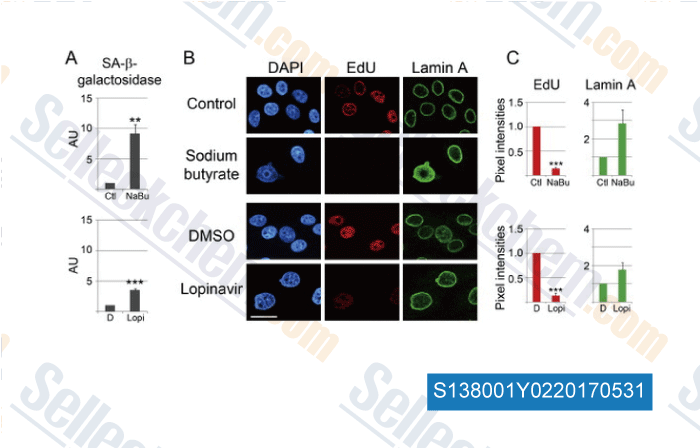
-
Daten von [ , , Biochim Biophys Acta, 2017, 1864(3):475-486 ]
Sellecks Lopinavir (ABT-378) Wurde zitiert von 46 Publikationen
| Exploring the Therapeutic Potential of Cordyceps Mushroom on SARS-CoV-2 Using Virtual Screening against Mpro and In Vitro Validation of Cordycepin [ J Microbiol Biotechnol, 2025, 35:e2411063] | PubMed: 40147924 |
| Reactivated endogenous retroviruses promote protein aggregate spreading [ Nat Commun, 2023, 14(1):5034] | PubMed: 37596282 |
| Stabilization of the Dimeric State of SARS-CoV-2 Main Protease by GC376 and Nirmatrelvir [ Int J Mol Sci, 2023, 24(7)6062] | PubMed: 37047038 |
| Garbage in, garbage out: how reliable training data improved a virtual screening approach against SARS-CoV-2 MPro [ Front Pharmacol, 2023, 14:1193282] | PubMed: 37426813 |
| The Interleukin-11/IL-11 Receptor Promotes Glioblastoma Survival and Invasion under Glucose-Starved Conditions through Enhanced Glutaminolysis [ Int J Mol Sci, 2023, 24(4)3356] | PubMed: 36834778 |
| Stabilization of the Dimeric State of SARS-CoV-2 Main Protease by GC376 and Nirmatrelvir [ Int. J. Mol. Sci, 2023, 10.3390/ijms24076062] | PubMed: None |
| Biological and Structural Analyses of New Potent Allosteric Inhibitors of HIV-1 Integrase [ Antimicrob Agents Chemother, 2023, 67(7):e0046223] | PubMed: 37310224 |
| The IDentif.AI-x pandemic readiness platform: Rapid prioritization of optimized COVID-19 combination therapy regimens [ NPJ Digit Med, 2022, 5(1):83] | PubMed: 35773329 |
| Cell-to-cell transmission of HIV-1 from provirus-activated cells to resting naïve and memory human primary CD4 T cells is highly efficient and requires CD4 and F-actin but not chemokine receptors [ J Med Virol, 2022, 10.1002/jmv.28005] | PubMed: 35840493 |
| Significant role of host sialylated glycans in the infection and spread of severe acute respiratory syndrome coronavirus 2 [ PLoS Pathog, 2022, 18(6):e1010590] | PubMed: 35700214 |
RÜCKGABERICHTLINIE
Die bedingungslose Rückgaberichtlinie von Selleck Chemical gewährleistet unseren Kunden ein reibungsloses Online-Einkaufserlebnis. Wenn Sie in irgendeiner Weise mit Ihrem Kauf unzufrieden sind, können Sie jeden Artikel innerhalb von 7 Tagen nach Erhalt zurückgeben. Im Falle von Produktqualitätsproblemen, sei es protokollbezogene oder produktbezogene Probleme, können Sie jeden Artikel innerhalb von 365 Tagen ab dem ursprünglichen Kaufdatum zurückgeben. Bitte befolgen Sie die nachstehenden Anweisungen, wenn Sie Produkte zurücksenden.
VERSAND UND LAGERUNG
Selleck-Produkte werden bei Raumtemperatur transportiert. Wenn Sie das Produkt bei Raumtemperatur erhalten, seien Sie versichert, dass die Qualitätskontrollabteilung von Selleck Experimente durchgeführt hat, um zu überprüfen, dass die normale Temperaturplatzierung von einem Monat die biologische Aktivität von Pulverprodukten nicht beeinträchtigt. Nach dem Sammeln lagern Sie das Produkt bitte gemäß den in der Datenblatt beschriebenen Anforderungen. Die meisten Selleck-Produkte sind unter den empfohlenen Bedingungen stabil.
NICHT FÜR DIE ANWENDUNG AM MENSCHEN, FÜR VETERINÄRMEDIZINISCHE DIAGNOSTIK ODER THERAPEUTISCHE ZWECKE.