
Technische Daten
| Formel | C23H21N5O3S |
||||||||||
| Molekulargewicht | 447.51 | CAS-Nr. | 850879-09-3 | ||||||||
| Löslichkeit (25°C)* | In vitro | DMSO | 90 mg/mL (201.11 mM) | ||||||||
| Water | Insoluble | ||||||||||
| Ethanol | Insoluble | ||||||||||
| In vivo (Lösungsmittel einzeln und der Reihe nach zum Produkt hinzufügen.) |
|
||||||||||
|
* <1 mg/ml bedeutet schwer löslich oder unlöslich. * Bitte beachten Sie, dass Selleck die Löslichkeit aller Verbindungen intern testet und die tatsächliche Löslichkeit geringfügig von veröffentlichten Werten abweichen kann. Dies ist normal und ist auf geringfügige Batch-zu-Batch-Variationen zurückzuführen. * Versand bei Raumtemperatur (Stabilitätstests zeigen, dass dieses Produkt ohne Kühlmaßnahmen versendet werden kann.) |
|||||||||||
Vorbereitung von Stammlösungen
Biologische Aktivität
| Beschreibung | Amuvatinib (MP-470, HPK 56) ist ein potenter und Multi-Target-Inhibitor von c-Kit, PDGFRα und Flt3 mit IC50 von 10 nM, 40 nM bzw. 81 nM. Es unterdrückt c-MET und c-RET und ist auch als DNA-Reparaturprotein-Rad51-Inhibitor mit antineoplastischer Aktivität aktiv. Phase 2. | |||||||||||
|---|---|---|---|---|---|---|---|---|---|---|---|---|
| Ziele |
|
|||||||||||
| In vitro | Das Hydrochloridsalz von Amuvatinib (MP-470) hemmt mehrere Mutanten von c-Kit, einschließlich c-KitD816V, c-KitD816H, c-KitV560G und c-KitV654A, sowie eine Flt3-Mutante (Flt3D835Y) und zwei PDGFRα-Mutanten (PDGFRαV561D und PDGFRαD842V), mit einer IC50 von 10 nM bis 8,4 μM. Es bindet auch an mehrere c-Kit-Mutanten, einschließlich c-KitK642E, c-KitD816V und c-KitK642E/D816V, und hemmt diese. Diese Verbindung hemmt potent die Proliferation von OVCAR-3-, A549-, NCI-H647-, DMS-153- und DMS-114-Zellen mit einer IC50 von 0,9 μM bis 7,86 μM. Es hemmt auch c-Kit und PDGFRα mit IC50-Werten von 31 μM bzw. 27 μM. Es zeigt eine potente Zytotoxizität gegen MiaPaCa-2-, PANC-1- und GIST882-Zellen mit einer IC50 von 1,6 μM bis 3,0 μM. In MDA-MB-231-Zellen hemmt es (1 μM) die Tyrosinphosphorylierung von AXL. In LNCaP- und PC-3-, aber nicht DU145-Zellen, zeigt es Zytotoxizität mit einer IC50 von 4 μM bzw. 8 μM und induziert Apoptose bei 10 μM. In LNCaP-Zellen induziert es (10 μM) einen G1-Arrest und verringert die Phosphorylierung von Akt und ERK1/2. In SF767-Zellen hemmt es (10 μM) die c-Met-Phosphorylierung und sensibilisiert Zellen für Strahlung. In Kombination mit Strahlung hemmt es (10 μM) die Glykogensynthasekinase (GSK)3β-Aktivität, induziert Apoptose und stört die Reparatur von dsDNA-Brüchen, wahrscheinlich durch die Unterdrückung von Rad51. |
|||||||||||
| In vivo | In Maus-Xenograft-Modellen von HT-29-, A549- und SB-CL2-Zellen hemmt Amuvatinib (MP-470) (10 mg/kg–75 mg/kg i.p. oder 50 mg/kg–200 mg/kg p.o.) das Tumorwachstum. In Mäusen mit LNCaP-Xenograft induziert diese Verbindung (20 mg/kg) in Kombination mit Erlotinib signifikant eine Hemmung des Tumorwachstums (TGI). |
Protokoll (aus Referenz)
| Kinase-Assay: |
|
|---|---|
| Zell-Assay: |
|
| Tierstudie: |
|
Referenzen
|
Kundenproduktvalidierung
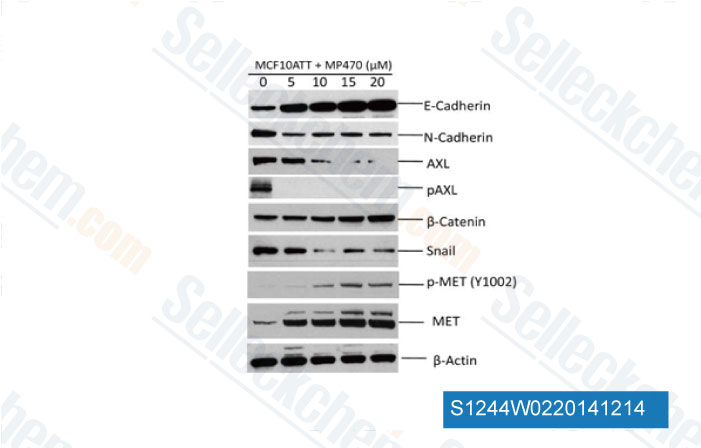
-
Daten von [ Oncogene , 2014 , 33(10), 1316-24 ]
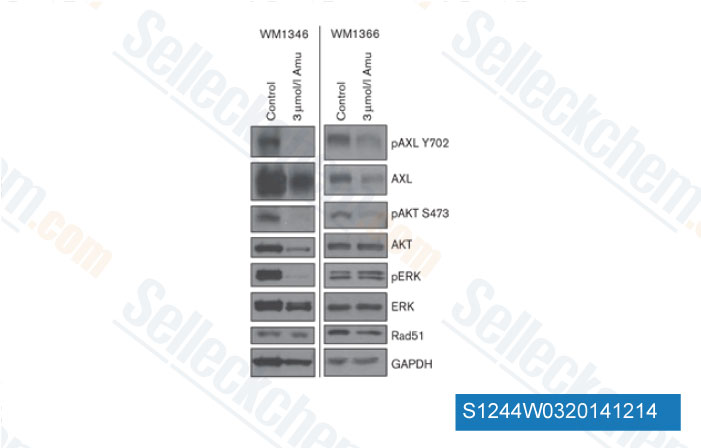
-
Daten von [ Melanoma Res , 2014 , 24(5), 448-53 ]
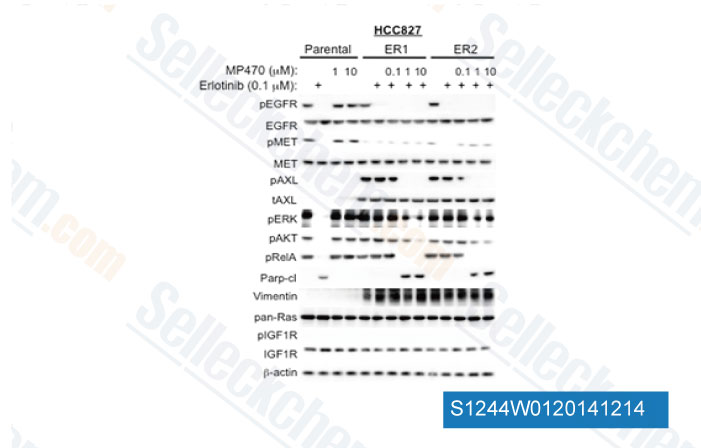
-
Daten von [ Nat Genet , 2012 , 44(8), 852-60 ]
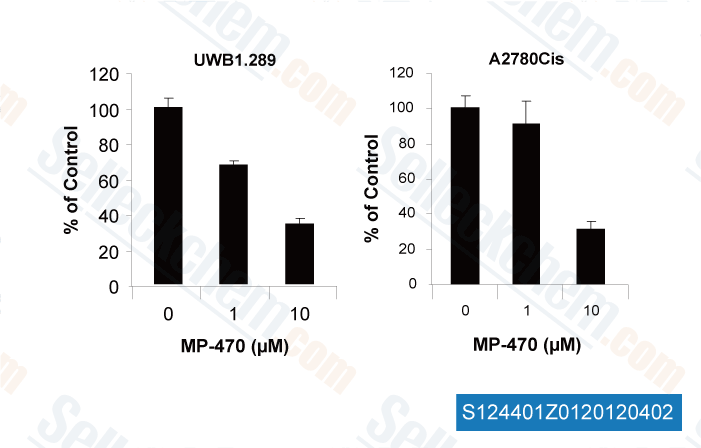
-
, , Dr. Yong-Weon Yi from Georgetown University Medical Center
Sellecks Amuvatinib (MP-470) Wurde zitiert von 21 Publikationen
| Tumorigenesis Driven by BRAFV600E Requires Secondary Mutations that Overcome it's Feedback Inhibition of RAC1 and Migration [ Cancer Res, 2025, 10.1158/0008-5472.CAN-24-2220] | PubMed: 39992718 |
| Synthetic Lethal Combinations of DNA Repair Inhibitors and Genotoxic Agents to Target High-Risk Diffuse Large B Cell Lymphoma [ Hematol Oncol, 2025, 43(5):e70131] | PubMed: 40847617 |
| Tumorigenesis driven by the BRAFV600E oncoprotein requires secondary mutations that overcome its feedback inhibition of migration and invasion [ bioRxiv, 2024, 2023.11.21.568071] | PubMed: 38659913 |
| Amuvatinib Blocks SARS-CoV-2 Infection at the Entry Step of the Viral Life Cycle [ Microbiol Spectr, 2023, e0510522.] | PubMed: 36995225 |
| Establishment and Characterization of NCC-PMP1-C1: A Novel Patient-Derived Cell Line of Metastatic Pseudomyxoma Peritonei [ J Pers Med, 2022, 12(2)258] | PubMed: 35207746 |
| Establishment and characterization of NCC-UPS4-C1: a novel cell line of undifferentiated pleomorphic sarcoma from a patient with Li-Fraumeni syndrome [ Hum Cell, 2022, 10.1007/s13577-022-00671-y] | PubMed: 35118583 |
| βIII-tubulin suppression enhances the activity of Amuvatinib to inhibit cell proliferation in c-Met positive non-small cell lung cancer cells [ Cancer Med, 2022, 10.1002/cam4.5128] | PubMed: 35946957 |
| STING-Mediated Interferon Induction by Herpes Simplex Virus 1 Requires the Protein Tyrosine Kinase Syk [ mBio, 2021, 12(6):e0322821] | PubMed: 34933455 |
| Establishment and characterization of NCC-MFS4-C1: a novel patient-derived cell line of myxofibrosarcoma [ Hum Cell, 2021, 34(6):1911-1918] | PubMed: 34383271 |
| Establishment and characterization of novel patient-derived cell lines from giant cell tumor of bone [ Hum Cell, 2021, 10.1007/s13577-021-00579-z] | PubMed: 34304386 |
RÜCKGABERICHTLINIE
Die bedingungslose Rückgaberichtlinie von Selleck Chemical gewährleistet unseren Kunden ein reibungsloses Online-Einkaufserlebnis. Wenn Sie in irgendeiner Weise mit Ihrem Kauf unzufrieden sind, können Sie jeden Artikel innerhalb von 7 Tagen nach Erhalt zurückgeben. Im Falle von Produktqualitätsproblemen, sei es protokollbezogene oder produktbezogene Probleme, können Sie jeden Artikel innerhalb von 365 Tagen ab dem ursprünglichen Kaufdatum zurückgeben. Bitte befolgen Sie die nachstehenden Anweisungen, wenn Sie Produkte zurücksenden.
VERSAND UND LAGERUNG
Selleck-Produkte werden bei Raumtemperatur transportiert. Wenn Sie das Produkt bei Raumtemperatur erhalten, seien Sie versichert, dass die Qualitätskontrollabteilung von Selleck Experimente durchgeführt hat, um zu überprüfen, dass die normale Temperaturplatzierung von einem Monat die biologische Aktivität von Pulverprodukten nicht beeinträchtigt. Nach dem Sammeln lagern Sie das Produkt bitte gemäß den in der Datenblatt beschriebenen Anforderungen. Die meisten Selleck-Produkte sind unter den empfohlenen Bedingungen stabil.
NICHT FÜR DIE ANWENDUNG AM MENSCHEN, FÜR VETERINÄRMEDIZINISCHE DIAGNOSTIK ODER THERAPEUTISCHE ZWECKE.