
Technische Daten
| Formel | C22H29ClN4O6.2HCl |
||||||
| Molekulargewicht | 517.4 | CAS-Nr. | 70476-82-3 | ||||
| Löslichkeit (25°C)* | In vitro | DMSO | 104 mg/mL (201.0 mM) | ||||
| Water | 104 mg/mL (201.0 mM) | ||||||
| Ethanol | Insoluble | ||||||
| In vivo (Lösungsmittel einzeln und der Reihe nach zum Produkt hinzufügen.) |
|
||||||
|
* <1 mg/ml bedeutet schwer löslich oder unlöslich. * Bitte beachten Sie, dass Selleck die Löslichkeit aller Verbindungen intern testet und die tatsächliche Löslichkeit geringfügig von veröffentlichten Werten abweichen kann. Dies ist normal und ist auf geringfügige Batch-zu-Batch-Variationen zurückzuführen. * Versand bei Raumtemperatur (Stabilitätstests zeigen, dass dieses Produkt ohne Kühlmaßnahmen versendet werden kann.) |
|||||||
Vorbereitung von Stammlösungen
Biologische Aktivität
| Beschreibung | Mitoxantrone 2HCl ist ein Dihydrochlorid-Salz von Mitoxantrone. Mitoxantrone ist ein Inhibitor der type II topoisomerase und protein kinase C (PKC) mit einer IC50 von 8,5 μM für PKC. Mitoxantrone hemmt das zellproliferative Wachstum von MCF-7/wt-Zellen mit einer IC50 von 0,42 μM. Mitoxantrone induziert auch apoptosis. | ||||
|---|---|---|---|---|---|
| Ziele |
|
||||
| In vitro | Mitoxantrone induziert in allen untersuchten Patienten DNA-Fragmentierung und die proteolytische Spaltung der Poly(ADP-Ribose)-Polymerase (PARP), einen Marker für die Aktivierung von Caspasen, was zeigt, dass die zytotoxische Wirkung von Mitoxantrone auf der Induktion von Apoptose beruht. Mitoxantrone aktiviert NFkappaB und stimuliert den IkappaBalpha-Abbau in der promyelozytischen Leukämiezelllinie HL60, aber nicht in den Varianten, den HL60/MX2-Zellen, denen die Beta-Isoform der Topoisomerase II fehlt und die eine verkürzte Alpha-Isoform exprimieren, die zu einer veränderten subzellulären Verteilung führt. Mitoxantrone hemmt die Proliferation aktivierter PBMCs, B-Lymphozyten oder antigenspezifischer T-Zelllinien (TCLs), die auf Antigen-präsentierenden Zellen (APCs) stimuliert werden, dosisabhängig. Mitoxantrone induziert Apoptose von PBMCs, Monozyten und DCs bei niedrigen Konzentrationen, während höhere Dosen Zelllyse verursachen. |
||||
| In vivo | Mitoxantrone verringert vorübergehend die Wachstumsrate von HID-Xenografts bei Mäusen, beeinflusst jedoch nicht die von PAC120-Xenografts. Mitoxantrone führt zu einer Verschlimmerung der Herzläsionen sowie der Nephropathie und der intestinalen Toxizität bei spontan hypertensiven Ratten. Mitoxantrone und Eisen(III) bilden einen starken 2:1-Komplex, in dem Mitoxantrone als dreizähniger Ligand wirken kann. |
Protokoll (aus Referenz)
Referenzen
|
Kundenproduktvalidierung
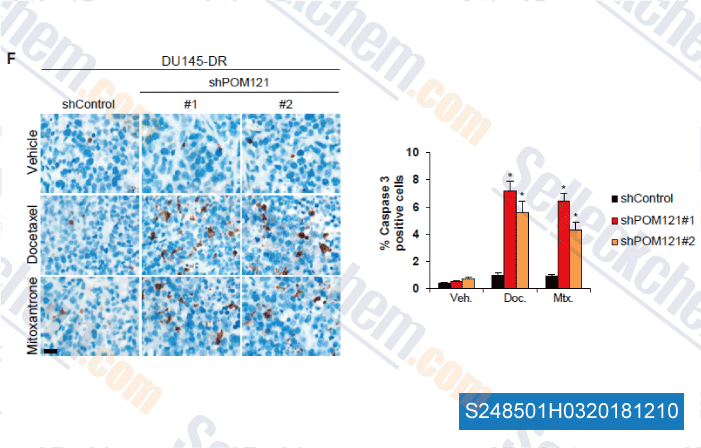
-
Daten von [ , , Cell, 2018, 174(5):1200-1215 ]
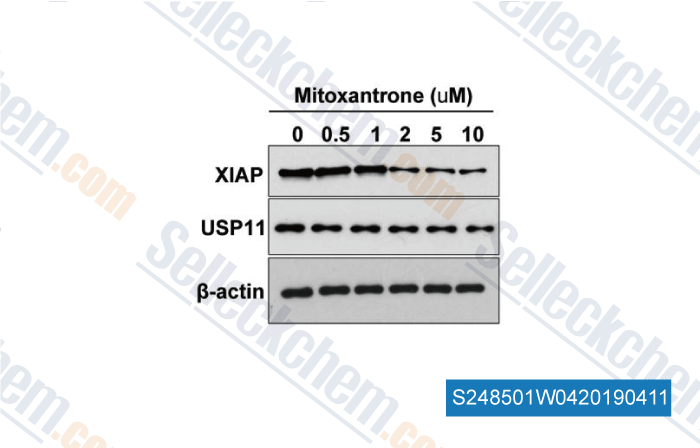
-
Daten von [ , , EBioMedicine, 2017, 15:48-61 ]
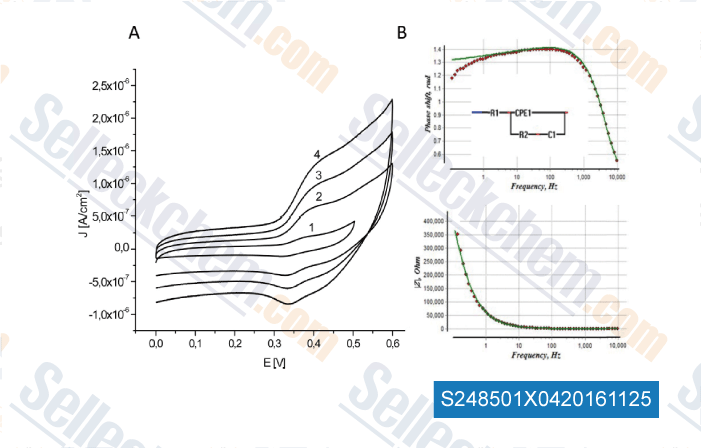
-
Daten von [ , , Electrochimica Acta, 2015, 165:430-442. ]
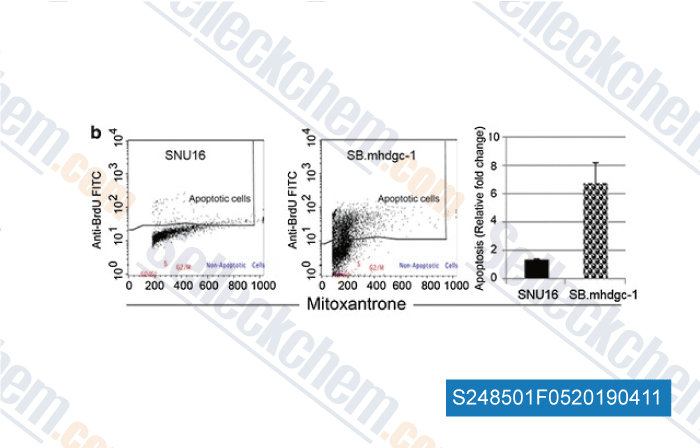
-
Daten von [ , , J Transl Med, 2017, 15(1):92 ]
Sellecks Mitoxantrone Dihydrochloride (NSC 301739) Wurde zitiert von 57 Publikationen
| Identifying Age-Modulating Compounds Using a Novel Computational Framework for Evaluating Transcriptional Age [ Aging Cell, 2025, e70075] | PubMed: 40307992 |
| A functional comparison of two transplantable syngeneic mouse models of melanoma: B16F0 and YUMM1.7 [ Biol Open, 2025, 14(9)bio062175] | PubMed: 40878826 |
| Propafenone facilitates mitochondrial-associated ferroptosis and synergizes with immunotherapy in melanoma [ J Immunother Cancer, 2024, 12(11)e009805] | PubMed: 39581704 |
| Deletion of the mitochondrial calcium uniporter in adipose tissue promotes energy expenditure and alleviates diet-induced obesity [ Mol Metab, 2024, 80:101873] | PubMed: 38199601 |
| Mitoxantrone ameliorates ineffective erythropoiesis in a β-thalassemia intermedia mouse model [ Blood Adv, 2024, 8(15):4017-4024] | PubMed: 38861356 |
| Patient-derived rhabdomyosarcoma cells recapitulate the genetic and transcriptomic landscapes of primary tumors [ iScience, 2024, 27(10):110862] | PubMed: 39319271 |
| Immuno-oncological effects of standard anticancer agents and commonly used concomitant drugs: an in vitro assessment [ BMC Pharmacol Toxicol, 2024, 25(1):25] | PubMed: 38444002 |
| Visualization strategies to aid interpretation of high-dimensional genotoxicity data [ Environ Mol Mutagen, 2024, 10.1002/em.22604] | PubMed: 38757760 |
| Carbonic anhydrase IX inhibitor S4 triggers release of DAMPs related to immunogenic cell death in glioma cells via endoplasmic reticulum stress pathway [ Cell Commun Signal, 2023, 21(1):167] | PubMed: 37386564 |
| Development of Novel Epigenetic Anti-Cancer Therapy Targeting TET Proteins [ Int J Mol Sci, 2023, 10.3390/ijms242216375] | PubMed: 38003566 |
RÜCKGABERICHTLINIE
Die bedingungslose Rückgaberichtlinie von Selleck Chemical gewährleistet unseren Kunden ein reibungsloses Online-Einkaufserlebnis. Wenn Sie in irgendeiner Weise mit Ihrem Kauf unzufrieden sind, können Sie jeden Artikel innerhalb von 7 Tagen nach Erhalt zurückgeben. Im Falle von Produktqualitätsproblemen, sei es protokollbezogene oder produktbezogene Probleme, können Sie jeden Artikel innerhalb von 365 Tagen ab dem ursprünglichen Kaufdatum zurückgeben. Bitte befolgen Sie die nachstehenden Anweisungen, wenn Sie Produkte zurücksenden.
VERSAND UND LAGERUNG
Selleck-Produkte werden bei Raumtemperatur transportiert. Wenn Sie das Produkt bei Raumtemperatur erhalten, seien Sie versichert, dass die Qualitätskontrollabteilung von Selleck Experimente durchgeführt hat, um zu überprüfen, dass die normale Temperaturplatzierung von einem Monat die biologische Aktivität von Pulverprodukten nicht beeinträchtigt. Nach dem Sammeln lagern Sie das Produkt bitte gemäß den in der Datenblatt beschriebenen Anforderungen. Die meisten Selleck-Produkte sind unter den empfohlenen Bedingungen stabil.
NICHT FÜR DIE ANWENDUNG AM MENSCHEN, FÜR VETERINÄRMEDIZINISCHE DIAGNOSTIK ODER THERAPEUTISCHE ZWECKE.