
Technische Daten
| Formel | C22H23N5O.2H3PO4 |
||||||
| Molekulargewicht | 569.44 | CAS-Nr. | 857876-30-3 | ||||
| Löslichkeit (25°C)* | In vitro | DMSO | 100 mg/mL (175.61 mM) | ||||
| Water | 19 mg/mL (33.36 mM) | ||||||
| Ethanol | Insoluble | ||||||
| In vivo (Lösungsmittel einzeln und der Reihe nach zum Produkt hinzufügen.) |
|
||||||
|
* <1 mg/ml bedeutet schwer löslich oder unlöslich. * Bitte beachten Sie, dass Selleck die Löslichkeit aller Verbindungen intern testet und die tatsächliche Löslichkeit geringfügig von veröffentlichten Werten abweichen kann. Dies ist normal und ist auf geringfügige Batch-zu-Batch-Variationen zurückzuführen. * Versand bei Raumtemperatur (Stabilitätstests zeigen, dass dieses Produkt ohne Kühlmaßnahmen versendet werden kann.) |
|||||||
Vorbereitung von Stammlösungen
Biologische Aktivität
| Beschreibung | Motesanib Diphosphate (AMG-706) ist ein potenter ATP-kompetitiver Inhibitor von VEGFR1/2/3 mit einer IC50 von 2 nM/3 nM/6 nM. Es zeigt eine ähnliche Aktivität gegen Kit (c-Kit) und ist etwa 10-mal selektiver für VEGFR als PDGFR und Ret. Diese Verbindung befindet sich in Phase 3. | |||||||||||
|---|---|---|---|---|---|---|---|---|---|---|---|---|
| Ziele |
|
|||||||||||
| In vitro | Motesanib Diphosphate (AMG-706) besitzt eine breite Aktivität gegen die menschliche VEGFR-Familie und weist eine >1000-fache Selektivität gegenüber EGFR, Src und p38 Kinase auf. Es hemmt signifikant die VEGF-induzierte Zellproliferation von HUVECs mit einer IC50 von 10 nM, während es bei der bFGF-induzierten Proliferation mit einer IC50 von >3.000 nM nur geringe Auswirkungen zeigt. Diese Verbindung hemmt auch potent die PDGF-induzierte Proliferation und die SCF-induzierte c-kit-Phosphorylierung mit einer IC50 von 207 nM bzw. 37 nM, ist aber nicht wirksam gegen die EGF-induzierte EGFR-Phosphorylierung und die Zellviabilität von A431-Zellen. Obwohl es allein eine geringe antiproliferative Aktivität auf das Zellwachstum von HUVECs zeigt, sensibilisiert es die Zellen signifikant gegenüber fraktionierter Strahlung. |
|||||||||||
| In vivo | Die Verabreichung von Motesanib Diphosphate (AMG-706) in einer Dosis von 100 mg/kg hemmt die VEGF-induzierte vaskuläre Permeabilität signifikant und zeitabhängig. Die orale Verabreichung dieser Verbindung zweimal täglich oder einmal täglich hemmt die VEGF-induzierte Angiogenese im Rattenkorneamodell potent und dosisabhängig mit einer ED50 von 2,1 mg/kg bzw. 4,9 mg/kg. Es induziert eine dosisabhängige Tumorregression etablierter A431-Xenotransplantate durch selektive Hemmung der Neovaskularisierung in Tumorzellen. In Kombination mit Bestrahlung zeigt es eine signifikante Antitumoraktivität in Xenotransplantatmodellen für Plattenepithelkarzinome des Kopf- und Halsbereichs (HNSCC). Die Behandlung mit dieser Verbindung induziert auch signifikante dosisabhängige Reduktionen des Tumorwachstums und der Blutgefäßdichte von MCF-7-, MDA-MB-231- oder Cal-51-Xenotransplantaten. |
Protokoll (aus Referenz)
| Kinase-Assay: |
|
|---|---|
| Zell-Assay: |
|
| Tierstudie: |
|
Referenzen
|
Kundenproduktvalidierung
-
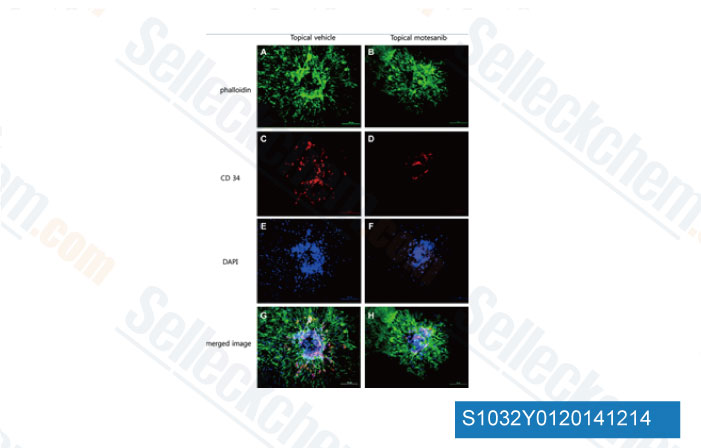
Daten von [ J Ocul Pharmacol Ther , 2014 , 10.1089/jop.2014.0023 ]
-
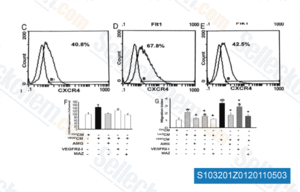
Daten von [ Cardiovasc Res , 2011 , 91, 402-11 ]
-
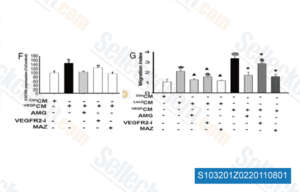
Daten von [ Cardiovasc Res , 2011 , 91, 402-11 ]
Sellecks Motesanib Diphosphate (AMG-706) Wurde zitiert von 12 Publikationen
| Anosmin-1-Like Effect of UMODL1/Olfactorin on the Chemomigration of Mouse GnRH Neurons and Zebrafish Olfactory Axons Development [ Front Cell Dev Biol, 2022, 10:836179] | PubMed: 35223856 |
| Preclinical Evaluation of Ixabepilone in Combination with VEGF Receptor and PARP Inhibitors in Taxane-Sensitive and Taxane-Resistant MDA-MB-231 Breast Cancer Cells [ J Pharm Sci, 2022, 111(8):2180-2190] | PubMed: 35700798 |
| Extension of the Mechanistic Tissue Distribution Model of Rodgers and Rowland by Systematic Incorporation of Lysosomal Trapping: Impact on Unbound Partition Coefficient and Volume of Distribution Predictions in the Rat [ Drug Metab Dispos, 2021, 49(1):53-61] | PubMed: 33148688 |
| Cardiac Reprogramming Factors Synergistically Activate Genome-wide Cardiogenic Stage-Specific Enhancers [ Cell Stem Cell, 2019, 25(1):69-86] | PubMed: 31080136 |
| Targeting the Kaposi Sarcoma Herpesvirus ORF 21 tyrosine kinase and viral lytic reactivation by tyrosine kinase inhibitors approved for clinical use. [ J Virol, 2019, 10.1128/JVI.01791-19] | PubMed: 31826996 |
| [ Cancer Res, 2016, ] | PubMed: 27488524 |
| Dual inhibition of EGFR and MET induces synthetic lethality in triple-negative breast cancer cells through downregulation of ribosomal protein S6 [ Int J Oncol, 2015, 47(1):122-32] | PubMed: 25955731 |
| VEGF/SDF-1 promotes cardiac stem cell mobilization and myocardial repair in the infarcted heart. [Tang JM, et al. Int J Cardiol, 2015, 183C:221-231] | PubMed: 25679991 |
| Antiangiogenic Effects of Topically Administered Multiple Kinase Inhibitor, Motesanib (AMG 706), on Experimental Choroidal Neovascularization in Mice [Rho CR, et al. J Ocul Pharmacol Ther, 2015, 31(1):25-31] | |
| Bioluminescent cell-based NAD(P)/NAD(P)H assays for rapid dinucleotide measurement and inhibitor screening [ Assay Drug Dev Technol, 2014, 12(9-10):514-26] | PubMed: 25506801 |
RÜCKGABERICHTLINIE
Die bedingungslose Rückgaberichtlinie von Selleck Chemical gewährleistet unseren Kunden ein reibungsloses Online-Einkaufserlebnis. Wenn Sie in irgendeiner Weise mit Ihrem Kauf unzufrieden sind, können Sie jeden Artikel innerhalb von 7 Tagen nach Erhalt zurückgeben. Im Falle von Produktqualitätsproblemen, sei es protokollbezogene oder produktbezogene Probleme, können Sie jeden Artikel innerhalb von 365 Tagen ab dem ursprünglichen Kaufdatum zurückgeben. Bitte befolgen Sie die nachstehenden Anweisungen, wenn Sie Produkte zurücksenden.
VERSAND UND LAGERUNG
Selleck-Produkte werden bei Raumtemperatur transportiert. Wenn Sie das Produkt bei Raumtemperatur erhalten, seien Sie versichert, dass die Qualitätskontrollabteilung von Selleck Experimente durchgeführt hat, um zu überprüfen, dass die normale Temperaturplatzierung von einem Monat die biologische Aktivität von Pulverprodukten nicht beeinträchtigt. Nach dem Sammeln lagern Sie das Produkt bitte gemäß den in der Datenblatt beschriebenen Anforderungen. Die meisten Selleck-Produkte sind unter den empfohlenen Bedingungen stabil.
NICHT FÜR DIE ANWENDUNG AM MENSCHEN, FÜR VETERINÄRMEDIZINISCHE DIAGNOSTIK ODER THERAPEUTISCHE ZWECKE.