
Technische Daten
| Formel | C23H31NO7 |
||||||
| Molekulargewicht | 433.49 | CAS-Nr. | 128794-94-5 | ||||
| Löslichkeit (25°C)* | In vitro | DMSO | 86 mg/mL (198.38 mM) | ||||
| Water | Insoluble | ||||||
| Ethanol | Insoluble | ||||||
| In vivo (Lösungsmittel einzeln und der Reihe nach zum Produkt hinzufügen.) |
|
||||||
|
* <1 mg/ml bedeutet schwer löslich oder unlöslich. * Bitte beachten Sie, dass Selleck die Löslichkeit aller Verbindungen intern testet und die tatsächliche Löslichkeit geringfügig von veröffentlichten Werten abweichen kann. Dies ist normal und ist auf geringfügige Batch-zu-Batch-Variationen zurückzuführen. * Versand bei Raumtemperatur (Stabilitätstests zeigen, dass dieses Produkt ohne Kühlmaßnahmen versendet werden kann.) |
|||||||
Vorbereitung von Stammlösungen
Biologische Aktivität
| Beschreibung | Mycophenolate mofetil ist ein nicht-kompetitiver, selektiver und reversibler Inhibitor der inosine monophosphate dehydrogenase I/II mit IC50 von 39 nM bzw. 27 nM. Diese Verbindung induziert Caspase-abhängige apoptosis und Zellzyklushemmung in multiplen Myelomzellen. | ||||
|---|---|---|---|---|---|
| Ziele |
|
||||
| In vitro | Mycophenolate mofetil ist ein Ester-Prodrug des aktiven Immunsuppressivums Mycophenolsäure (MPA). Letztere zeigt eine nicht-kompetitive, selektive und reversible Hemmaktivität gegen inosine monophosphate dehydrogenase Typ I/II mit IC50 von 39 nM bzw. 27 nM. Darüber hinaus bewirkt MPA auch eine konzentrationsabhängige Hemmung der Proliferation von ConA-stimulierten T-Zellen, LPS-stimulierten B-Zellen und Alloantigen-spezifischen T-Zellen mit IC50 von 100 nM, 120 nM bzw. 51 nM. Diese Verbindung in hoher Konzentration von 10 μg/mL induziert eine starke Apoptose in Mikrogliazellkulturen und erhöht die Anzahl aktivierter Caspase-3-immunreaktiver apoptotischer Zellen. Darüber hinaus hemmt sie (1 μg/mL) stark die Proliferation sowohl von Mikrogliazellen als auch von Astrozyten. Eine aktuelle Studie zeigt, dass diese Chemikalie das Ausmaß des neuronalen Zelltods von organotypischen Hippocampus-Schnittkulturen nach neuronaler Verletzung zeitabhängig signifikant abschwächt. |
||||
| In vivo | In einem heterotopen kardialen Transplantationsmodell von ACI-zu-Lewis-Ratten führt die Behandlung mit Mycophenolate mofetil in Dosen von 20 mg/kg und 40 mg/kg zu einer Verlängerung des Transplantatüberlebens mit einer mittleren Überlebenszeit (MST) von 14,5 Tagen bzw. 18,5 Tagen. In einem Bleomycin (BLM)-induzierten Sklerodermie-Mausmodell reduziert diese Verbindung die Infiltration von Entzündungszellen, den Gewebe-Hydroxyprolingehalt und die Hautdicke. |
Protokoll (aus Referenz)
| Kinase-Assay: |
|
|---|---|
| Zell-Assay: |
|
| Tierstudie: |
|
Referenzen
|
Kundenproduktvalidierung
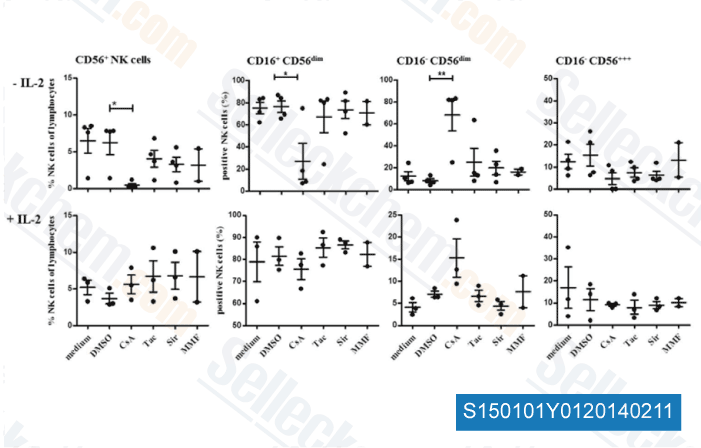
-
Daten von [ Front Immunol , 2013 , 4, 46 ]
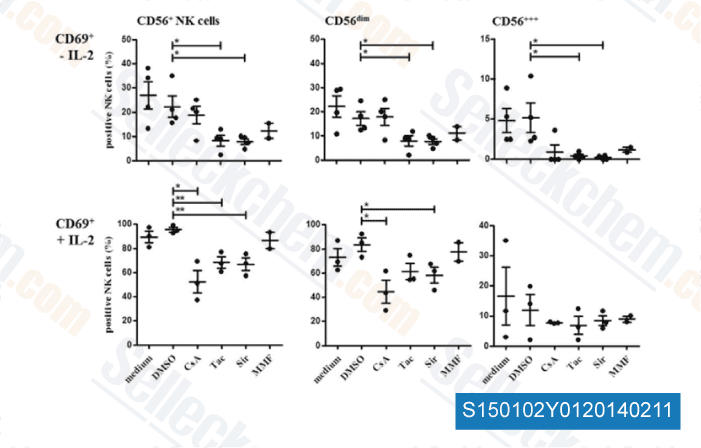
-
Daten von [ Front Immunol , 2013 , 4, 46 ]
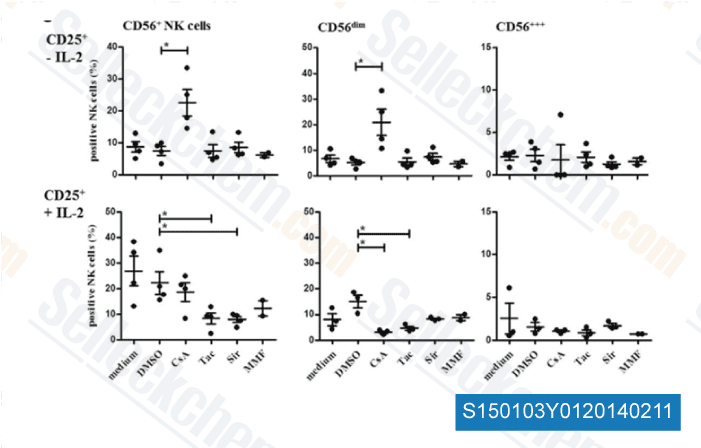
-
Daten von [ Front Immunol , 2013 , 4:, 46 ]
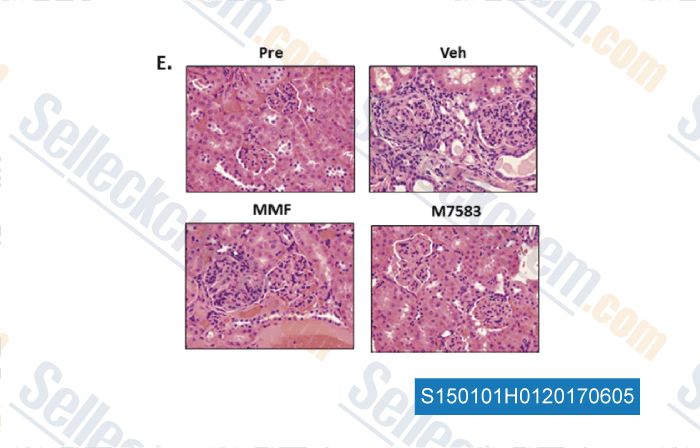
-
Daten von [ , , Clin Immunol, 2016, 164:65-77 ]
Sellecks Mycophenolate mofetil Wurde zitiert von 14 Publikationen
| Digital twins for in vivo metabolic flux estimations in patients with brain cancer [ Cell Metab, 2025, S1550-4131(25)00482-6] | PubMed: 41330373 |
| Genome-scale clustered regularly interspaced short palindromic repeats screen identifies nucleotide metabolism as an actionable therapeutic vulnerability in diffuse large B-cell lymphoma [ Haematologica, 2024, 109(12):3989-4006] | PubMed: 38841800 |
| Spatiotemporal Regulation of De Novo and Salvage Purine Synthesis during Brain Development [ eNeuro, 2023, 10(10)ENEURO.0159-23.2023] | PubMed: 37770184 |
| Spatiotemporal regulation ofde novoand salvage purine synthesis during brain development [ bioRxiv, 2023, 10.1101/2023.03.01.530588] | PubMed: None |
| Reversal of cancer gene expression identifies repurposed drugs for diffuse intrinsic pontine glioma [ Acta Neuropathol Commun, 2022, 10(1):150] | PubMed: 36274161 |
| Comprehensive drug response profiling and pan-omic analysis identified therapeutic candidates and prognostic biomarkers for Asian cholangiocarcinoma [ iScience, 2022, 25(10):105182] | PubMed: 36248745 |
| GATA4 regulates mitochondrial biogenesis and functions during cardiac development and rescues cardiac and mitochondrial functions impaired by TKIs [ Research Square, 2022, Version 1] | PubMed: None |
| The effect of nintedanib versus mycophenolate mofetil in the Fra2 mouse model of systemic sclerosis-associated interstitial lung disease [ Clin Exp Rheumatol, 2021, N/A] | PubMed: 33886452 |
| Purine metabolism regulates DNA repair and therapy resistance in glioblastoma [ Nat Commun, 2020, 11(1):3811] | PubMed: 32732914 |
| IMPDH Inhibitors for Antitumor Therapy in Tuberous Sclerosis Complex [ JCI Insight, 2020, 9;5(7):e135071] | PubMed: 32271165 |
RÜCKGABERICHTLINIE
Die bedingungslose Rückgaberichtlinie von Selleck Chemical gewährleistet unseren Kunden ein reibungsloses Online-Einkaufserlebnis. Wenn Sie in irgendeiner Weise mit Ihrem Kauf unzufrieden sind, können Sie jeden Artikel innerhalb von 7 Tagen nach Erhalt zurückgeben. Im Falle von Produktqualitätsproblemen, sei es protokollbezogene oder produktbezogene Probleme, können Sie jeden Artikel innerhalb von 365 Tagen ab dem ursprünglichen Kaufdatum zurückgeben. Bitte befolgen Sie die nachstehenden Anweisungen, wenn Sie Produkte zurücksenden.
VERSAND UND LAGERUNG
Selleck-Produkte werden bei Raumtemperatur transportiert. Wenn Sie das Produkt bei Raumtemperatur erhalten, seien Sie versichert, dass die Qualitätskontrollabteilung von Selleck Experimente durchgeführt hat, um zu überprüfen, dass die normale Temperaturplatzierung von einem Monat die biologische Aktivität von Pulverprodukten nicht beeinträchtigt. Nach dem Sammeln lagern Sie das Produkt bitte gemäß den in der Datenblatt beschriebenen Anforderungen. Die meisten Selleck-Produkte sind unter den empfohlenen Bedingungen stabil.
NICHT FÜR DIE ANWENDUNG AM MENSCHEN, FÜR VETERINÄRMEDIZINISCHE DIAGNOSTIK ODER THERAPEUTISCHE ZWECKE.