
Technische Daten
| Formel | C30H40ClN7O3S |
||||||||||
| Molekulargewicht | 614.2 | CAS-Nr. | 761439-42-3 | ||||||||
| Löslichkeit (25°C)* | In vitro | DMSO | 18 mg/mL (29.3 mM) | ||||||||
| Water | Insoluble | ||||||||||
| Ethanol | Insoluble | ||||||||||
| In vivo (Lösungsmittel einzeln und der Reihe nach zum Produkt hinzufügen.) |
|
||||||||||
|
* <1 mg/ml bedeutet schwer löslich oder unlöslich. * Bitte beachten Sie, dass Selleck die Löslichkeit aller Verbindungen intern testet und die tatsächliche Löslichkeit geringfügig von veröffentlichten Werten abweichen kann. Dies ist normal und ist auf geringfügige Batch-zu-Batch-Variationen zurückzuführen. * Versand bei Raumtemperatur (Stabilitätstests zeigen, dass dieses Produkt ohne Kühlmaßnahmen versendet werden kann.) |
|||||||||||
Vorbereitung von Stammlösungen
Biologische Aktivität
| Beschreibung | TAE684 (NVP-TAE684) ist ein potenter und selektiver ALK-Inhibitor, der das Wachstum von ALCL-abgeleiteten und ALK-abhängigen Zelllinien mit IC50-Werten zwischen 2 und 10 nM blockierte, 100-fach empfindlicher für ALK als InsR. Diese Verbindung induziert Zellzyklusarrest und Apoptose. | ||
|---|---|---|---|
| Ziele |
|
||
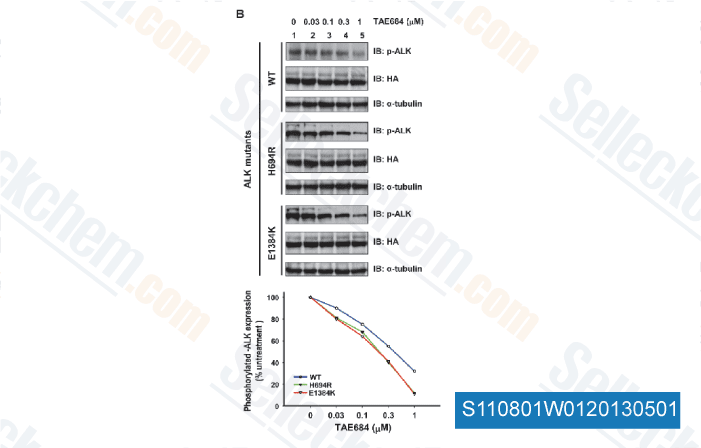
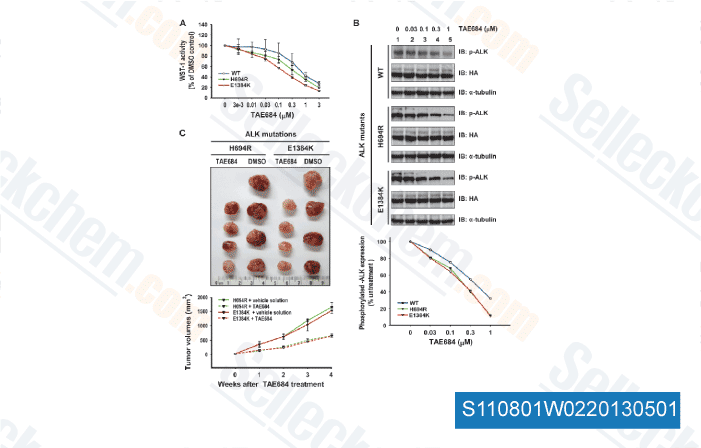
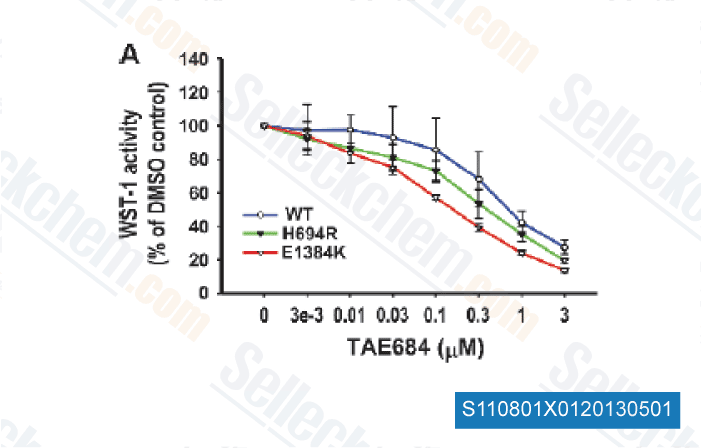
| In vitro | TAE684 (NVP-TAE684) zeigt keine signifikante Kreuzreaktivität gegenüber anderen Kinasen. Diese Verbindung hemmt die Proliferation von Ba/F3 NPM-ALK-Zellen potent mit einer IC50 von 3 nM, ohne die Überlebensfähigkeit von Ba/F3-Zellen selbst bei 1 µM zu beeinflussen. Es hemmt auch die Proliferation von NPM-ALK-exprimierenden humanen ALCL-Zelllinien, einschließlich Karpas-299 und SU-DHL-1, mit einer IC50 von 2–5 nM. Molekulare Modellierung zeigt, dass L258 einer der Hauptdeterminanten für die Kinase-Selektivität dieser Chemikalie sein könnte. Die Behandlung führt zu einer schnellen und anhaltenden Hemmung der Phosphorylierung von NPM-ALK. Die Verbindung induziert Apoptose und G1-Phasenarrest in NPM-ALK-exprimierenden Ba/F3-Zellen und ALCL-Patientenzelllinien. Es überwindet deutlich Resistenzen in H3122 CR-Zellen, die das Fusionsonkogen EML4-ALK beherbergen, indem es das Zellwachstum reduziert, die ALK-Phosphorylierung unterdrückt und Apoptose induziert. Die durch Expression der mALK R1279Q-Mutante induzierte Neuritenentwicklung konnte durch diese Verbindung bei 30 nM vollständig gehemmt werden. |
||
| In vivo | Nach 4-wöchiger Behandlung mit TAE684 (NVP-TAE684) in Dosen von 3 und 10 mg/kg kommt es zu einer signifikanten Verzögerung der Lymphomentwicklung und einer 100- bis 1.000-fachen Reduktion des Lumineszenzsignals, ohne Anzeichen von Verbindungs- oder krankheitsbedingter Toxizität im Karpas-299-Lymphommodell. Diese Verbindungstherapie induziert auch eine Krankheitsregression bei etablierten Karpas-299-Lymphomen und reguliert die CD30-Expression herunter. Sie zeigt auch eine beeindruckende Antitumoraktivität gegen H3122 CR-Xenograft-Tumoren. Darüber hinaus verbessert die Behandlung mit dieser Chemikalie den Rauaugen-Phänotyp beider ALK-Mutanten, insbesondere den bei ALKR1275Q beobachteten. |
Protokoll (aus Referenz)
| Kinase-Assay: |
|
|---|---|
| Zell-Assay: |
|
| Tierstudie: |
|
Referenzen
|
Kundenproduktvalidierung
![<p>(A) H3122 xenografts harboring the EML4-ALK translocation were treated with control vehicle or the ALK inhibitor, TAE-684, for 2 days; the tumors were excised and lysates were prepared. The TIMM results for the control and treated animals are shown. (B) H3122 cells were treated in the presence or absence of TAE-684 (100 nM) for 6 hours in the presence or absence of the indicated ligands [EGF (50 ng/mL), IGF1 (50 ng/mL), and HGF (50 ng/mL)]. Extracts were probed with the indicated antibodies.</p>](https://file.selleckchem.com/downloads/review/700px/TAE-684-S110801Z0120110620.gif)
-
Daten von [ Cancer Res , 2011 , 71, 4920-31 ]
-
Daten von [ Neoplasia , 2011 , 13, 704-15 ]
-
Daten von [ Neoplasia , 2011 , 13, 704-15 ]
-
Daten von [ Neoplasia , 2011 , 13, 704-15 ]
Sellecks TAE684 (NVP-TAE684) Wurde zitiert von 86 Publikationen
| Wnt Inhibition Safeguards Porcine Embryonic Stem Cells From the Acquisition of Extraembryonic Endoderm Cell Fates [ Adv Sci (Weinh), 2025, 12(17):e2416802] | PubMed: 40063421 |
| Selective impact of ALK and MELK inhibition on ERα stability and cell proliferation in cell lines representing distinct molecular phenotypes of breast cancer [ Sci Rep, 2024, 14(1):8200] | PubMed: 38589728 |
| LTK and ALK promote neuronal polarity and cortical migration by inhibiting IGF1R activity [ EMBO Rep, 2023, 24(7):e56937] | PubMed: 37291945 |
| Development of the nonreceptor tyrosine kinase FER-targeting PROTACs as a potential strategy for antagonizing ovarian cancer cell motility and invasiveness [ J Biol Chem, 2023, 299(6):104825] | PubMed: 37196766 |
| Autocrine EGF and TGF-α promote primary and acquired resistance to ALK/c-Met kinase inhibitors in non-small-cell lung cancer [ Pharmacol Res Perspect, 2023, 11(1):e01047] | PubMed: 36583451 |
| Selective Impact of ALK and MELK Inhibition on ERα Stability and Cell Proliferation in Cell Lines Representing Distinct Molecular Phenotypes of Breast Cancer [ bioRxiv, 2023, 10.1101/2023.12.19.572304] | PubMed: none |
| Integrative analysis of drug response and clinical outcome in acute myeloid leukemia [ Cancer Cell, 2022, S1535-6108(22)00312-9] | PubMed: 35868306 |
| Deregulation and epigenetic modification of BCL2-family genes cause resistance to venetoclax in hematologic malignancies [ Blood, 2022, blood.2021014304] | PubMed: 35704690 |
| Prediction of drug candidates for clear cell renal cell carcinoma using a systems biology-based drug repositioning approach [ EBioMedicine, 2022, 78:103963] | PubMed: 35339898 |
| FER-mediated phosphorylation and PIK3R2 recruitment on IRS4 promotes AKT activation and tumorigenesis in ovarian cancer cells [ Elife, 2022, 11e76183] | PubMed: 35550247 |
RÜCKGABERICHTLINIE
Die bedingungslose Rückgaberichtlinie von Selleck Chemical gewährleistet unseren Kunden ein reibungsloses Online-Einkaufserlebnis. Wenn Sie in irgendeiner Weise mit Ihrem Kauf unzufrieden sind, können Sie jeden Artikel innerhalb von 7 Tagen nach Erhalt zurückgeben. Im Falle von Produktqualitätsproblemen, sei es protokollbezogene oder produktbezogene Probleme, können Sie jeden Artikel innerhalb von 365 Tagen ab dem ursprünglichen Kaufdatum zurückgeben. Bitte befolgen Sie die nachstehenden Anweisungen, wenn Sie Produkte zurücksenden.
VERSAND UND LAGERUNG
Selleck-Produkte werden bei Raumtemperatur transportiert. Wenn Sie das Produkt bei Raumtemperatur erhalten, seien Sie versichert, dass die Qualitätskontrollabteilung von Selleck Experimente durchgeführt hat, um zu überprüfen, dass die normale Temperaturplatzierung von einem Monat die biologische Aktivität von Pulverprodukten nicht beeinträchtigt. Nach dem Sammeln lagern Sie das Produkt bitte gemäß den in der Datenblatt beschriebenen Anforderungen. Die meisten Selleck-Produkte sind unter den empfohlenen Bedingungen stabil.
NICHT FÜR DIE ANWENDUNG AM MENSCHEN, FÜR VETERINÄRMEDIZINISCHE DIAGNOSTIK ODER THERAPEUTISCHE ZWECKE.