
Technische Daten
| Formel | C20H19N3O.CH4O3S |
||||||||||
| Molekulargewicht | 413.49 | CAS-Nr. | 803712-79-0 | ||||||||
| Löslichkeit (25°C)* | In vitro | DMSO | 83 mg/mL (200.73 mM) | ||||||||
| Water | Insoluble | ||||||||||
| Ethanol | Insoluble | ||||||||||
| In vivo (Lösungsmittel einzeln und der Reihe nach zum Produkt hinzufügen.) |
|
||||||||||
|
* <1 mg/ml bedeutet schwer löslich oder unlöslich. * Bitte beachten Sie, dass Selleck die Löslichkeit aller Verbindungen intern testet und die tatsächliche Löslichkeit geringfügig von veröffentlichten Werten abweichen kann. Dies ist normal und ist auf geringfügige Batch-zu-Batch-Variationen zurückzuführen. * Versand bei Raumtemperatur (Stabilitätstests zeigen, dass dieses Produkt ohne Kühlmaßnahmen versendet werden kann.) |
|||||||||||
Vorbereitung von Stammlösungen
Biologische Aktivität
| Beschreibung | Obatoclax Mesylate (GX15-070) ist ein Antagonist von Bcl-2 mit einem Ki von 0,22 μM in einem zellfreien Assay und kann dazu beitragen, MCL-1-vermittelte Apoptosis-Resistenz zu überwinden. | ||
|---|---|---|---|
| Ziele |
|
||
| In vitro | Obatoclax hemmt die Bak-Rekonvaleszenz von Mcl-1 bei 5 μM in SK-Mel5-Zellen vollständig und überwindet die Resistenz gegen ABT-373-induzierte Apoptosis, die durch Mcl-1 in KB/Bcl-2-Zellen vermittelt wird. Obatoclax ist ein BH3-Mimetikum, das an ein breites Spektrum von Bcl-2-Familienmitgliedern bindet, einschließlich Bcl-2, Bcl-xL und Mcl-1. Obatoclax verdrängt einzigartig BH3-Domänen durch Aktivierung der Mcl-1-Tasche, gefolgt von einer Auslösung von Apoptosis, die durch Oligomerisierung von Bak und Freisetzung von Cytochrom c vermittelt wird. Obatoclax ist empfindlich gegenüber Bcl-xL in Zelllinien, denen es fehlt oder die eine geringe Expression zeigen. Es zeigt eine geringe Zytotoxizität gegenüber Mcl-1, Bcl-2 und Bcl-xL in allen stark exprimierten Zelllinien. Obatoclax hemmt multiple Myelom (MM)-Zelllinien (KMS12PE, KMS18, MY5 usw.) mit IC50-Werten von 52 bis 1100 nM, und die Hemmung ist selbst in Gegenwart von IL-6 oder IGF-1, die eine Resistenz gegenüber zytotoxischen Wirkstoffen darstellen, bei einer Konzentration von 150 nM unbeeinträchtigt. Obatoclax verstärkt TRAIL (Tumornekrosefaktor-verwandter Apoptosis-induzierender Ligand)-vermittelte Apoptosis, indem es Bak und Bim von Bcl-2/Bcl-xL- oder Mcl-1-Proteinen in PANC-1- und BxPC-3-Zellen freisetzt. |
||
| In vivo | Obatoclax zeigt auch bei SCID-Mäusen mit humanen C33A Zervixkarzinom-Tumoren bei einer Dosis von 0,5 mg/kg eine hohe Antitumoraktivität. |
||
| Merkmale | Potenzieller „First-in-Class“-Antagonist kleiner Moleküle von Bcl-2, entwickelt zur Hemmung aller relevanten Bcl-2-Familienmitglieder, einschließlich Mcl-1. |
Protokoll (aus Referenz)
| Kinase-Assay: |
|
|---|---|
| Zell-Assay: |
|
| Tierstudie: |
|
Referenzen
|
Kundenproduktvalidierung

-
Daten von [ Cancer Lett , 2014 , 348, 20-8 ]
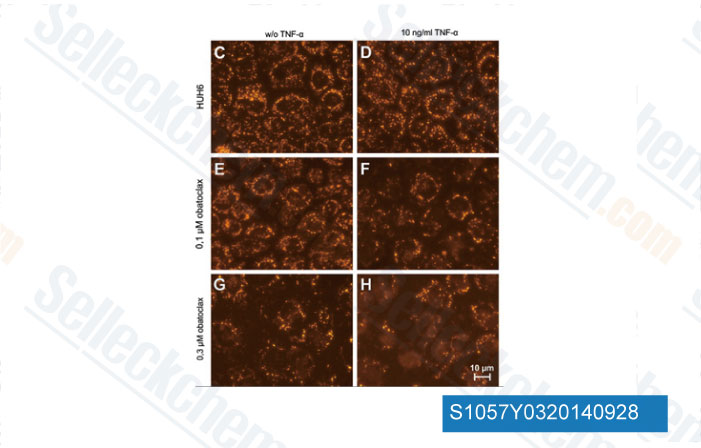
-
Daten von [ Exp Cell Res , 2014 , 322, 217-25 ]
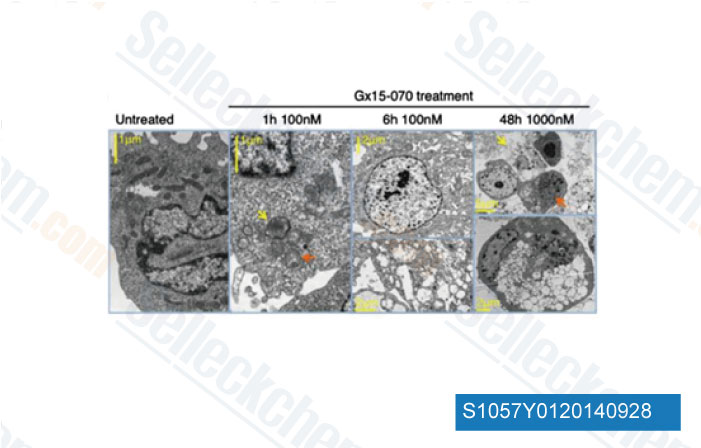
-
Daten von [ Cell Death Dis , 2012 , 19, 3:e351 ]
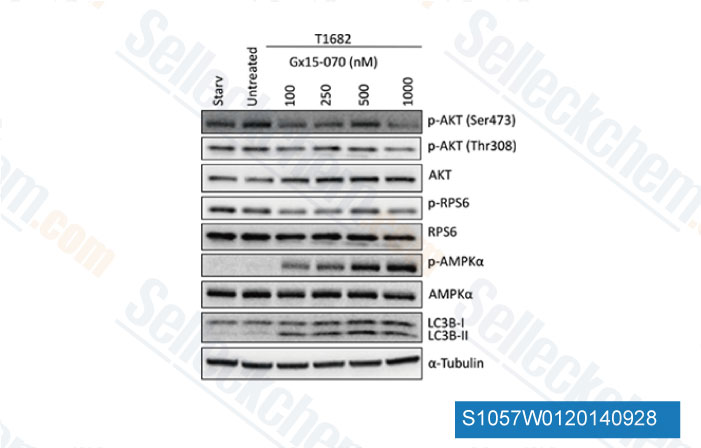
-
Daten von [ Cell Death Dis , 2012 , 19, 3:e351 ]
Sellecks Obatoclax Mesylate (GX15-070) Wurde zitiert von 112 Publikationen
| VDAC2 and Bak scarcity in liver mitochondria enables targeting hepatocarcinoma while sparing hepatocytes [ Nat Commun, 2025, 16(1):2416] | PubMed: 40069152 |
| Gravitational and mechanical forces drive mitochondrial translation [ bioRxiv, 2024, 10.1101/2023.01.18.524628] | PubMed: none |
| Obatoclax inhibits SARS-CoV-2 entry by altered endosomal acidification and impaired cathepsin and furin activity in vitro [ Emerg Microbes Infect, 2022, 1-29] | PubMed: 34989664 |
| Trabectedin Is Active against Two Novel, Patient-Derived Solitary Fibrous Pleural Tumor Cell Lines and Synergizes with Ponatinib [ Cancers (Basel), 2022, 14(22)5602] | PubMed: 36428694 |
| Predicting heterogeneity in clone-specific therapeutic vulnerabilities using single-cell transcriptomic signatures [ Genome Med, 2021, 13(1):189] | PubMed: 34915921 |
| Computational analysis of cholangiocarcinoma phosphoproteomes identifies patient-specific drug targets [ Cancer Res, 2021, canres.0955.2021] | PubMed: 34551960 |
| Inhibition of the Anti-Apoptotic Bcl-2 Family by BH3 Mimetics Sensitize the Mitochondrial Permeability Transition Pore Through Bax and Bak [ Front Cell Dev Biol, 2021, 9:765973] | PubMed: 34926454 |
| Obatoclax, the pan-Bcl-2 inhibitor sensitizes hepatocellular carcinoma cells to promote the anti-tumor efficacy in combination with immune checkpoint blockade [ Transl Oncol, 2021, 14(8):101116] | PubMed: 33975180 |
| Dual-stimuli responsive nanotheranostics for mild hyperthermia enhanced inhibition of Wnt/β-catenin signaling. [ Biomaterials, 2020, 232:119709] | PubMed: 31896513 |
| Development and implementation of the SUM breast cancer cell line functional genomics knowledge base [ NPJ Breast Cancer, 2020, 6:30] | PubMed: 32715085 |
RÜCKGABERICHTLINIE
Die bedingungslose Rückgaberichtlinie von Selleck Chemical gewährleistet unseren Kunden ein reibungsloses Online-Einkaufserlebnis. Wenn Sie in irgendeiner Weise mit Ihrem Kauf unzufrieden sind, können Sie jeden Artikel innerhalb von 7 Tagen nach Erhalt zurückgeben. Im Falle von Produktqualitätsproblemen, sei es protokollbezogene oder produktbezogene Probleme, können Sie jeden Artikel innerhalb von 365 Tagen ab dem ursprünglichen Kaufdatum zurückgeben. Bitte befolgen Sie die nachstehenden Anweisungen, wenn Sie Produkte zurücksenden.
VERSAND UND LAGERUNG
Selleck-Produkte werden bei Raumtemperatur transportiert. Wenn Sie das Produkt bei Raumtemperatur erhalten, seien Sie versichert, dass die Qualitätskontrollabteilung von Selleck Experimente durchgeführt hat, um zu überprüfen, dass die normale Temperaturplatzierung von einem Monat die biologische Aktivität von Pulverprodukten nicht beeinträchtigt. Nach dem Sammeln lagern Sie das Produkt bitte gemäß den in der Datenblatt beschriebenen Anforderungen. Die meisten Selleck-Produkte sind unter den empfohlenen Bedingungen stabil.
NICHT FÜR DIE ANWENDUNG AM MENSCHEN, FÜR VETERINÄRMEDIZINISCHE DIAGNOSTIK ODER THERAPEUTISCHE ZWECKE.