
Technische Daten
| Formel | C20H31N3O2S2 |
||||||||||
| Molekulargewicht | 409.61 | CAS-Nr. | 1191951-57-1 | ||||||||
| Löslichkeit (25°C)* | In vitro | DMSO | 82 mg/mL (200.19 mM) | ||||||||
| Ethanol | 60 mg/mL (146.48 mM) | ||||||||||
| Water | Insoluble | ||||||||||
| In vivo (Lösungsmittel einzeln und der Reihe nach zum Produkt hinzufügen.) |
|
||||||||||
|
* <1 mg/ml bedeutet schwer löslich oder unlöslich. * Bitte beachten Sie, dass Selleck die Löslichkeit aller Verbindungen intern testet und die tatsächliche Löslichkeit geringfügig von veröffentlichten Werten abweichen kann. Dies ist normal und ist auf geringfügige Batch-zu-Batch-Variationen zurückzuführen. * Versand bei Raumtemperatur (Stabilitätstests zeigen, dass dieses Produkt ohne Kühlmaßnahmen versendet werden kann.) |
|||||||||||
Vorbereitung von Stammlösungen
Biologische Aktivität
| Beschreibung | PHT-427 (CS-0223) ist ein dualer Akt- und PDPK1-Inhibitor (hohe Affinitätsbindung an die PH-Domänen von Akt und PDPK1) mit einem Ki von 2,7 μM bzw. 5,2 μM. | ||||
|---|---|---|---|---|---|
| Ziele |
|
||||
| In vitro | PH-427 ist ein Pleckstrin-Homologie-Domänen-Inhibitor von Akt/PDPK1. Diese Verbindung reduziert signifikant Phospho-Ser241-PDPK1 und Phospho-Thr308-Akt in PC-3 Prostatakrebszellen bei 10 μM, was zeigt, dass sie sowohl Akt als auch PDPK1 hemmen kann. Sie hemmt auch die Translokation der Akt- und PDPK1-PH-Domänen in der Plasmamembran. Diese Chemikalie induziert Apoptose und hemmt die AKT-Phosphorylierung mit einer IC50 von 8,6 μM (in BxPC-3-Zellen), hauptsächlich an ihrem Ser473-Rest und weniger stark an Thr308, ohne die Gesamt-Akt-Proteinexpression zu beeinflussen. Sie zeigt auch eine Antiproliferation in Panc-1-Zellen mit einer IC50 von 65 μM. | ||||
| In vivo | PHT-427 zeigt eine große Antitumoraktivität in BxPC-3-Pankreas-, MCF-7-Brust- und A-549-NSCL-Krebs-Xenograft-Modellen. Diese Verbindung führt bei Dosen von 125 bis 250 mg/kg zu einer bis zu 80%igen Hemmung des Tumorwachstums in BxPC-3. |
Protokoll (aus Referenz)
| Kinase-Assay:[1] |
|
|---|---|
| Tierstudie:[1] |
|
Referenzen
|
Kundenproduktvalidierung
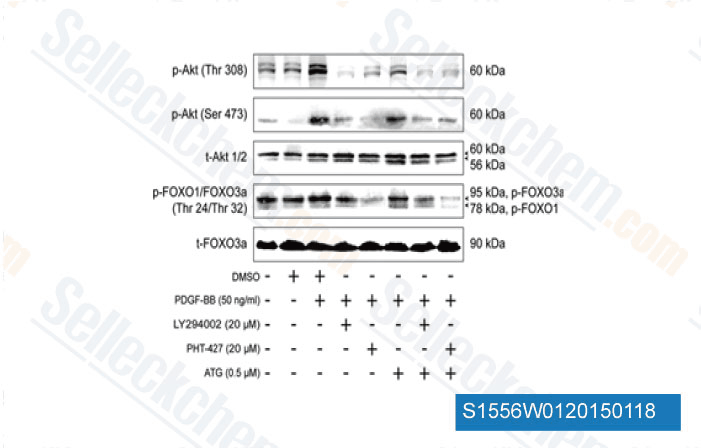
-
Daten von [ Eur J Pharmacol , 2014 , 747C, 71-87 ]
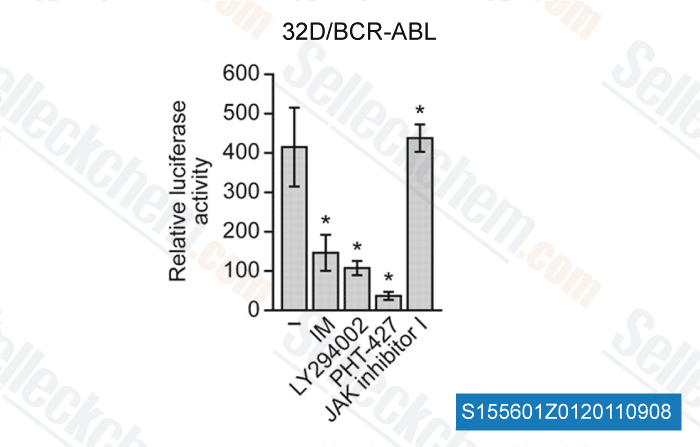
-
Daten von [ Blood , 2011 , 118, 2840-2848 ]
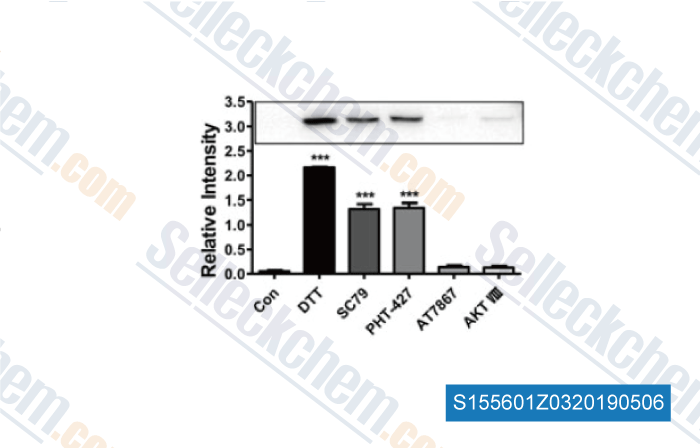
-
Daten von [ , , Research Letter, 2018, doi:org/10.1002/1873-3468.13305 ]
Sellecks PHT-427 Wurde zitiert von 19 Publikationen
| Functional restoration of lysosomes and mitochondria through modulation of AKT activity ameliorates senescence [ Exp Gerontol, 2023, 173:112091] | PubMed: 36657533 |
| Integrative analysis of drug response and clinical outcome in acute myeloid leukemia [ Cancer Cell, 2022, S1535-6108(22)00312-9] | PubMed: 35868306 |
| Telomerase RNA TERC and the PI3K-AKT pathway form a positive feedback loop to regulate cell proliferation independent of telomerase activity [ Nucleic Acids Res, 2022, gkac179] | PubMed: 35323972 |
| Identification of a New Antimicrobial Agent against Bovine Mastitis-Causing Staphylococcus aureus [ J Agric Food Chem, 2021, 10.1021/acs.jafc.1c02738] | PubMed: 34406764 |
| Patient-specific logic models of signaling pathways from screenings on cancer biopsies to prioritize personalized combination therapies. [ Mol Syst Biol, 2020, 16(2):e8664] | PubMed: 32073727 |
| Genipin, a natural AKT inhibitor, targets the PH domain to affect downstream signaling and alleviates inflammation [ Biochem Pharmacol, 2019, 170:113660] | PubMed: 31605673 |
| A natural AKT inhibitor swertiamarin targets AKT-PH domain, inhibits downstream signaling, and alleviates inflammation. [ FEBS J, 2019, 10.1111/febs.15112] | PubMed: 31665825 |
| The flavonoid baicalin improves glucose metabolism by targeting the PH domain of AKT and activating AKT/GSK3β phosphorylation. [ FEBS Lett, 2019, 593(2):175-186] | PubMed: 30489635 |
| A microfluidics platform for combinatorial drug screening on cancer biopsies. [ Nat Commun, 2018, 9(1):2434] | PubMed: 29934552 |
| Chlorogenic Acid Targeting of the AKT PH Domain Activates AKT/GSK3β/FOXO1 Signaling and Improves Glucose Metabolism. [ Nutrients, 2018, 10(10)] | PubMed: 30249058 |
RÜCKGABERICHTLINIE
Die bedingungslose Rückgaberichtlinie von Selleck Chemical gewährleistet unseren Kunden ein reibungsloses Online-Einkaufserlebnis. Wenn Sie in irgendeiner Weise mit Ihrem Kauf unzufrieden sind, können Sie jeden Artikel innerhalb von 7 Tagen nach Erhalt zurückgeben. Im Falle von Produktqualitätsproblemen, sei es protokollbezogene oder produktbezogene Probleme, können Sie jeden Artikel innerhalb von 365 Tagen ab dem ursprünglichen Kaufdatum zurückgeben. Bitte befolgen Sie die nachstehenden Anweisungen, wenn Sie Produkte zurücksenden.
VERSAND UND LAGERUNG
Selleck-Produkte werden bei Raumtemperatur transportiert. Wenn Sie das Produkt bei Raumtemperatur erhalten, seien Sie versichert, dass die Qualitätskontrollabteilung von Selleck Experimente durchgeführt hat, um zu überprüfen, dass die normale Temperaturplatzierung von einem Monat die biologische Aktivität von Pulverprodukten nicht beeinträchtigt. Nach dem Sammeln lagern Sie das Produkt bitte gemäß den in der Datenblatt beschriebenen Anforderungen. Die meisten Selleck-Produkte sind unter den empfohlenen Bedingungen stabil.
NICHT FÜR DIE ANWENDUNG AM MENSCHEN, FÜR VETERINÄRMEDIZINISCHE DIAGNOSTIK ODER THERAPEUTISCHE ZWECKE.