
Technische Daten
| Formel | C19H16N4O3 |
||||||
| Molekulargewicht | 348.36 | CAS-Nr. | 371935-74-9 | ||||
| Löslichkeit (25°C)* | In vitro | DMSO | 24 mg/mL (68.89 mM) | ||||
| Water | Insoluble | ||||||
| Ethanol | Insoluble | ||||||
| In vivo (Lösungsmittel einzeln und der Reihe nach zum Produkt hinzufügen.) |
|
||||||
|
* <1 mg/ml bedeutet schwer löslich oder unlöslich. * Bitte beachten Sie, dass Selleck die Löslichkeit aller Verbindungen intern testet und die tatsächliche Löslichkeit geringfügig von veröffentlichten Werten abweichen kann. Dies ist normal und ist auf geringfügige Batch-zu-Batch-Variationen zurückzuführen. * Versand bei Raumtemperatur (Stabilitätstests zeigen, dass dieses Produkt ohne Kühlmaßnahmen versendet werden kann.) |
|||||||
Vorbereitung von Stammlösungen
Biologische Aktivität
| Beschreibung | PI-103 ist ein Multi-Target-PI3K-Inhibitor für p110α/β/δ/γ mit IC50 von 2 nM/3 nM/3 nM/15 nM in zellfreien Assays, weniger potent gegenüber mTOR/DNA-PK mit IC50 von 30 nM/23 nM. Diese Verbindung induziert Apoptose in murinem T-Zell-Lymphom. | |||||||||||
|---|---|---|---|---|---|---|---|---|---|---|---|---|
| Ziele |
|
|||||||||||
| In vitro | PI-103 hemmt potent sowohl die Rapamycin-sensitiven (mTORC1) als auch die Rapamycin-insensitiven (mTORC2) Komplexe der Proteinkinase mTOR. Diese Verbindung hemmt die konstitutive und Wachstumsfaktor-induzierte PI3K/Akt- sowie die mTORC1-Aktivierung. In Blasten hemmt sie die leukämische Proliferation, die Klonogenität leukämischer Vorläuferzellen und induziert mitochondriale Apoptose, insbesondere im Kompartiment, das leukämische Stammzellen enthält. Diese Chemikalie hemmt p110α >200-fach potenter als p110β. Sie blockiert auch potent die Produktion von PI(3,4)P2 und PIP3 in Adipozyten und PIP3 in Myotubes. Diese Verbindung hemmt die Phosphorylierung von Akt mit einem IC95-Wert, der 100-fach niedriger ist als der für LY294002. Auffallend ist, dass sie Tiere vollständig vor einem stimulierten Abfall des Blutzuckers schützt. Sie hat additive proapoptotische Effekte in Blasten und in unreifen leukämischen Zellen. |
|||||||||||
| In vivo | Wenn die Tumoren 50-100 mm3 erreichen, werden die Tiere randomisiert und mit Vehikel oder PI-103 behandelt. Diese Verbindung zeigt eine signifikante Aktivität und verringert die durchschnittliche Tumorgröße nach 18 Tagen um das 4-fache. Mäuse, die mit dieser Chemikalie behandelt wurden, zeigen keine offensichtlichen Anzeichen von präexistenter Toxizität (basierend auf Körpergewicht, Nahrungs- und Wasseraufnahme, Aktivität und allgemeiner Untersuchung) oder bei der Nekropsie. Behandelte Tumoren zeigen verringerte Spiegel von phosphoryliertem Akt und S6, was mit der Blockade von p110α und mTOR übereinstimmt. Diese Behandlung ist zytostatisch für Gliom-Xenotransplantate. |
|||||||||||
| Merkmale | Der erste potente, synthetische mTOR-Inhibitor. |
Protokoll (aus Referenz)
| Kinase-Assay: |
|
|---|---|
| Zell-Assay: |
|
| Tierstudie: |
|
Referenzen
|
Kundenproduktvalidierung
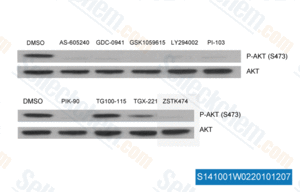
-
, Saraswati Sukumar of Johns Hopkins University School of Medicine
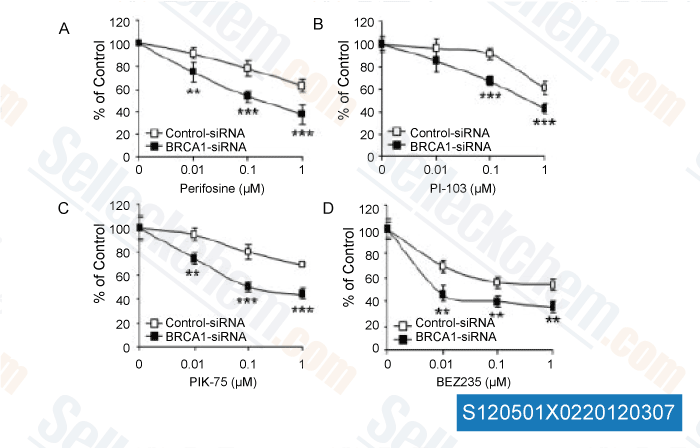
-
Daten von [ Mol Carcinog , 2012 , ahead of print ]
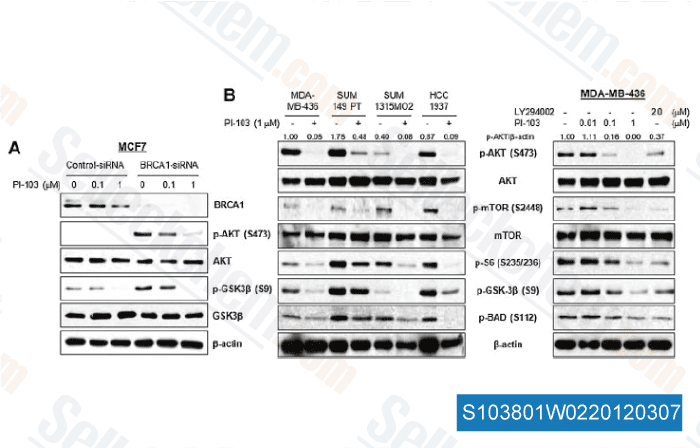
-
Daten von [ Mol Carcinog , 2012 , 52, 667-75 ]
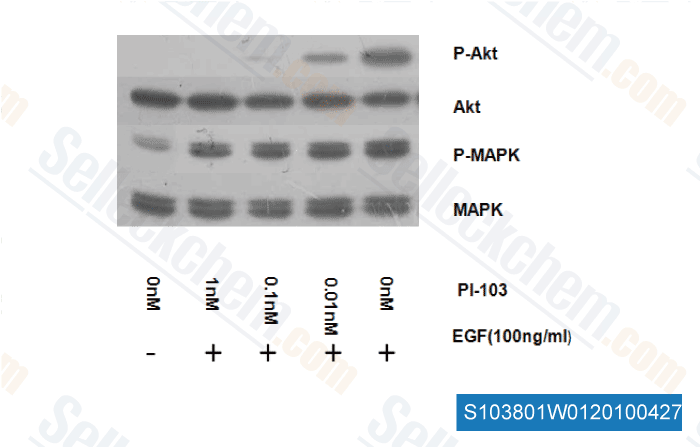
-
, , Dr. Zhang of Tianjin Medical University
Sellecks PI-103 Wurde zitiert von 110 Publikationen
| hnRNPL phase separation activates PIK3CB transcription and promotes glycolysis in ovarian cancer [ Nat Commun, 2025, 16(1):4828] | PubMed: 40413189 |
| Bile acid-FXR signaling facilitates the long-term maintenance of hepatic characteristics in human iPSC-derived organoids [ Cell Rep, 2025, 44(5):115675] | PubMed: 40367952 |
| Autophagy and PXR Crosstalk in the Regulation of Cancer Drug Metabolism and Resistance According to Gene Mutational Status in Colorectal Cancer [ Genes (Basel), 2025, 16(8)892] | PubMed: 40869940 |
| Development of Acquired Resistance in Alpelisib-treated Gastric Cancer Cells With PIK3CA Mutations and Overcoming Strategies [ Anticancer Res, 2025, 45(5):1877-1896] | PubMed: 40295072 |
| TMEM176B Promotes EMT via FGFR/JNK Signalling in Development and Tumourigenesis of Lung Adenocarcinoma [ Cancers (Basel), 2024, 16(13)2447] | PubMed: 39001509 |
| Overcoming brain-derived therapeutic resistance in HER2+ breast cancer brain metastasis [ bioRxiv, 2024, 2024.02.19.581073] | PubMed: 38529509 |
| Young and undamaged recombinant albumin alleviates T2DM by improving hepatic glycolysis through EGFR and protecting islet β cells in mice [ J Transl Med, 2023, 21(1):89] | PubMed: 36747238 |
| RIDR-PI-103, ROS-activated prodrug PI3K inhibitor inhibits cell growth and impairs the PI3K/Akt pathway in BRAF and MEK inhibitor-resistant BRAF-mutant melanoma cells [ Anticancer Drugs, 2023, 34(4):519-531] | PubMed: 36847042 |
| Synergistic effects of complex drug combinations in colorectal cancer cells predicted by logical modelling [ Front Syst Biol, 2023, Volume 3] | PubMed: None |
| Integrative analysis of drug response and clinical outcome in acute myeloid leukemia [ Cancer Cell, 2022, S1535-6108(22)00312-9] | PubMed: 35868306 |
RÜCKGABERICHTLINIE
Die bedingungslose Rückgaberichtlinie von Selleck Chemical gewährleistet unseren Kunden ein reibungsloses Online-Einkaufserlebnis. Wenn Sie in irgendeiner Weise mit Ihrem Kauf unzufrieden sind, können Sie jeden Artikel innerhalb von 7 Tagen nach Erhalt zurückgeben. Im Falle von Produktqualitätsproblemen, sei es protokollbezogene oder produktbezogene Probleme, können Sie jeden Artikel innerhalb von 365 Tagen ab dem ursprünglichen Kaufdatum zurückgeben. Bitte befolgen Sie die nachstehenden Anweisungen, wenn Sie Produkte zurücksenden.
VERSAND UND LAGERUNG
Selleck-Produkte werden bei Raumtemperatur transportiert. Wenn Sie das Produkt bei Raumtemperatur erhalten, seien Sie versichert, dass die Qualitätskontrollabteilung von Selleck Experimente durchgeführt hat, um zu überprüfen, dass die normale Temperaturplatzierung von einem Monat die biologische Aktivität von Pulverprodukten nicht beeinträchtigt. Nach dem Sammeln lagern Sie das Produkt bitte gemäß den in der Datenblatt beschriebenen Anforderungen. Die meisten Selleck-Produkte sind unter den empfohlenen Bedingungen stabil.
NICHT FÜR DIE ANWENDUNG AM MENSCHEN, FÜR VETERINÄRMEDIZINISCHE DIAGNOSTIK ODER THERAPEUTISCHE ZWECKE.