
Technische Daten
| Formel | C16H14BrN5O4S.HCl |
||||||
| Molekulargewicht | 488.74 | CAS-Nr. | 372196-77-5 | ||||
| Löslichkeit (25°C)* | In vitro | DMSO | 98 mg/mL (200.51 mM) | ||||
| Ethanol | 9 mg/mL (18.41 mM) | ||||||
| Water | Insoluble | ||||||
| In vivo (Lösungsmittel einzeln und der Reihe nach zum Produkt hinzufügen.) |
|
||||||
|
* <1 mg/ml bedeutet schwer löslich oder unlöslich. * Bitte beachten Sie, dass Selleck die Löslichkeit aller Verbindungen intern testet und die tatsächliche Löslichkeit geringfügig von veröffentlichten Werten abweichen kann. Dies ist normal und ist auf geringfügige Batch-zu-Batch-Variationen zurückzuführen. * Versand bei Raumtemperatur (Stabilitätstests zeigen, dass dieses Produkt ohne Kühlmaßnahmen versendet werden kann.) |
|||||||
Vorbereitung von Stammlösungen
Biologische Aktivität
| Beschreibung | PIK-75 HCl ist ein p110α-Inhibitor mit einer IC50 von 5,8 nM (200-mal potenter als p110β), isoformspezifischen Mutanten an Ser773 und hemmt auch potent DNA-PK mit einer IC50 von 2 nM in zellfreien Assays. | ||||||||
|---|---|---|---|---|---|---|---|---|---|
| Ziele |
|
||||||||
| In vitro | PIK-75 zeigt eine beeindruckende Potenz und Isoform-Selektivität bei p110α, während die entsprechenden IC50-Werte für andere PI3K-Isoformen, p110β, -γ und -δ, 1300 nM, 76 nM bzw. 510 nM betragen. Darüber hinaus ist PIK-75 bei Bindung an gereinigtes p110α ein nicht-kompetitiver Inhibitor bezüglich ATP mit Ki von 36 nM und kompetitiv bezüglich des Substrats PI mit Ki von 2,3 nM. PIK-75 zeigt auch eine potente Hemmung der DNA-PK. PIK-75 (1 μM) reduziert die Zellüberlebensfähigkeit durch signifikante Verringerung der mitochondrialen Aktivität in unstimulierten nicht-asthmatischen glatten Atemwegsmuskelzellen (ASM), asthmatischen ASM-Zellen und Lungenfibroblasten. Während in TGFβ-stimulierten ASM-Zellen PIK75 die mitochondriale Aktivität nur in asthmatischen Zellen verringert, ohne Effekte in nicht-asthmatischen Zellen. Eine aktuelle Studie zeigt, dass PIK-75 (10 nM) die TNF-α-induzierte CD38-mRNA-Expression hemmt und die TNF-α-induzierte ADP-Ribosyl-Cyclase-Aktivität in menschlichen glatten Atemwegsmuskelzellen signifikant abschwächt. | ||||||||
| In vivo | Im ErbB3WT-Tumormodell reduziert PIK-75 die In-vitro-chemotaktische Reaktion auf HRGβ1 und senkt die pAkt-Spiegel um 40 %. Außerdem reduziert PIK-75 signifikant die Tumorzellmotilität und die In-vivo-Invasion in primären ErbB3WT-Tumoren. Bei CD1-Männermäusen führt PIK-75 zu schwerwiegenden Beeinträchtigungen im Insulintoleranztest (ITT) und Glukosetoleranztest (GTT) sowie zu einem Anstieg der Glukoseproduktion während eines Pyruvat-Toleranztests (PTT). | ||||||||
| Merkmale | PI3K- und DNA-PK-Inhibitor. |
Protokoll (aus Referenz)
| Kinase-Assay:[1] |
|
|---|---|
| Zell-Assay:[3] |
|
| Tierstudie:[5] |
|
Referenzen
|
Kundenproduktvalidierung
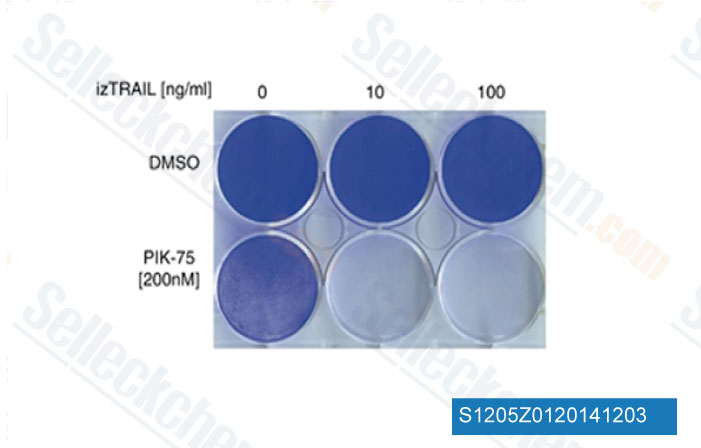
-
Daten von [ Cell Death Differ , 2014 , 21(3), 491-502 ]
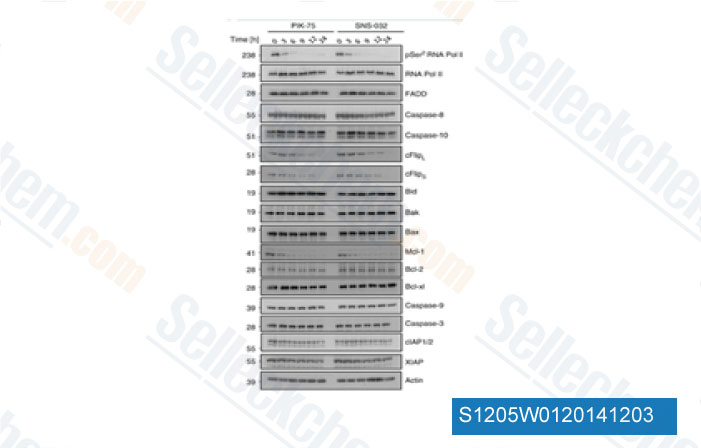
-
Daten von [ Cell Death Differ , 2014 , 21(3), 491-502 ]
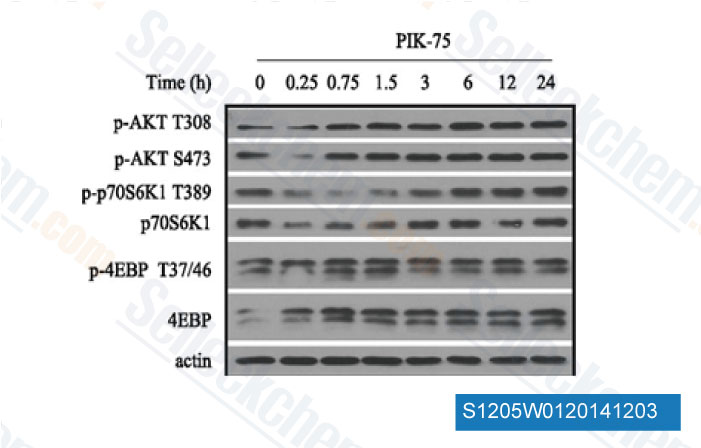
-
Daten von [ J Pharmacol Exp Ther , 2014 , 348(3), 432-41 ]
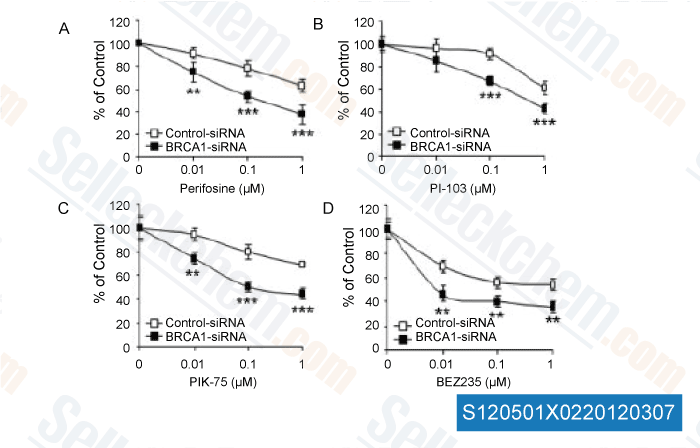
-
Daten von [ Mol Carcinog , 2012 , 52, 667-75 ]
Sellecks PIK-75 HCl Wurde zitiert von 46 Publikationen
| Lysosomal PIP3 revealed by genetically encoded lipid biosensors [ Proc Natl Acad Sci U S A, 2025, 122(13):e2426929122] | PubMed: 40127277 |
| The mevalonate pathway contributes to breast primary tumorigenesis and lung metastasis [ Mol Oncol, 2024, 10.1002/1878-0261.13716] | PubMed: 39119789 |
| PIK Your Poison: The Effects of Combining PI3K and CDK Inhibitors against Metastatic Cutaneous Squamous Cell Carcinoma In Vitro [ Cancers (Basel), 2024, 16(2)370] | PubMed: 38254859 |
| Pharmacological Targeting of Androgen Receptor Elicits Context-Specific Effects in Estrogen Receptor-Positive Breast Cancer [ Cancer Res, 2023, 83(3):456-470] | PubMed: 36469363 |
| MDM2 antagonists promote CRISPR/Cas9-mediated precise genome editing in sheep primary cells [ Mol Ther Nucleic Acids, 2023, 31:309-323] | PubMed: 36726409 |
| Reciprocal regulation of Daxx and PIK3CA promotes colorectal cancer cell growth [ Cell Mol Life Sci, 2022, 79(7):367] | PubMed: 35718818 |
| The Lectin LecB Induces Patches with Basolateral Characteristics at the Apical Membrane to Promote Pseudomonas aeruginosa Host Cell Invasion [ mBio, 2022, 13(3):e0081922] | PubMed: 35491830 |
| PIK-75 overcomes venetoclax resistance via blocking PI3K-AKT signaling and MCL-1 expression in mantle cell lymphoma [ Am J Cancer Res, 2022, 12(3):1102-1115] | PubMed: 35411248 |
| Identification of New Vulnerabilities in Conjunctival Melanoma Using Image-Based High Content Drug Screening [ Cancers (Basel), 2022, 14(6)1575] | PubMed: 35326726 |
| Isthmin-1 is an adipokine that promotes glucose uptake and improves glucose tolerance and hepatic steatosis [ Cell Metab, 2021, S1550-4131(21)00326-0] | PubMed: 34348115 |
RÜCKGABERICHTLINIE
Die bedingungslose Rückgaberichtlinie von Selleck Chemical gewährleistet unseren Kunden ein reibungsloses Online-Einkaufserlebnis. Wenn Sie in irgendeiner Weise mit Ihrem Kauf unzufrieden sind, können Sie jeden Artikel innerhalb von 7 Tagen nach Erhalt zurückgeben. Im Falle von Produktqualitätsproblemen, sei es protokollbezogene oder produktbezogene Probleme, können Sie jeden Artikel innerhalb von 365 Tagen ab dem ursprünglichen Kaufdatum zurückgeben. Bitte befolgen Sie die nachstehenden Anweisungen, wenn Sie Produkte zurücksenden.
VERSAND UND LAGERUNG
Selleck-Produkte werden bei Raumtemperatur transportiert. Wenn Sie das Produkt bei Raumtemperatur erhalten, seien Sie versichert, dass die Qualitätskontrollabteilung von Selleck Experimente durchgeführt hat, um zu überprüfen, dass die normale Temperaturplatzierung von einem Monat die biologische Aktivität von Pulverprodukten nicht beeinträchtigt. Nach dem Sammeln lagern Sie das Produkt bitte gemäß den in der Datenblatt beschriebenen Anforderungen. Die meisten Selleck-Produkte sind unter den empfohlenen Bedingungen stabil.
NICHT FÜR DIE ANWENDUNG AM MENSCHEN, FÜR VETERINÄRMEDIZINISCHE DIAGNOSTIK ODER THERAPEUTISCHE ZWECKE.