
Technische Daten
| Formel | C15H20O3 |
||||||
| Molekulargewicht | 248.32 | CAS-Nr. | 20554-84-1 | ||||
| Löslichkeit (25°C)* | In vitro | DMSO | 49 mg/mL (197.32 mM) | ||||
| Ethanol | 49 mg/mL (197.32 mM) | ||||||
| Water | Insoluble | ||||||
| In vivo (Lösungsmittel einzeln und der Reihe nach zum Produkt hinzufügen.) |
|
||||||
|
* <1 mg/ml bedeutet schwer löslich oder unlöslich. * Bitte beachten Sie, dass Selleck die Löslichkeit aller Verbindungen intern testet und die tatsächliche Löslichkeit geringfügig von veröffentlichten Werten abweichen kann. Dies ist normal und ist auf geringfügige Batch-zu-Batch-Variationen zurückzuführen. * Versand bei Raumtemperatur (Stabilitätstests zeigen, dass dieses Produkt ohne Kühlmaßnahmen versendet werden kann.) |
|||||||
Vorbereitung von Stammlösungen
Biologische Aktivität
| Beschreibung | (-)-Parthenolide, ein Inhibitor des Nuclear Factor-κB Signalwegs, depletiert spezifisch das HDAC1 Protein, ohne andere Klasse I/II HDACs zu beeinflussen; Fördert auch die Ubiquitinierung von MDM2 und aktiviert p53 Zellfunktionen. | ||||
|---|---|---|---|---|---|
| Ziele |
|
||||
| In vitro | Parthenolide (PTL), ein Sesquiterpenlacton, das aus den Sprossen des Mutterkrauts gereinigt wird, hemmt die Aktivität der Ubiquitin-spezifischen Peptidase 7 (USP7) und deubiquitiniert und stabilisiert β-Catenin, den wichtigen Transkriptionsfaktor des Wnt-Signalwegs, was darauf hindeutet, dass PTL ein vielversprechendes Antikrebsmittel ist, das auf die aberrante USP7/Wnt-Signalgebung abzielt. |
||||
| In vivo | Parthenolide (PN), ein P65-Inhibitor, erhöht signifikant die Tumorvolumina in einem subkutanen Xenograft-Magenkrebs (GC)-Mausmodell, was durch Gastrin umgekehrt werden kann. |
Protokoll (aus Referenz)
| Zell-Assay: |
|
|---|---|
| Tierstudie: |
|
Referenzen
|
Kundenproduktvalidierung
-Parthenolide-S234101W0220161110.gif)
-
, , Harvard University, 2014.
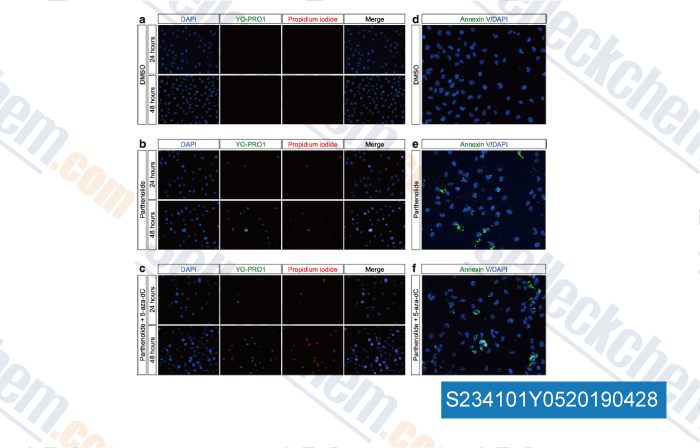
-
Daten von [ , , Cell Oncol (Dordr), 2017, 40(3):263-279 ]
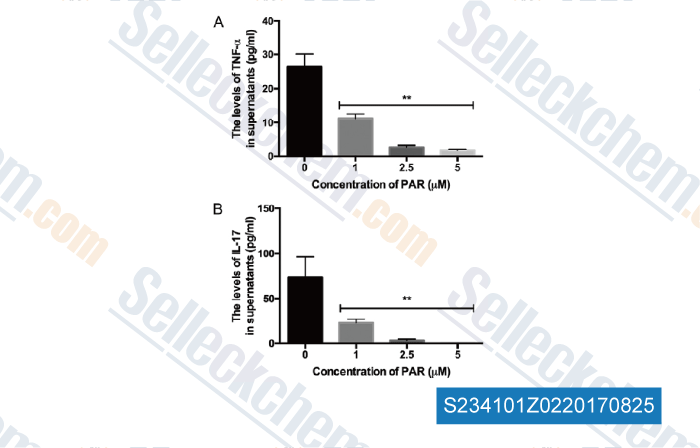
-
Daten von [ , , J Neuroimmunol, 2017, 305:154-161 ]
Sellecks (-)-Parthenolide Wurde zitiert von 27 Publikationen
| Ketogenic diet and β-hydroxybutyrate inhibit HDAC1 to preserve vascular smooth muscle cell function in thoracic aortic aneurysm [ J Adv Res, 2025, S2090-1232(25)00353-4] | PubMed: 40398746 |
| Synergistic activity of S63845 and parthenolide to overcome acquired resistance to MEK1/2 inhibitor in melanoma cells: Mechanisms and therapeutic potential [ Biomed Pharmacother, 2025, 188:118183] | PubMed: 40424823 |
| Development of translational read-through-inducing drugs as novel therapeutic options for patients with Fanconi anemia [ Cell Death Discov, 2025, 11(1):286] | PubMed: 40544182 |
| TNFSF14-HVEM/LTβR Exacerbates Keratinocyte Abnormalities and IMQ-Induced Psoriatic Skin Inflammation via Activating NF-κB/TWIST1 Signalling Pathway [ J Cell Mol Med, 2025, 29(15):e70774] | PubMed: 40768619 |
| Astaxanthin suppresses the malignant behaviors of nasopharyngeal carcinoma cells by blocking PI3K/AKT and NF-κB pathways via miR-29a-3p [ Genes Environ, 2024, 46(1):10] | PubMed: 38649975 |
| Parthenolide Targets NLRP3 to Treat Inflammasome-Related Diseases [ Int Immunopharmacol, 2023, 119:110229.] | PubMed: 37167640 |
| Connexin43 is associated with the progression of clear cell renal carcinoma and is regulated by tangeretin to sygergize with tyrosine kinase inhibitors [ Transl Oncol, 2023, 35:101712] | PubMed: 37354638 |
| Histone deacetylase 1 controls cardiomyocyte proliferation during embryonic heart development and cardiac regeneration in zebrafish [ PLoS Genet, 2021, 17(11):e1009890] | PubMed: 34723970 |
| Reduced Mitochondrial Apoptotic Priming Drives Resistance to BH3 Mimetics in Acute Myeloid Leukemia [ Cancer Cell, 2020, 38(6):872-890.e6] | PubMed: 33217342 |
| Lack of FGF21 promotes NASH-HCC transition via hepatocyte-TLR4-IL-17A signaling [ Theranostics, 2020, 10(22):9923-9936] | PubMed: 32929325 |
RÜCKGABERICHTLINIE
Die bedingungslose Rückgaberichtlinie von Selleck Chemical gewährleistet unseren Kunden ein reibungsloses Online-Einkaufserlebnis. Wenn Sie in irgendeiner Weise mit Ihrem Kauf unzufrieden sind, können Sie jeden Artikel innerhalb von 7 Tagen nach Erhalt zurückgeben. Im Falle von Produktqualitätsproblemen, sei es protokollbezogene oder produktbezogene Probleme, können Sie jeden Artikel innerhalb von 365 Tagen ab dem ursprünglichen Kaufdatum zurückgeben. Bitte befolgen Sie die nachstehenden Anweisungen, wenn Sie Produkte zurücksenden.
VERSAND UND LAGERUNG
Selleck-Produkte werden bei Raumtemperatur transportiert. Wenn Sie das Produkt bei Raumtemperatur erhalten, seien Sie versichert, dass die Qualitätskontrollabteilung von Selleck Experimente durchgeführt hat, um zu überprüfen, dass die normale Temperaturplatzierung von einem Monat die biologische Aktivität von Pulverprodukten nicht beeinträchtigt. Nach dem Sammeln lagern Sie das Produkt bitte gemäß den in der Datenblatt beschriebenen Anforderungen. Die meisten Selleck-Produkte sind unter den empfohlenen Bedingungen stabil.
NICHT FÜR DIE ANWENDUNG AM MENSCHEN, FÜR VETERINÄRMEDIZINISCHE DIAGNOSTIK ODER THERAPEUTISCHE ZWECKE.