
Technische Daten
| Formel | C21H23N7O2S.HCl |
||||||||||
| Molekulargewicht | 473.98 | CAS-Nr. | 635702-64-6 | ||||||||
| Löslichkeit (25°C)* | In vitro | DMSO | 32 mg/mL (67.51 mM) | ||||||||
| Water | Insoluble | ||||||||||
| Ethanol | Insoluble | ||||||||||
| In vivo (Lösungsmittel einzeln und der Reihe nach zum Produkt hinzufügen.) |
|
||||||||||
|
* <1 mg/ml bedeutet schwer löslich oder unlöslich. * Bitte beachten Sie, dass Selleck die Löslichkeit aller Verbindungen intern testet und die tatsächliche Löslichkeit geringfügig von veröffentlichten Werten abweichen kann. Dies ist normal und ist auf geringfügige Batch-zu-Batch-Variationen zurückzuführen. * Versand bei Raumtemperatur (Stabilitätstests zeigen, dass dieses Produkt ohne Kühlmaßnahmen versendet werden kann.) |
|||||||||||
Vorbereitung von Stammlösungen
Biologische Aktivität
| Beschreibung | Pazopanib HCl ist ein neuartiger Multi-Target-Inhibitor von VEGFR1, VEGFR2, VEGFR3, PDGFR, FGFR, c-Kit und c-Fms mit IC50-Werten von 10 nM, 30 nM, 47 nM, 84 nM, 74 nM, 140 nM und 146 nM in zellfreien Assays. Pazopanib induziert den autophagischen Typ-II-Zelltod. | |||||||||||
|---|---|---|---|---|---|---|---|---|---|---|---|---|
| Ziele |
|
|||||||||||
| In vitro | Pazopanib hemmt die VEGF-induzierte Phosphorylierung von VEGFR2 in HUVEC-Zellen potent mit einer IC50 von 8 nM. Pazopanib zeigt eine dosisabhängige Wachstumshemmung in allen synovialen Sarkomzelllinien, einschließlich SYO-1- und HS-SY-II-Zellen. Die Proliferation von SYO-1- und HS-SY-II-Zellen wird bereits bei 1 µg/mL Pazopanib gehemmt und bei 5 µg/mL vollständig unterdrückt. Pazopanib induziert einen G1-Arrest und unterdrückt dadurch das Wachstum von synovialen Sarkomzellen. Die Phosphorylierung von Akts, GSK-3β, JNKs, p70 S6 Kinase und mTOR ist in Pazopanib-behandelten SYO-1-Zellen im Vergleich zu den Vehikel-behandelten Zellen unterdrückt. Pazopanib zwischen 20 mg/mL und 22,5 mg/mL zeigt eine zunehmende Reduzierung der Lebensfähigkeit von RPE-Zellen. | |||||||||||
| In vivo | Die mit 30 mg/kg oder 100 mg/kg Pazopanib behandelten Mäuse zeigten eine signifikante Abnahme der Tumorlast im Vergleich zu den mit Vehikel oder 10 mg/kg Pazopanib behandelten Mäusen. Die Behandlung mit Pazopanib wurde gut vertragen, und es gab keinen signifikanten Unterschied im Körpergewicht zwischen den Mäusen in jeder Gruppe. | |||||||||||
| Merkmale | Ein Multi-Kinase-Inhibitor. |
Protokoll (aus Referenz)
| Kinase-Assay: |
|
|---|---|
| Zell-Assay: |
|
| Tierstudie: |
|
Referenzen
|
Kundenproduktvalidierung
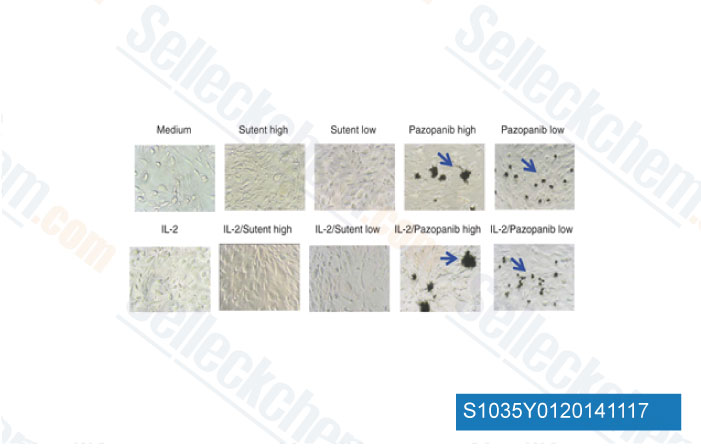
-
Daten von [ Expert Opin Pharmacother , 2014 , 15(11), 1489-99 ]
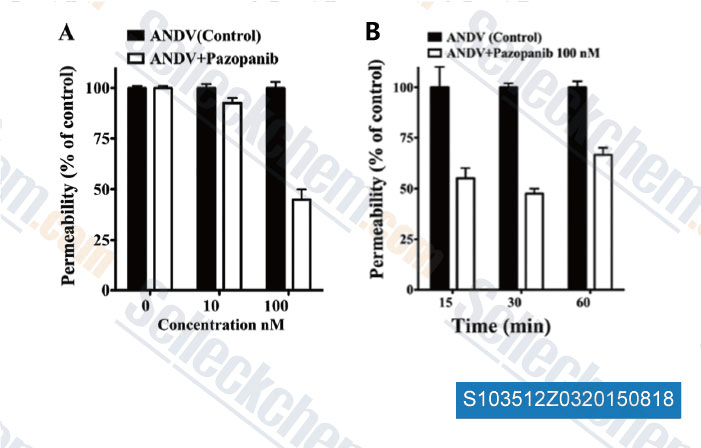
-
Daten von [ , , J Virol, 2011, 85(5): 2296-303 ]
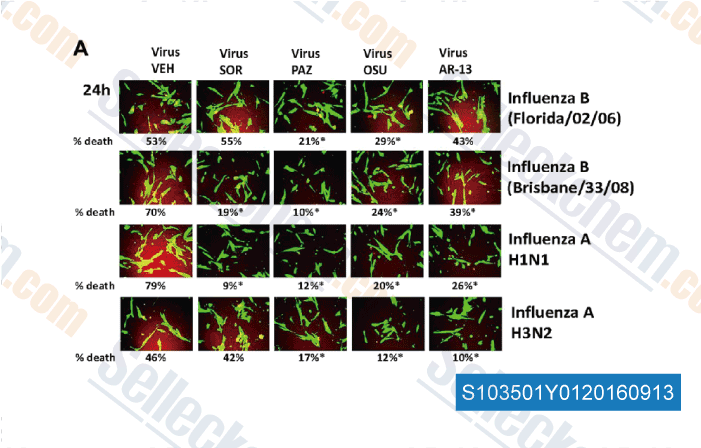
-
Daten von [ , , J Cell Physiol, 2016, 231(10):2286-302. ]
Sellecks Pazopanib HCl Wurde zitiert von 57 Publikationen
| Patient-derived rhabdomyosarcoma cells recapitulate the genetic and transcriptomic landscapes of primary tumors [ iScience, 2024, 27(10):110862] | PubMed: 39319271 |
| Cutoff value of IC50 for drug sensitivity in patient-derived tumor organoids in colorectal cancer [ iScience, 2023, 26(7):107116] | PubMed: 37426352 |
| Therapeutic and immunomodulatory potential of pazopanib in malignant phyllodes tumor [ NPJ Breast Cancer, 2022, 8(1):44] | PubMed: 35365682 |
| Establishment and Characterization of NCC-PMP1-C1: A Novel Patient-Derived Cell Line of Metastatic Pseudomyxoma Peritonei [ J Pers Med, 2022, 12(2)258] | PubMed: 35207746 |
| Establishment and characterization of NCC-UPS4-C1: a novel cell line of undifferentiated pleomorphic sarcoma from a patient with Li-Fraumeni syndrome [ Hum Cell, 2022, 10.1007/s13577-022-00671-y] | PubMed: 35118583 |
| Preclinical Evaluation of Ixabepilone in Combination with VEGF Receptor and PARP Inhibitors in Taxane-Sensitive and Taxane-Resistant MDA-MB-231 Breast Cancer Cells [ J Pharm Sci, 2022, 111(8):2180-2190] | PubMed: 35700798 |
| Pazopanib restricts small cell lung cancer proliferation via reactive oxygen species-mediated endoplasmic reticulum stress [ Thorac Cancer, 2022, 13(17):2421-2428] | PubMed: 35866204 |
| Proteogenomic characterization identifies clinically relevant subgroups of intrahepatic cholangiocarcinoma [ Cancer Cell, 2021, S1535-6108(21)00659-0] | PubMed: 34971568 |
| Integrated transcriptional-phenotypic analysis captures systemic immunomodulation following antiangiogenic therapy in renal cell carcinoma patients [ Clin Transl Med, 2021, 11(6):e434] | PubMed: 34185403 |
| Synergistic PIM kinase and proteasome inhibition as a therapeutic strategy for MYC-overexpressing triple-negative breast cancer [ Cell Chem Biol, 2021, S2451-9456(21)00400-1] | PubMed: 34525344 |
RÜCKGABERICHTLINIE
Die bedingungslose Rückgaberichtlinie von Selleck Chemical gewährleistet unseren Kunden ein reibungsloses Online-Einkaufserlebnis. Wenn Sie in irgendeiner Weise mit Ihrem Kauf unzufrieden sind, können Sie jeden Artikel innerhalb von 7 Tagen nach Erhalt zurückgeben. Im Falle von Produktqualitätsproblemen, sei es protokollbezogene oder produktbezogene Probleme, können Sie jeden Artikel innerhalb von 365 Tagen ab dem ursprünglichen Kaufdatum zurückgeben. Bitte befolgen Sie die nachstehenden Anweisungen, wenn Sie Produkte zurücksenden.
VERSAND UND LAGERUNG
Selleck-Produkte werden bei Raumtemperatur transportiert. Wenn Sie das Produkt bei Raumtemperatur erhalten, seien Sie versichert, dass die Qualitätskontrollabteilung von Selleck Experimente durchgeführt hat, um zu überprüfen, dass die normale Temperaturplatzierung von einem Monat die biologische Aktivität von Pulverprodukten nicht beeinträchtigt. Nach dem Sammeln lagern Sie das Produkt bitte gemäß den in der Datenblatt beschriebenen Anforderungen. Die meisten Selleck-Produkte sind unter den empfohlenen Bedingungen stabil.
NICHT FÜR DIE ANWENDUNG AM MENSCHEN, FÜR VETERINÄRMEDIZINISCHE DIAGNOSTIK ODER THERAPEUTISCHE ZWECKE.