Pemetrexed Disodium (LY231514)

Katalog-Nr.S1135 Charge:S113507

Drucken

Technische Daten

Formel

C20H19N5Na2O6

Molekulargewicht 471.37 CAS-Nr. 150399-23-8
Löslichkeit (25°C)* In vitro Water 94 mg/mL (199.41 mM)
DMSO Insoluble
Ethanol Insoluble
* <1 mg/ml bedeutet schwer löslich oder unlöslich.
* Bitte beachten Sie, dass Selleck die Löslichkeit aller Verbindungen intern testet und die tatsächliche Löslichkeit geringfügig von veröffentlichten Werten abweichen kann. Dies ist normal und ist auf geringfügige Batch-zu-Batch-Variationen zurückzuführen.
* Versand bei Raumtemperatur (Stabilitätstests zeigen, dass dieses Produkt ohne Kühlmaßnahmen versendet werden kann.)

Vorbereitung von Stammlösungen

Biologische Aktivität

Beschreibung Pemetrexed-Dinatriumsalz ist ein neuartiges Antifolat und Antimetabolit für TS, DHFR und GARFT mit Ki von 1,3 nM, 7,2 nM bzw. 65 nM in zellfreien Assays. Pemetrexed induziert Autophagie und Apoptosis.
Ziele
TS
(Cell-free assay)
DHFR
(Cell-free assay)
GARFT
(Cell-free assay)
1.3 nM(Ki) 7.2 nM(Ki) 65 nM(Ki)
In vitro Pemetrexed disodium zeigt die antiproliferative Aktivität in CCRF-CEM Leukämie-, GC3/C1 Kolonkarzinom- und HCT-8 Ileozökarzinomzellen mit IC50-Werten von 25 nM, 34 nM bzw. 220 nM. Eine aktuelle Studie zeigt, dass Cisplatin plus diese Verbindung in Kombination mit der SOCS-1-Genabgabe den Antitumoreffekt durch Hemmung der Zellproliferation, Invasivität und Induktion von Apoptosis in MPM-Zellen zeigt, die mit einem Adenovirus-exprimierenden SOCS-1-Vektor infiziert sind.
In vivo In dem humanen H460 nicht-kleinzelligen Lungenkarzinom-Xenograft bewirkt Pemetrexed disodium eine dosisabhängige Tumorwachstumsverzögerung (TGD).

Protokoll (aus Referenz)

Kinase-Assay:[1]
  • Enzymassays und -methoden.

    Die TS-Aktivität wird mittels einer spektrophotometrischen Methode bestimmt, bei der die Zunahme der Absorption bei 340 nm überwacht wird, die durch die Bildung des Produkts 7,8-Dihydrofolat entsteht. Der Assaypuffer enthält 50 mM N-Tris[hydroxymethyl]methyl-2-aminoethansulfonsäure, 25 mM MgC12, 6,5 mM Formaldehyd, 1 mM EDTA und 75 mM 2-Mercaptoethanol, pH 7,4. Die Konzentrationen von Deoxyuridylatmonophosphat, 6R-MTHF und hIS betragen 100 μM, 30 μM bzw. 30 nM (1,7 Milliunits/mL). Bei der 6R-MTHF-Konzentration werden eine ungehemmte Reaktion und sechs Inhibitorkonzentrationen getestet. Ki app-Werte werden durch Anpassung der Daten an die Morrison-Gleichung mittels nichtlinearer Regressionsanalyse mit Hilfe des Programms ENZFITTER bestimmt. Ki-Werte werden mit der Gleichung berechnet: Ki app = Ki(1 + [S]/Km), wobei [S] gleich 30 μM und Km gleich 3 μM ist. Die DHFR-Aktivität wird spektrophotometrisch durch Überwachung des Verschwindens der Substrate NADPH und 7,8-Dihydrofolat bei 340 nm bestimmt. Die Reaktion findet bei 25 °C in 0,5 mL 50 mM Kaliumphosphatpuffer statt, der 150 mM KCl und 10 nM 2-Mercaptoethanol, pH 7,5, und 14 nM (0,34 Milliunit/mL) DHFR enthält. Die NADPH-Konzentration beträgt 10 μM und 7,8-Dihydrofolat wird bei 5, 10 oder 15 μM variiert. Bei jeder 7,8-Dihydrofolat-Konzentration werden eine ungehemmte Reaktion und sieben Inhibitorkonzentrationen getestet. Das Mikrocomputerprogramm ENZFITI'ER wird verwendet, um Ki app-Werte durch Anpassung der Daten an die Morrison-Gleichung mittels nichtlinearer Regressionsanalyse zu erhalten. Ki app = Ki(1 + [S]/Km), wobei [S] gleich der verwendeten Konzentration von 7,8-Dihydrofolat ist und Km von 7,8-Dihydrofolat gleich 0,15 μM ist. Die GARFT-Aktivität wird spektrophotometrisch durch Überwachung der Zunahme der Absorption bestimmt, die durch die Bildung des Produkts 5,8-Dideazafolat bei 295 nm entsteht. Das Reaktionslösungsmittel enthält 75 mM HEPES, 20 % Glycerin und 50 mM α-Thioglycerol, pH 7,5, bei 25 °C. Die Konzentrationen der verwendeten Substrate und Enzyme betragen 10 μM α,β-Glycinamid-Ribonucleotid, 0–10 μM 10-Formyl-5,8-dideazafolsäure und 10 nM (1,9 Milliunits/mL) GARFT. Ki-Werte werden mit dem Enzymmechanismusprogramm des Beckman DU640 Spektrophotometers berechnet, das die nichtlineare Regressionsanalyse verwendet, um Daten an die Michaelis-Menten-Gleichung für kompetitive Hemmung anzupassen.

Zell-Assay:[1]
  • Zelllinien

    CCRF-CEM leukemia, GC3/C1 colon carcinoma, and HCT-8 ileocecal carcinoma cells.

  • Konzentrationen

    0-30 μM

  • Inkubationszeit

    72 hours

  • Methode

    Dose-response curves are generated to determine the concentration required for 50% inhibition of growth (IC50). Pemetrexed disodium is dissolved initially in DMSO at a concentration of 4 mg/mL and further diluted with cell culture medium to the desired concentration. CCRF-CEM leukemia cells in complete medium are added to 24-well Cluster plates in a total volume of 2.0 mL. This compound at various concentrations are added to duplicate wells so that the final volume of DMSO is 0.5%. The plates are incubated for 72 hour at 37 °C in an atmosphere of 5% CO2 in air. At the end of the incubation, cell numbers are determined on a ZBI Coulter counter. For several studies, IC50s are determined for each compound in the presence of either 300 μM AICA, 5 μM thymidine, 100 μM hypoxanthine, or combination of 5 μM hymidine plus 100 μM hypoxanthine. For adherent tumor cells, a modification of the original MTT colorimetric assay is used to measure cell cytotoxicity. The human tumor cells are seeded in 100 μL assay medium/well in 96-well flat-bottomed tissue culture plates. The assay medium contains folic acid-free RPMI 1640 supplemented with 10% FCS and either 2 nM folinic acid or 2.3 μM folic acid as the sole folate source. Well 1A is left blank. Stock solutions of antifolates are prepared in Dulbecco's PBS at 1 mg/mL, and a series of 2-fold dilutions are subsequently made in PBS. Ten-μL aliquots of each concentration are added to triplicate wells. Plates are incubated for 72 hours at 37 °C in a humidified atmosphere of 5% CO2-in-air. MTT is dissolved in PBS at 5 mg/mL, 10 μL of stock MTF solution are added to each well of an assay, and the plates are incubated at 37 °C for 2 additional hours. Following incubation, 100 μL of DMSO are added to each well. After thorough formazan solubilization, the plates are read on a Dynatech MR600 reader, using a test wavelength of 570 nm and a reference wavelength of 630 nm. The IC50 is determined as the concentration of drug required to inhibit cell growth by 50% compared to an untreated controls.

Tierstudie:[3]
  • Tiermodelle

    EMT-6 mammary carcinoma, the human HCT 116 colon carcinoma, and the human H460 non-small cell lung carcinoma are injected s.c. into the nude mice.

  • Dosierungen

    100 mg/kg or 150 mg/kg

  • Verabreichung

    Administered via i.p.

Referenzen

  • https://pubmed.ncbi.nlm.nih.gov/9067281/
  • https://pubmed.ncbi.nlm.nih.gov/22532243/
  • https://pubmed.ncbi.nlm.nih.gov/10741729/

Kundenproduktvalidierung

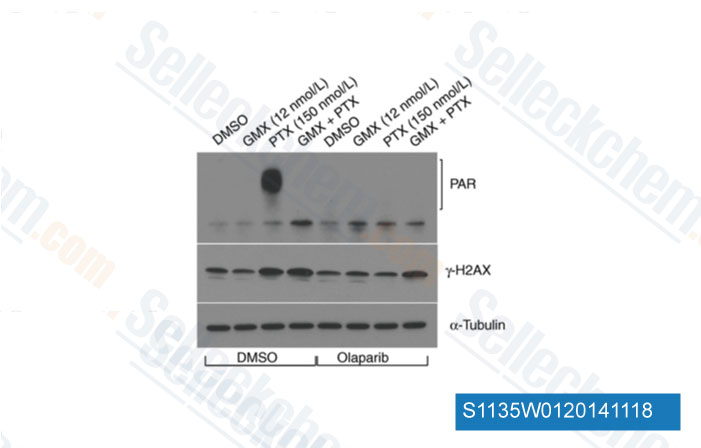
Role of PARP and BER in the synergy between PTX and GMX in A549 cells. Cells were pretreated ±1 umol/L olaparib (2 hours) then sequentially ±150 nmol/L PTX (24 hours), then ± GMX 12 nmol/L (48 hours). PAR modification of proteins and γ-H2AX levels were measured in extracts treated as in A by Western blotting.

Daten von [ Cancer Res , 2014 , 74(21), 5948-54 ]
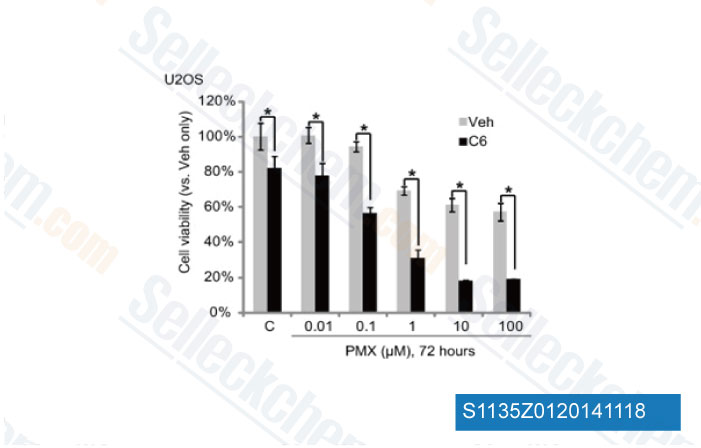
Cell viability of U2OS cells after indicated pemetrexed in different concentrations or plus C6 ceramide (C6, 5 ug/ml) treatment was tested by MTT assay.

Daten von [ Biochem Biophys Res Commun , 2014 , 452(1), 72-8 ]
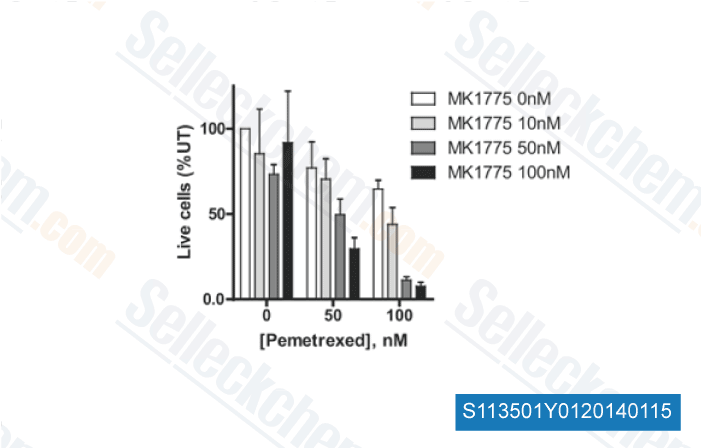
A549 cells were treated with pemetrexed and/or MK1775 for 72 hours and counted by flow cytometry and the number of live cells relative to untreated is depicted.

Daten von [ Mol Cancer Ther , 2013 , 12, 2675-84 ]

Sellecks Pemetrexed Disodium (LY231514) Wurde zitiert von 46 Publikationen

Non-canonical dihydrolipoyl transacetylase promotes chemotherapy resistance via mitochondrial tetrahydrofolate signaling [ Nat Commun, 2025, 16(1):8932] PubMed: 41062483
PD-L1 induces autophagy and primary resistance to EGFR-TKIs in EGFR-mutant lung adenocarcinoma via the MAPK signaling pathway [ Cell Death Dis, 2024, 15(8):555] PubMed: 39090096
Olanzapine suppresses mPFC activity-norepinephrine releasing to alleviate CLOCK-enhanced cancer stemness under chronic stress [ Cell Commun Signal, 2024, 22(1):375] PubMed: 39054537
Patient-derived rhabdomyosarcoma cells recapitulate the genetic and transcriptomic landscapes of primary tumors [ iScience, 2024, 27(10):110862] PubMed: 39319271
MPS1 inhibition primes immunogenicity of KRAS-LKB1 mutant lung cancer [ Cancer Cell, 2022, 40(10):1128-1144.e8] PubMed: 36150391
CDK/cyclin dependencies define extreme cancer cell-cycle heterogeneity and collateral vulnerabilities [ Cell Rep, 2022, 38(9):110448] PubMed: 35235778
Establishment and large-scale validation of a three-dimensional tumor model on an array chip for anticancer drug evaluation [ Front Pharmacol, 2022, 13:1032975] PubMed: 36313330
A study of protein-drug interaction based on solvent-induced protein aggregation by fluorescence correlation spectroscopy [ Analyst, 2022, 10.1039/d2an00031h] PubMed: 35253833
The novel mechanism of Med12-mediated drug resistance in a TGFBR2-independent manner [ Biochem Biophys Res Commun, 2022, 610:1-7] PubMed: 35461070
A Novel Molecular Target in EGFR-mutant Lung Cancer Treated With the Combination of Osimertinib and Pemetrexed [ Anticancer Res, 2022, 42(2):709-722] PubMed: 35093869

RÜCKGABERICHTLINIE
Die bedingungslose Rückgaberichtlinie von Selleck Chemical gewährleistet unseren Kunden ein reibungsloses Online-Einkaufserlebnis. Wenn Sie in irgendeiner Weise mit Ihrem Kauf unzufrieden sind, können Sie jeden Artikel innerhalb von 7 Tagen nach Erhalt zurückgeben. Im Falle von Produktqualitätsproblemen, sei es protokollbezogene oder produktbezogene Probleme, können Sie jeden Artikel innerhalb von 365 Tagen ab dem ursprünglichen Kaufdatum zurückgeben. Bitte befolgen Sie die nachstehenden Anweisungen, wenn Sie Produkte zurücksenden.

VERSAND UND LAGERUNG
Selleck-Produkte werden bei Raumtemperatur transportiert. Wenn Sie das Produkt bei Raumtemperatur erhalten, seien Sie versichert, dass die Qualitätskontrollabteilung von Selleck Experimente durchgeführt hat, um zu überprüfen, dass die normale Temperaturplatzierung von einem Monat die biologische Aktivität von Pulverprodukten nicht beeinträchtigt. Nach dem Sammeln lagern Sie das Produkt bitte gemäß den in der Datenblatt beschriebenen Anforderungen. Die meisten Selleck-Produkte sind unter den empfohlenen Bedingungen stabil.

NICHT FÜR DIE ANWENDUNG AM MENSCHEN, FÜR VETERINÄRMEDIZINISCHE DIAGNOSTIK ODER THERAPEUTISCHE ZWECKE.