
Technische Daten
| Formel | C16H15NO7S |
||||||
| Molekulargewicht | 365.36 | CAS-Nr. | 501919-59-1 | ||||
| Löslichkeit (25°C)* | In vitro | DMSO | 73 mg/mL (199.8 mM) | ||||
| Water | Insoluble | ||||||
| Ethanol | Insoluble | ||||||
| In vivo (Lösungsmittel einzeln und der Reihe nach zum Produkt hinzufügen.) |
|
||||||
|
* <1 mg/ml bedeutet schwer löslich oder unlöslich. * Bitte beachten Sie, dass Selleck die Löslichkeit aller Verbindungen intern testet und die tatsächliche Löslichkeit geringfügig von veröffentlichten Werten abweichen kann. Dies ist normal und ist auf geringfügige Batch-zu-Batch-Variationen zurückzuführen. * Versand bei Raumtemperatur (Stabilitätstests zeigen, dass dieses Produkt ohne Kühlmaßnahmen versendet werden kann.) |
|||||||
Vorbereitung von Stammlösungen
Biologische Aktivität
| Beschreibung | NSC 74859 (S3I-201) zeigt eine potente Hemmung der STAT3 DNA-bindenden Aktivität mit einem IC50 von 86 μM in zellfreien Assays und eine geringe Aktivität gegenüber STAT1 und STAT5. | ||
|---|---|---|---|
| Ziele |
|
||
| In vitro | NSC 74859 (S3I-201) hemmt das Wachstum und induziert Apoptose bevorzugt in Tumorzellen, die persistent aktiviertes Stat3 enthalten, indem es die Bildung des Stat3·Stat3-Komplexes sowie die DNA-bindenden und transkriptionellen Aktivitäten von Stat3 hemmt. Darüber hinaus hemmt es auch die Expression der Stat3-regulierten Gene, die Cyclin D1, Bcl-xL und Survivin kodieren. Diese Verbindung hemmt die Brustkarzinom-Zelllinien MDA-MB-435, MDA-MB-453 und MDA-MB-231 mit einem IC50 von 100 μM. Zusätzlich sind die Zellen mit beeinträchtigter TGF-β-Signalgebung viermal so empfindlich gegenüber S3I-201. Eine aktuelle Studie zeigt, dass es die antiproliferative Wirkung in HepG2- und Huh-7-Zellen über den STAT3-Signalweg verstärkt. |
||
| In vivo | NSC 74859 (S3I-201) (5 mg/kg, i.v. alle 2 oder alle 3 Tage) zeigt die Antitumor-Wirksamkeit in Mausmodellen mit humanen Brusttumor-Xenotransplantaten, die konstitutiv aktives Stat3 aufweisen. Diese Verbindungstherapie reduziert die Replikation des Varicella-zoster-Virus (VZV) basierend auf dem Biolumineszenzsignal und der Anzahl positiver Hautxenotransplantate im Vergleich zu DMSO-behandelten Mäusen durch Hemmung der STAT3-Phosphorylierung. |
||
| Merkmale | Ein chemischer Sondeninhibitor der Stat3-Aktivität. |
Protokoll (aus Referenz)
| Kinase-Assay: |
|
|---|---|
| Zell-Assay: |
|
| Tierstudie: |
|
Referenzen
|
Kundenproduktvalidierung
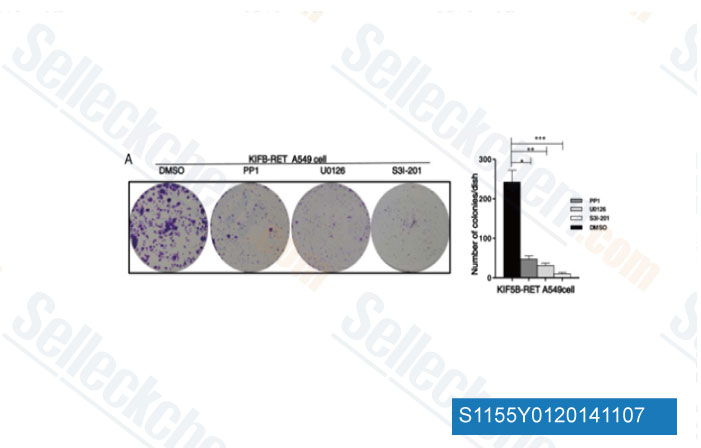
-
Daten von [ Mol Cancer , 2014 , 13:176 ]
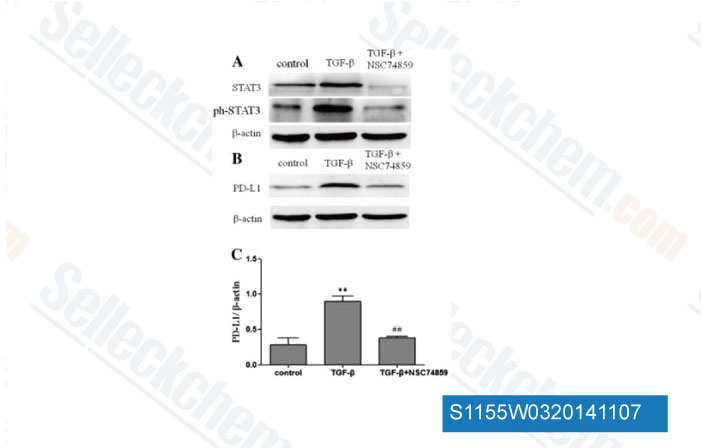
-
Daten von [ Int Immunopharmacol , 2014 , 20(1), 117-23 ]
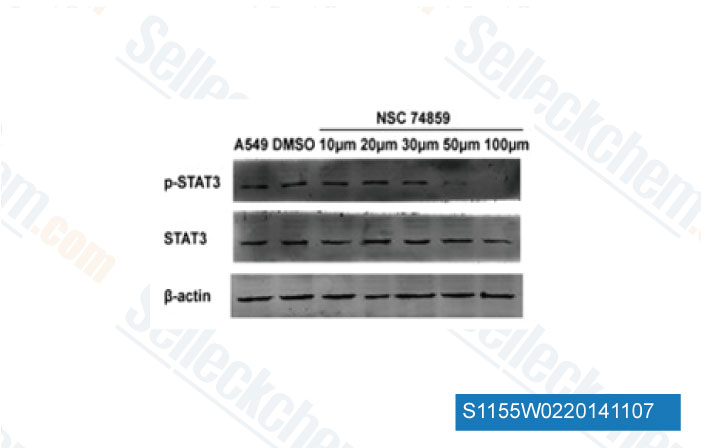
-
Daten von [ Microbes Infect , 2014 , 16(1), 17-27 ]
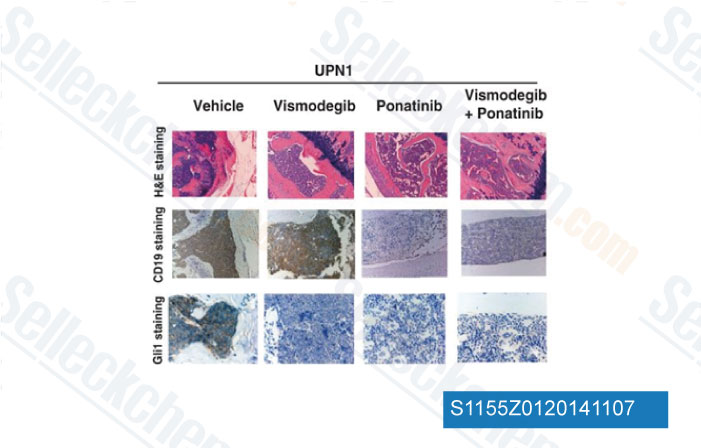
-
Daten von [ Clin Cancer Res , 2013 , 19(6), 1422-32 ]
Sellecks NSC 74859 (S3I-201) Wurde zitiert von 247 Publikationen
| Cancer-associated fibroblast derived CXCL14 drives cisplatin chemoresistance by enhancing nucleotide excision repair in bladder cancer [ J Exp Clin Cancer Res, 2025, 44(1):265] | PubMed: 40898244 |
| Paracrine iron activates Hopx+ rectal cancer stem cells to display radioresistance [ J Adv Res, 2025, S2090-1232(25)00961-0] | PubMed: 41325838 |
| Natural small molecule bergapten ameliorates rheumatoid arthritis by targeting STAT3 [ Pharmacol Res, 2025, 219:107878] | PubMed: 40714303 |
| Polarization of Vδ2 T cells to a Th2-like phenotype promotes plasmablast differentiation and possesses pro-fibrotic properties in IgG4-related disease [ Front Immunol, 2025, 16:1550405] | PubMed: 40213561 |
| SYT7 accelerates nasopharyngeal carcinoma progression via ALDH1A3-mediated STAT3 signaling activation [ Oncogenesis, 2025, 14(1):16] | PubMed: 40346036 |
| KLHL25-ACLY module functions as a switch in the fate determination of the differentiation of iTreg/Th17 [ Commun Biol, 2025, 8(1):471] | PubMed: 40119138 |
| Intrapleural dual blockade of IL-6 and PD-L1 reprograms CAF dynamics and the tumor microenvironment in lung cancer-associated malignant pleural effusion [ Respir Res, 2025, 26(1):180] | PubMed: 40349069 |
| Suberosin attenuates rheumatoid arthritis by repolarizing macrophages and inhibiting synovitis via the JAK/STAT signaling pathway [ Arthritis Res Ther, 2025, 27(1):12] | PubMed: 39838477 |
| Regulation of keratinocyte barrier function and inflammatory response by the EGFR-STAT3 Pathway: Potential therapeutic implications of osimertinib and afatinib [ Cytokine, 2025, 185:156802] | PubMed: 39612655 |
| Heterogeneous therapy-resistant cancer cells have distinct and exploitable drug sensitivity profiles [ bioRxiv, 2025, 2025.04.25.650475] | PubMed: 40654745 |
RÜCKGABERICHTLINIE
Die bedingungslose Rückgaberichtlinie von Selleck Chemical gewährleistet unseren Kunden ein reibungsloses Online-Einkaufserlebnis. Wenn Sie in irgendeiner Weise mit Ihrem Kauf unzufrieden sind, können Sie jeden Artikel innerhalb von 7 Tagen nach Erhalt zurückgeben. Im Falle von Produktqualitätsproblemen, sei es protokollbezogene oder produktbezogene Probleme, können Sie jeden Artikel innerhalb von 365 Tagen ab dem ursprünglichen Kaufdatum zurückgeben. Bitte befolgen Sie die nachstehenden Anweisungen, wenn Sie Produkte zurücksenden.
VERSAND UND LAGERUNG
Selleck-Produkte werden bei Raumtemperatur transportiert. Wenn Sie das Produkt bei Raumtemperatur erhalten, seien Sie versichert, dass die Qualitätskontrollabteilung von Selleck Experimente durchgeführt hat, um zu überprüfen, dass die normale Temperaturplatzierung von einem Monat die biologische Aktivität von Pulverprodukten nicht beeinträchtigt. Nach dem Sammeln lagern Sie das Produkt bitte gemäß den in der Datenblatt beschriebenen Anforderungen. Die meisten Selleck-Produkte sind unter den empfohlenen Bedingungen stabil.
NICHT FÜR DIE ANWENDUNG AM MENSCHEN, FÜR VETERINÄRMEDIZINISCHE DIAGNOSTIK ODER THERAPEUTISCHE ZWECKE.