
Technische Daten
| Formel | C20H30N4O2 |
||||||
| Molekulargewicht | 358.48 | CAS-Nr. | 929016-96-6 | ||||
| Löslichkeit (25°C)* | In vitro | DMSO | 72 mg/mL (200.84 mM) | ||||
| Ethanol | 27 mg/mL (75.31 mM) | ||||||
| Water | Insoluble | ||||||
| In vivo (Lösungsmittel einzeln und der Reihe nach zum Produkt hinzufügen.) |
|
||||||
|
* <1 mg/ml bedeutet schwer löslich oder unlöslich. * Bitte beachten Sie, dass Selleck die Löslichkeit aller Verbindungen intern testet und die tatsächliche Löslichkeit geringfügig von veröffentlichten Werten abweichen kann. Dies ist normal und ist auf geringfügige Batch-zu-Batch-Variationen zurückzuführen. * Versand bei Raumtemperatur (Stabilitätstests zeigen, dass dieses Produkt ohne Kühlmaßnahmen versendet werden kann.) |
|||||||
Vorbereitung von Stammlösungen
Biologische Aktivität
| Beschreibung | Pracinostat (SB939) ist ein potenter Pan-HDAC-Inhibitor mit IC50 von 40-140 nM, mit Ausnahme von HDAC6. Es hat keine Aktivität gegen das Klasse III Isoenzym SIRT I. Diese Verbindung induziert Apoptose in Tumorzellen. Phase 2. | |||||||||||
|---|---|---|---|---|---|---|---|---|---|---|---|---|
| Ziele |
|
|||||||||||
| In vitro | Pracinostat (SB939) weist eine 100-fach höhere Selektivität für HDACs auf als für Zn-bindende Nicht-HDAC-Enzyme, Rezeptoren und Ionenkanäle. Diese Verbindung ist ein potenter Inhibitor der HDAC-Klasse I Isoenzyme, HDAC1, HDAC2, HDAC3 und HDAC8 mit IC50-Werten im Bereich von 43 nM bis 140 nM. Es hemmt die HDAC-Klasse II Isoenzyme, HDAC4, HDAC5, HDAC7, HDAC9 und HDAC10 signifikant mit IC50-Werten im Bereich von 40 nM bis 137 nM, mit Ausnahme von HDAC6, das einen IC50 von 1008 nM aufweist. Es hemmt HDAC11 der HDAC-Klasse IV Enzyme deutlich mit einem IC50 von 93 nM, zeigt aber keine hemmende Aktivität gegen SIRT 1 der Klasse III HDACs. Diese Chemikalie zeigt eine signifikante antiproliferative Aktivität gegen eine Vielzahl von Tumorzelllinien, insbesondere Leukämiezellen und kutane T-Zell-Lymphomzellen, mit IC50-Werten im Bereich von 50 nM (H9-Zellen) bis 170 nM (HEL92.1.7-Zellen). |
|||||||||||
| In vivo | Die Verabreichung dieser Verbindung (25 mg/kg bis 100 mg/kg) zeigt eine dosisabhängige Antitumorwirksamkeit in einem Xenograft-Mausmodell für menschlichen Darmkrebs (HCT-116). Dies ist ungefähr doppelt so wirksam wie SAHA: diese Chemikalie bewirkt eine Tumorwachstumshemmung von 94 % gegenüber 48 % durch SAHA, beide bei der maximal verträglichen Dosis. Die orale Verabreichung dieses Mittels in einer Dosis von 50 mg/kg oder 75 mg/kg im APCmin genetischen Mausmodell für Darmkrebs im Frühstadium reduziert die Anzahl der Tumoren deutlich, verringert die kumulativen Hemoccult-Werte und erhöht die Hämatokritwerte effektiver. |
|||||||||||
| Merkmale | Ein neuer Histon-Deacetylase-Inhibitor auf Hydroxamsäurebasis mit verbesserten physikalisch-chemischen, pharmazeutischen und pharmakokinetischen Eigenschaften. |
Protokoll (aus Referenz)
| Kinase-Assay: |
|
|---|---|
| Zell-Assay: |
|
| Tierstudie: |
|
Referenzen
|
Kundenproduktvalidierung
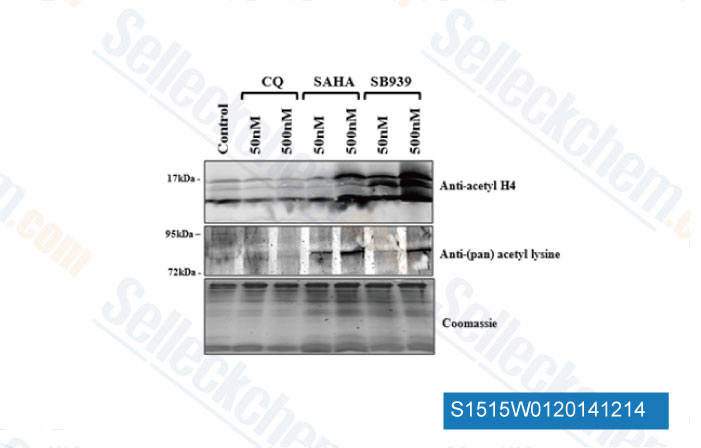
-
Daten von [ Antimicrob Agents Chemother , 2012 , 56(7), 3849-56 ]
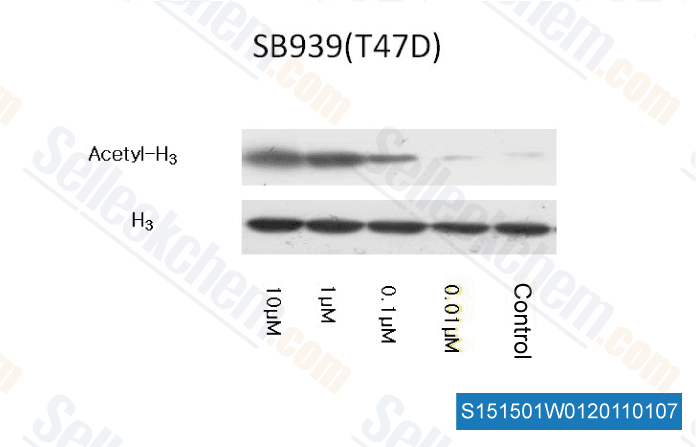
-
, , Dr. Zhang of Tianjin Medical University
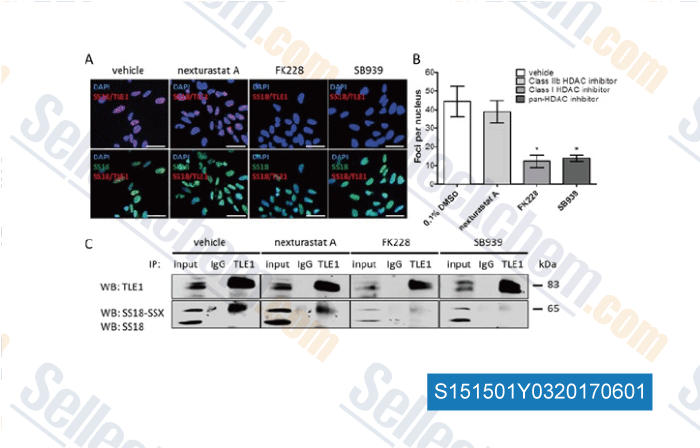
-
Daten von [ , , Oncotarget, 2016, 7(23):34384-94 ]
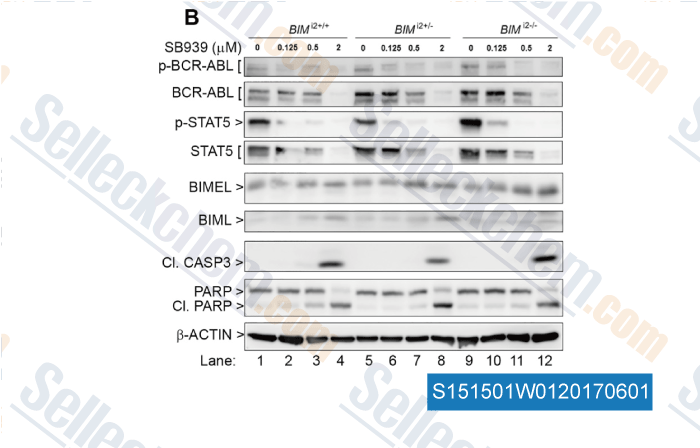
-
Daten von [ , , PLoS One, 2017, 12(3):e0174107 ]
Sellecks Pracinostat (SB939) Wurde zitiert von 25 Publikationen
| Functional Characterization of LTR12C as Regulators of Germ-Cell-Associated TA-p63 in U87-MG and T98-G In Vitro Models [ Cells, 2025, 14(11)852] | PubMed: 40498028 |
| Targeting histone deacetylase 6 (HDAC6) to enhance radiation therapy in meningiomas in a 2D and 3D in vitro study [ EBioMedicine, 2024, 105:105211] | PubMed: 38917510 |
| Epigenetic and molecular coordination between HDAC2 and SMAD3-SKI regulates essential brain tumour stem cell characteristics [ Nat Commun, 2023, 14(1):5051] | PubMed: 37598220 |
| Nuclear oligo hashing improves differential analysis of single-cell RNA-seq [ Nat Commun, 2022, 13(1):2666] | PubMed: 35562344 |
| The novel histone deacetylase inhibitor pracinostat suppresses the malignant phenotype in human glioma [ Mol Biol Rep, 2022, 10.1007/s11033-022-07559-y] | PubMed: 35622308 |
| CREBBP cooperates with the cell cycle machinery to attenuate chidamide sensitivity in relapsed/refractory diffuse large B-cell lymphoma [ Cancer Lett, 2021, 521:268-280] | PubMed: 34481935 |
| Exposure of Microglia to Interleukin-4 Represses NF-κB-Dependent Transcription of Toll-Like Receptor-Induced Cytokines [ Front Immunol, 2021, 12:771453] | PubMed: 34880868 |
| Identification of Required Host Factors for SARS-CoV-2 Infection in Human Cells [ Cell, 2020, S0092-8674(20)31394-5] | PubMed: 33147445 |
| Pracinostat (SB939), a histone deacetylase inhibitor, suppresses breast cancer metastasis and growth by inactivating the IL-6/STAT3 signalling pathways. [ Life Sci, 2020, 248:117469] | PubMed: 32109485 |
| Targeting NAD+ Biosynthesis Overcomes Panobinostat and Bortezomib-Induced Malignant Glioma Resistance [ Mol Cancer Res, 2020, 18(7):1004-1017] | PubMed: 32238439 |
RÜCKGABERICHTLINIE
Die bedingungslose Rückgaberichtlinie von Selleck Chemical gewährleistet unseren Kunden ein reibungsloses Online-Einkaufserlebnis. Wenn Sie in irgendeiner Weise mit Ihrem Kauf unzufrieden sind, können Sie jeden Artikel innerhalb von 7 Tagen nach Erhalt zurückgeben. Im Falle von Produktqualitätsproblemen, sei es protokollbezogene oder produktbezogene Probleme, können Sie jeden Artikel innerhalb von 365 Tagen ab dem ursprünglichen Kaufdatum zurückgeben. Bitte befolgen Sie die nachstehenden Anweisungen, wenn Sie Produkte zurücksenden.
VERSAND UND LAGERUNG
Selleck-Produkte werden bei Raumtemperatur transportiert. Wenn Sie das Produkt bei Raumtemperatur erhalten, seien Sie versichert, dass die Qualitätskontrollabteilung von Selleck Experimente durchgeführt hat, um zu überprüfen, dass die normale Temperaturplatzierung von einem Monat die biologische Aktivität von Pulverprodukten nicht beeinträchtigt. Nach dem Sammeln lagern Sie das Produkt bitte gemäß den in der Datenblatt beschriebenen Anforderungen. Die meisten Selleck-Produkte sind unter den empfohlenen Bedingungen stabil.
NICHT FÜR DIE ANWENDUNG AM MENSCHEN, FÜR VETERINÄRMEDIZINISCHE DIAGNOSTIK ODER THERAPEUTISCHE ZWECKE.